<?xml version="1.0" encoding="utf-8" standalone="yes"?>
<feed xmlns="http://www.w3.org/2005/Atom">
  <title>Web3 on Sooraj Sathyanarayanan</title>
  <link rel="alternate" href="https://profincognito.me/tags/web3/" />
  <link rel="self" href="https://profincognito.me/tags/web3/index.xml" />
  <subtitle>Recent content in Web3 on Sooraj Sathyanarayanan</subtitle>
  <id>https://profincognito.me/tags/web3/</id>
  <generator uri="http://gohugo.io" version="0.147.8">Hugo</generator>
  <language>en-us</language>
  <updated>2026-05-25T14:44:10-07:00</updated>
  <author>
    <name>Sooraj Sathyanarayanan</name>
    
  </author>
  <rights>[CC BY-SA 4.0](https://creativecommons.org/licenses/by-sa/4.0/)</rights>
      <entry>
        <title>Decentralized Identity Research: A Comprehensive Analysis</title>
        <link rel="alternate" href="https://profincognito.me/research/decentralized-identity/" />
        <id>https://profincognito.me/research/decentralized-identity/</id>
        <published>2026-03-04T00:00:00Z</published>
        <updated>2026-05-25T14:44:10-07:00</updated>
        <summary type="html">An in-depth exploration of decentralized identity systems, their challenges, and future directions, based on research leadership at Superscrypt</summary>
          <content type="html"><![CDATA[<h2 id="introduction">Introduction</h2>
<p>In an era where digital interactions are integral to daily life, managing digital identities has become a critical concern. Traditional centralized identity systems are vulnerable to security breaches, data misuse, and privacy violations.</p>
<p><strong>Decentralized Identity (DID) systems offer a promising alternative</strong> by empowering users with control over their personal data and reducing reliance on centralized authorities.</p>
<p>This comprehensive analysis delves into the state of decentralized identity systems. We examine technical architectures, user adoption challenges, regulatory considerations, and future directions. The research was spearheaded by the NEU Blockchain Club in collaboration with Superscrypt, aiming to contribute valuable insights to the evolving landscape of digital identity.</p>
<h2 id="research-context">Research Context</h2>
<p>As the research lead for the NEU Blockchain Club&rsquo;s collaborative project with Superscrypt—a crypto-native venture capital firm focused on infrastructure and emerging use cases in Web3—we embarked on an extensive investigation into decentralized identity systems.</p>
<p>Superscrypt&rsquo;s mission to onboard the next wave of builders and users into Web3 aligned seamlessly with our research focus on identity and credentials.</p>
<p>Our multidisciplinary team, comprising members Shaan, Maria, Lin, Arshia, and collaborative inputs from Andy, conducted a thorough examination of the digital identity landscape. We analyzed the shift from Web2 to Web3 paradigms, exploring how decentralized technologies can redefine identity management.</p>
<h2 id="executive-summary">Executive Summary</h2>
<p>Our research uncovered a multifaceted landscape where decentralized identity systems represent a significant advancement in digital identity management but also present considerable implementation challenges.</p>
<p><strong>Key findings highlight:</strong></p>
<ul>
<li>The evolution of digital identity systems</li>
<li>Critical technical and adoption barriers</li>
<li>Regulatory complexities</li>
<li>Emerging innovation opportunities, particularly at the intersection of decentralized identity and artificial intelligence (AI)</li>
</ul>
<h2 id="key-research-findings">Key Research Findings</h2>
<h3 id="evolution-of-digital-identity-systems">Evolution of Digital Identity Systems</h3>
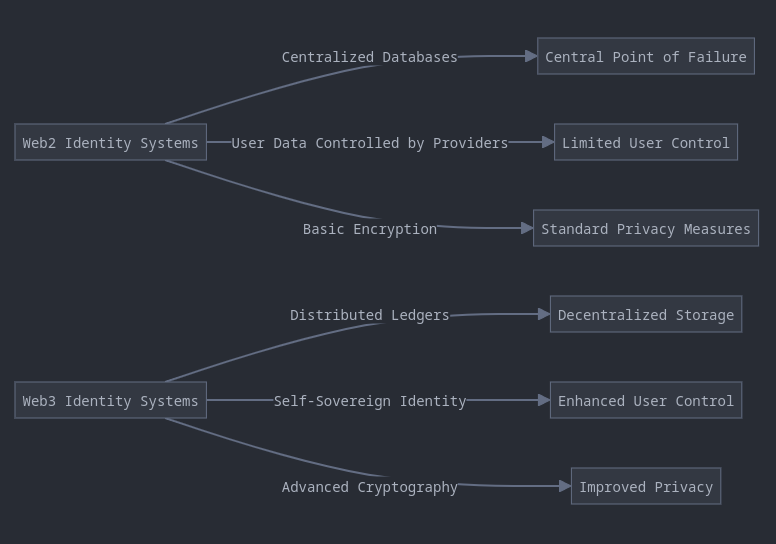
<p>The transition from Web2 to Web3 identity systems is characterized by several pivotal shifts:</p>
<ul>
<li>
<p><strong>Architectural Changes</strong>: Moving from centralized databases to distributed ledger technologies (DLTs) like blockchain, enabling decentralized storage and verification of identity data.</p>
</li>
<li>
<p><strong>User Control</strong>: Enhancing user sovereignty over personal data through self-sovereign identity (SSI) frameworks, allowing individuals to own and manage their identity credentials without intermediaries.</p>
</li>
<li>
<p><strong>Security Model</strong>: Transitioning from single points of failure inherent in centralized systems to distributed trust models that reduce vulnerability to attacks.</p>
</li>
<li>
<p><strong>Privacy Framework</strong>: Implementing advanced cryptographic techniques, such as zero-knowledge proofs, to enable selective disclosure of identity attributes while preserving user privacy.</p>
</li>
</ul>
<p><img loading="lazy" src="/images/content/research-decentralized-identity-d9a9ec97-4586-460e-82fa-f10d8e682a93.png" alt="Evolution of Identity Systems" />
</p>
<h3 id="critical-challenges-identified">Critical Challenges Identified</h3>
<h4 id="technical-implementation">Technical Implementation</h4>
<ul>
<li>
<p><strong>Scalability Constraints</strong>: Current blockchain platforms face limitations in transaction throughput, impacting the scalability of DID solutions for mass adoption.</p>
</li>
<li>
<p><strong>Interoperability Issues</strong>: Lack of standardization leads to compatibility problems between different DID systems and protocols.</p>
</li>
<li>
<p><strong>Key Management Complexity</strong>: Users must securely manage private keys, and recovery mechanisms are often complex or inadequate.</p>
</li>
<li>
<p><strong>Performance Limitations</strong>: High latency and transaction costs in some blockchain networks hinder real-time identity verification.</p>
</li>
</ul>
<blockquote>
<p><strong>Note:</strong></p>
<p><strong>Key Management Complexity is a Major Barrier</strong></p>
<p>Simplifying key management is crucial for user adoption, as losing access to private keys can result in permanent loss of identity credentials.</p></blockquote>
<h4 id="adoption-barriers">Adoption Barriers</h4>
<ul>
<li>
<p><strong>User Experience Complexity</strong>: Non-intuitive interfaces and processes deter mainstream users unfamiliar with blockchain technology.</p>
</li>
<li>
<p><strong>Educational Gaps</strong>: Limited public understanding of the benefits and functionalities of DIDs hampers adoption.</p>
</li>
<li>
<p><strong>Integration Costs</strong>: Enterprises face significant costs and technical challenges when integrating DID solutions with legacy systems.</p>
</li>
<li>
<p><strong>Incumbent Resistance</strong>: Established identity providers may resist decentralized models that disrupt traditional business practices.</p>
</li>
</ul>
<blockquote>
<p><strong>Note:</strong></p>
<p><strong>User Experience is Key to Adoption</strong></p>
<p>Enhancing usability can significantly accelerate the adoption of decentralized identity solutions among mainstream users.</p></blockquote>
<h4 id="regulatory-landscape">Regulatory Landscape</h4>
<ul>
<li>
<p><strong>Compliance Challenges</strong>: Ensuring that DID systems comply with data protection regulations like GDPR and CCPA is complex due to the immutable nature of blockchain.</p>
</li>
<li>
<p><strong>Legal Recognition</strong>: DID-based credentials may lack legal status in certain jurisdictions, affecting their acceptance.</p>
</li>
<li>
<p><strong>Cross-Border Verification</strong>: Variations in international regulations complicate cross-border identity verification and data sharing.</p>
</li>
<li>
<p><strong>Regulatory Uncertainty</strong>: Ambiguity in emerging markets regarding blockchain technologies creates compliance risks.</p>
</li>
</ul>
<h2 id="in-depth-analysis">In-Depth Analysis</h2>
<h3 id="technical-implementation-challenges">Technical Implementation Challenges</h3>
<p>The technical hurdles in implementing DIDs are significant. Scalability remains a core issue, as blockchain networks like Ethereum struggle with high transaction fees and limited throughput.</p>
<p>Layer 2 solutions and alternative consensus mechanisms are being explored to mitigate these issues.</p>
<p><strong>Interoperability</strong> is another critical challenge. The proliferation of various DID methods and standards (e.g., <code>did:btc:</code>, <code>did:eth:</code>) without a unified framework leads to fragmentation.</p>
<p>Initiatives like the World Wide Web Consortium&rsquo;s (W3C) DID standards aim to address this, but widespread adoption is pending.</p>
<p><strong>Key management</strong> is perhaps the most user-centric technical challenge. The reliance on users to manage private keys introduces risks of loss or theft.</p>
<p>Solutions like social recovery mechanisms and hardware wallets offer mitigation but add complexity.</p>
<h3 id="adoption-barriers-1">Adoption Barriers</h3>
<p>User experience is a decisive factor in the adoption of DID systems. The complexity of current solutions often requires a steep learning curve, which is a deterrent for non-technical users.</p>
<p>Simplifying interfaces and abstracting underlying blockchain complexities are essential steps toward broader adoption.</p>
<p><strong>Educational initiatives</strong> are crucial to bridge the knowledge gap. Users and organizations need to understand the benefits of DIDs over traditional systems.</p>
<p>Case studies demonstrating successful implementations can serve as persuasive tools.</p>
<p><strong>Integration costs</strong> and technical hurdles also pose significant barriers for organizations. Developing middleware solutions and APIs that facilitate seamless integration with existing systems can alleviate some of these challenges.</p>
<h3 id="regulatory-landscape-1">Regulatory Landscape</h3>
<p>Compliance with regulations like GDPR introduces complexities due to the immutable nature of blockchain. The &ldquo;right to be forgotten&rdquo; is challenging to implement when data cannot be altered or deleted.</p>
<p>Solutions involving off-chain storage and on-chain references are being explored.</p>
<p><strong>Legal recognition</strong> of DID-based credentials is another hurdle. Without official acknowledgment, these credentials may not be accepted by governmental and institutional entities.</p>
<p>Advocacy and collaboration with regulatory bodies are necessary to advance legal frameworks.</p>
<p><strong>Cross-border identity verification</strong> is complicated by differing regulations and standards. Establishing international standards and mutual recognition agreements can facilitate smoother cross-border interactions.</p>
<h2 id="innovation-opportunities">Innovation Opportunities</h2>
<h3 id="decentralized-ai-integration">Decentralized AI Integration</h3>
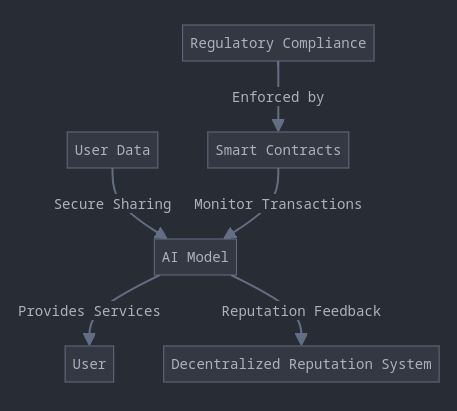
<p>The convergence of decentralized identity and AI presents novel opportunities:</p>
<ul>
<li>
<p><strong>Identity Verification for AI Systems</strong>: Ensuring that AI agents interacting in decentralized networks have verified identities to prevent malicious activities.</p>
</li>
<li>
<p><strong>Privacy-Preserving Data Sharing</strong>: Enabling users to share data with AI systems securely and privately, enhancing data quality while respecting user privacy.</p>
</li>
<li>
<p><strong>Reputation Systems</strong>: Developing decentralized reputation mechanisms for AI models to assess their reliability and performance transparently.</p>
</li>
<li>
<p><strong>Automated Compliance</strong>: Implementing smart contracts that automatically enforce compliance with regulatory requirements during data transactions.</p>
</li>
</ul>
<p><img loading="lazy" src="/images/content/research-decentralized-identity-1a14f4cf-d9e6-42e4-94f7-90d6d2213138.png" alt="Decentralized Identity and AI Integration Flow" />
</p>
<h3 id="market-applications">Market Applications</h3>
<p>Decentralized identity systems have the potential to revolutionize various industries:</p>
<ol>
<li>
<p><strong>Financial Services</strong>: Streamlining KYC/AML processes, reducing fraud, and enhancing customer onboarding experiences.</p>
</li>
<li>
<p><strong>Healthcare</strong>: Empowering patients with control over their medical records, facilitating secure sharing with providers.</p>
</li>
<li>
<p><strong>Supply Chain</strong>: Enhancing traceability and authenticity verification of products through immutable identity credentials.</p>
</li>
<li>
<p><strong>Education</strong>: Issuing tamper-proof academic credentials and certifications that are easily verifiable.</p>
</li>
<li>
<p><strong>Professional Licensing</strong>: Simplifying verification of professional qualifications and licenses across jurisdictions.</p>
</li>
</ol>
<h2 id="research-insights">Research Insights</h2>
<h3 id="profit-vs-decentralization-trade-offs">Profit vs. Decentralization Trade-offs</h3>
<p>Balancing commercial viability with decentralization principles involves navigating several tensions.</p>
<h4 id="revenue-models">Revenue Models</h4>
<ul>
<li>
<p><strong>Sustainable Business Models</strong>: Developing revenue streams without resorting to centralized control requires innovative approaches, such as service fees, token economies, or value-added services.</p>
</li>
<li>
<p><strong>User Incentives</strong>: Aligning incentives so that users benefit directly from the value they contribute to the network is essential for participation.</p>
</li>
</ul>
<h4 id="governance-structures">Governance Structures</h4>
<ul>
<li>
<p><strong>Decentralized Decision-Making</strong>: Implementing governance models that allow for community input while ensuring efficient decision-making processes.</p>
</li>
<li>
<p><strong>Stakeholder Alignment</strong>: Balancing the interests of developers, users, investors, and other stakeholders to foster a healthy ecosystem.</p>
</li>
<li>
<p><strong>Protocol Upgrades</strong>: Establishing mechanisms for protocol evolution that are transparent and minimize disruptions.</p>
</li>
</ul>
<h3 id="success-factors-for-did-systems">Success Factors for DID Systems</h3>
<p>Successful implementation of decentralized identity systems hinges on several key factors.</p>
<h4 id="technical-architecture">Technical Architecture</h4>
<ul>
<li>
<p><strong>Modularity</strong>: Designing systems that can adapt and scale by incorporating modular components.</p>
</li>
<li>
<p><strong>Privacy</strong>: Employing advanced cryptographic methods to protect user data.</p>
</li>
<li>
<p><strong>Key Management</strong>: Simplifying key management with user-friendly recovery options.</p>
</li>
<li>
<p><strong>Standards Compliance</strong>: Adhering to and contributing to interoperable standards.</p>
</li>
</ul>
<h4 id="user-experience">User Experience</h4>
<ul>
<li>
<p><strong>Simplicity</strong>: Creating intuitive interfaces that abstract technical complexities.</p>
</li>
<li>
<p><strong>Onboarding</strong>: Streamlining the process to reduce friction for new users.</p>
</li>
<li>
<p><strong>Value Proposition</strong>: Clearly communicating the benefits to encourage adoption.</p>
</li>
<li>
<p><strong>Support Systems</strong>: Providing robust customer support and educational resources.</p>
</li>
</ul>
<h4 id="ecosystem-development">Ecosystem Development</h4>
<ul>
<li>
<p><strong>Developer Tools</strong>: Offering comprehensive SDKs and APIs to encourage third-party development.</p>
</li>
<li>
<p><strong>Community Engagement</strong>: Fostering an active community through forums, events, and collaborative projects.</p>
</li>
<li>
<p><strong>Governance</strong>: Implementing transparent governance models that encourage participation.</p>
</li>
<li>
<p><strong>Incentives</strong>: Designing tokenomics or reward systems that motivate desired behaviors.</p>
</li>
</ul>
<h2 id="future-directions">Future Directions</h2>
<h3 id="emerging-trends">Emerging Trends</h3>
<h4 id="technical-innovation">Technical Innovation</h4>
<ul>
<li>
<p><strong>Advanced Cryptography</strong>: Exploring homomorphic encryption and secure multi-party computation to enhance privacy.</p>
</li>
<li>
<p><strong>Scalability Solutions</strong>: Implementing Layer 2 protocols and sharding to increase transaction throughput.</p>
</li>
<li>
<p><strong>Cross-Chain Identity</strong>: Developing solutions that allow identities to be recognized across different blockchain networks.</p>
</li>
<li>
<p><strong>Decentralized Identifiers (DIDs)</strong>: Promoting universal adoption of W3C-compliant DIDs for interoperability.</p>
</li>
</ul>
<h4 id="market-evolution">Market Evolution</h4>
<ul>
<li>
<p><strong>Integration with Legacy Systems</strong>: Bridging the gap between traditional identity systems and decentralized models.</p>
</li>
<li>
<p><strong>Emerging Markets</strong>: Leveraging DIDs to provide identities to the unbanked and underrepresented populations.</p>
</li>
<li>
<p><strong>Regulatory Developments</strong>: Monitoring and influencing policy changes that affect decentralized identity.</p>
</li>
<li>
<p><strong>Standardization Efforts</strong>: Contributing to international standards to ensure compatibility and recognition.</p>
</li>
</ul>
<h3 id="research-recommendations">Research Recommendations</h3>
<h4 id="technical-development">Technical Development</h4>
<ul>
<li>
<p><strong>Scalable Architectures</strong>: Prioritize research into scalable blockchain technologies and off-chain solutions.</p>
</li>
<li>
<p><strong>User-Centric Design</strong>: Invest in UX/UI research to create accessible applications.</p>
</li>
<li>
<p><strong>Privacy Enhancements</strong>: Develop robust privacy-preserving techniques to meet regulatory standards.</p>
</li>
<li>
<p><strong>Interoperability</strong>: Advocate for and adopt interoperable standards to prevent ecosystem fragmentation.</p>
</li>
</ul>
<h4 id="market-approach">Market Approach</h4>
<ul>
<li>
<p><strong>Strategic Partnerships</strong>: Collaborate with industry leaders, governments, and standard bodies.</p>
</li>
<li>
<p><strong>Regulatory Engagement</strong>: Proactively engage with regulators to shape favorable policies.</p>
</li>
<li>
<p><strong>Education Initiatives</strong>: Launch programs to educate users, developers, and enterprises about DIDs.</p>
</li>
<li>
<p><strong>Community Building</strong>: Support community-led projects and open-source contributions to foster innovation.</p>
</li>
</ul>
<h2 id="conclusion">Conclusion</h2>
<p>Decentralized identity systems stand at the forefront of redefining how individuals and organizations manage digital identities. While challenges in technical implementation, user adoption, and regulatory compliance are significant, the potential benefits in security, privacy, and user empowerment are compelling.</p>
<p><strong>Success in this domain requires a holistic approach</strong> that combines technical innovation with user-centric design and proactive market engagement. Balancing the ideals of decentralization with practical business considerations will be crucial in developing sustainable and widely adopted DID systems.</p>
<p>As we advance, continued collaboration between academia, industry, and regulatory bodies will be essential. By addressing the identified challenges and seizing the outlined opportunities, decentralized identity can become a foundational element of the next-generation internet infrastructure.</p>
<h2 id="acknowledgments">Acknowledgments</h2>
<p>This research was conducted by the <a href="https://www.khoury.northeastern.edu/clubs_and_orgs/northeastern-blockchain-organization">NEU Blockchain Club</a> in collaboration with <a href="https://www.superscrypt.xyz">Superscrypt</a>, a crypto-native venture capital firm composed of founders with decades of experience in building and scaling technology businesses.</p>
<p>We extend our gratitude to all team members and collaborators who contributed to this project, exemplifying the potential of academic-industry partnerships in advancing Web3 infrastructure and emerging use cases.</p>
<hr>
<p><strong>For further inquiries or to participate in ongoing research initiatives, please contact the NEU Blockchain Club or Superscrypt.</strong></p>
]]></content>
      </entry>
      <entry>
        <title>Setting Up a Decentralized Web Presence: A Complete Guide</title>
        <link rel="alternate" href="https://profincognito.me/projects/web3/" />
        <id>https://profincognito.me/projects/web3/</id>
        <published>2026-03-04T00:00:00Z</published>
        <updated>2026-05-25T14:44:10-07:00</updated>
        <summary type="html">Learn how to create a fully decentralized website using Cloudflare Web3 Gateways and Unstoppable Domains, with step-by-step instructions for building a resilient and censorship-resistant web presence.</summary>
          <content type="html"><![CDATA[<p>Building a decentralized web presence is more than just following a trend—it&rsquo;s about reclaiming control over your digital identity, ensuring your content is always accessible, and embracing the future of the internet. In this comprehensive guide, we&rsquo;ll walk you through the process of creating a decentralized website using Cloudflare Web3 Gateways and Unstoppable Domains. Let&rsquo;s embark on this journey to a more open and resilient web.</p>
<h2 id="why-choose-decentralization">Why Choose Decentralization?</h2>
<p>Before we dive into the technical steps, it&rsquo;s essential to understand the benefits of a decentralized website:</p>
<ul>
<li><strong>Complete Ownership</strong>: You retain full control over your domain and content without relying on traditional hosting providers.</li>
<li><strong>Enhanced Resilience</strong>: Decentralized hosting eliminates single points of failure, ensuring your site remains accessible even if individual nodes go down.</li>
<li><strong>Censorship Resistance</strong>: Your content is free from central authority control, promoting freedom of expression.</li>
<li><strong>Privacy &amp; Security</strong>: Improved data protection and ownership reduce the risk of data breaches and unauthorized access.</li>
<li><strong>Web3 Ready</strong>: Native blockchain integration opens doors to advanced features like smart contracts and decentralized applications (dApps).</li>
</ul>
<h3 id="understanding-the-architecture">Understanding the Architecture</h3>
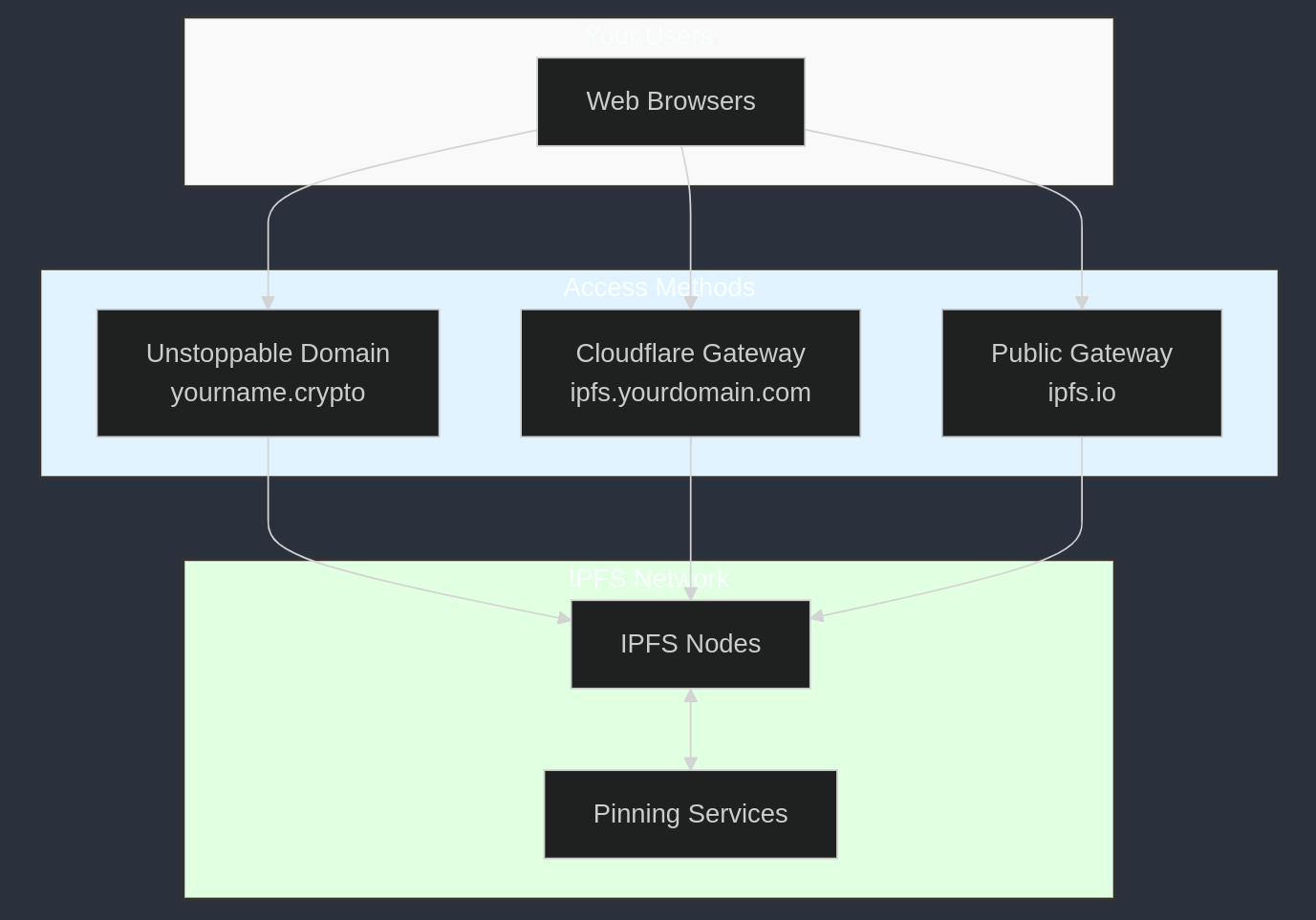
<p>Before we dive into the technical steps, let&rsquo;s understand how all the pieces fit together:</p>
<p><img loading="lazy" src="/images/content/projects-web3-89968305-c25c-4492-8a9f-efd036b4b10a.png" alt="Decentralized Web Architecture" />
</p>
<p><em>Architecture of a Decentralized Website using Unstoppable Domains, IPFS, and Cloudflare Web3 Gateways.</em></p>
<p>This architecture ensures your content remains accessible through multiple pathways, making your website resilient against failures and censorship.</p>
<h2 id="prerequisites">Prerequisites</h2>
<p>Before starting, make sure you have the following:</p>
<ul>
<li><strong>Brave Browser</strong>: <a href="https://brave.com">Download here</a>. Brave comes with a built-in wallet, ideal for Web3 interactions.</li>
<li><strong>Ethereum (ETH)</strong>: You&rsquo;ll need some ETH in your wallet to purchase a domain.</li>
<li><strong>Cloudflare Account</strong>: Sign up at <a href="https://dash.cloudflare.com/sign-up">Cloudflare</a>.</li>
<li><strong>Website Content</strong>: Have your site&rsquo;s content ready to deploy.</li>
<li><strong>IPFS Desktop or Command-Line Tool</strong>: <a href="https://ipfs.io/#install">Download IPFS</a> to upload your content to the network.</li>
</ul>
<blockquote>
<p><strong>Tip:</strong> Accessing <code>.crypto</code> domains directly requires a Web3-enabled browser like Brave or a browser extension that supports Unstoppable Domains.</p></blockquote>
<h2 id="domain-acquisition">Domain Acquisition</h2>
<h3 id="setting-up-your-unstoppable-domain">Setting Up Your Unstoppable Domain</h3>
<ol>
<li><strong>Visit Unstoppable Domains</strong>: Go to <a href="https://unstoppabledomains.com">unstoppabledomains.com</a>.</li>
<li><strong>Search for Your Domain</strong>: Use the search bar to find an available domain (e.g., <code>yourname.crypto</code>).</li>
<li><strong>Purchase the Domain</strong>: Add it to your cart and proceed to checkout.</li>
<li><strong>Connect Your Wallet</strong>: When prompted, connect your Brave Wallet to complete the transaction.</li>
</ol>
<blockquote>
<p><strong>Tip:</strong> Keep an eye out for promotions—Unstoppable Domains often offers discounts or free domains for new users.</p></blockquote>
<p>Once purchased, your domain can be resolved via:</p>
<ul>
<li><strong>Direct Access</strong> (with a compatible browser): <code>https://yourname.crypto</code></li>
<li><strong>Gateway Access</strong>: <code>https://ud.me/yourname.crypto</code></li>
</ul>
<p><strong>Example:</strong></p>
<p>For instance, if you registered the domain <code>profincognito.unstoppable</code>, you can access it via:</p>
<ul>
<li><code>https://ud.me/profincognito.unstoppable</code></li>
</ul>
<h2 id="cloudflare-web3-gateway-configuration">Cloudflare Web3 Gateway Configuration</h2>
<h3 id="ipfs-gateway-setup">IPFS Gateway Setup</h3>
<ol>
<li><strong>Access Cloudflare Dashboard</strong>: Log in to your <a href="https://dash.cloudflare.com/">Cloudflare account</a>.</li>
<li><strong>Navigate to Web3</strong>: In the dashboard, select the <strong>Web3</strong> tab.</li>
<li><strong>Create a New IPFS Gateway</strong>:
<ul>
<li><strong>Gateway Type</strong>: IPFS DNSLink</li>
<li><strong>Hostname</strong>: <code>ipfs.yourdomain.com</code> (e.g., <code>ipfs.profincognito.me</code>)</li>
</ul>
</li>
</ol>
<p>Your gateway URL will look like:</p>
<div class="highlight"><pre tabindex="0" style="color:#f8f8f2;background-color:#282a36;-moz-tab-size:4;-o-tab-size:4;tab-size:4;"><code class="language-plaintext" data-lang="plaintext"><span style="display:flex;"><span>https://ipfs.yourdomain.com/
</span></span></code></pre></div><p><strong>Example:</strong></p>
<ul>
<li><code>https://ipfs.profincognito.me/</code></li>
</ul>
<h3 id="dns-records-configuration">DNS Records Configuration</h3>
<p>Add the following records to your Cloudflare DNS settings:</p>
<ul>
<li><strong>CNAME Record</strong>:
<ul>
<li><strong>Type</strong>: CNAME</li>
<li><strong>Name</strong>: <code>ipfs.yourdomain.com</code></li>
<li><strong>Content</strong>: <code>cloudflare-ipfs.com</code></li>
</ul>
</li>
<li><strong>TXT Record</strong>:
<ul>
<li><strong>Type</strong>: TXT</li>
<li><strong>Name</strong>: <code>_dnslink.ipfs.yourdomain.com</code></li>
<li><strong>Content</strong>: <code>&quot;dnslink=/ipfs/YourContentHash&quot;</code></li>
</ul>
</li>
</ul>
<p>Replace <code>YourContentHash</code> with the actual IPFS hash (CID) of your website content.</p>
<p><strong>Example:</strong></p>
<p>If your content hash is <code>QmdzAcJAapp51CMSYPWepAdktxgWX9C1NTyCeLx2dAVw9i</code>, your TXT record would be:</p>
<ul>
<li><strong>Content</strong>: <code>&quot;dnslink=/ipfs/QmdzAcJAapp51CMSYPWepAdktxgWX9C1NTyCeLx2dAVw9i&quot;</code></li>
</ul>
<h2 id="content-publication">Content Publication</h2>
<h3 id="website-preparation-checklist">Website Preparation Checklist</h3>
<p>Before uploading, ensure:</p>
<ul>
<li><input checked="" disabled="" type="checkbox"> <strong>All Files Organized</strong>: Your website files are neatly organized in folders.</li>
<li><input checked="" disabled="" type="checkbox"> <strong>Local Testing Complete</strong>: Test your site locally to catch any issues.</li>
<li><input checked="" disabled="" type="checkbox"> <strong>Assets Optimized</strong>: Compress images and minify code for faster loading.</li>
<li><input checked="" disabled="" type="checkbox"> <strong>Ready for IPFS</strong>: Your content is packaged and ready for distribution.</li>
</ul>
<h3 id="uploading-to-ipfs">Uploading to IPFS</h3>
<p>You have several options to host your content on IPFS:</p>
<h4 id="1-using-ipfs-desktop-or-command-line-tool">1. <strong>Using IPFS Desktop or Command-Line Tool</strong></h4>
<ul>
<li>
<p><strong>Install IPFS</strong>: Download and install <a href="https://ipfs.io/#install">IPFS Desktop</a> or the <a href="https://docs.ipfs.tech/install/command-line/#official-distributions">command-line tool</a>.</p>
</li>
<li>
<p><strong>Add Your Files</strong>:</p>
<ul>
<li>
<p>For IPFS Desktop: Click on &ldquo;Add to IPFS&rdquo; and select your website folder.</p>
</li>
<li>
<p>For CLI:</p>
<div class="highlight"><pre tabindex="0" style="color:#f8f8f2;background-color:#282a36;-moz-tab-size:4;-o-tab-size:4;tab-size:4;"><code class="language-bash" data-lang="bash"><span style="display:flex;"><span>ipfs add -r /path/to/your/website
</span></span></code></pre></div></li>
</ul>
</li>
<li>
<p><strong>Note Your Content Hash</strong>: After uploading, you&rsquo;ll receive a CID (Content Identifier). This is your <code>YourContentHash</code>.</p>
</li>
</ul>
<h4 id="2-using-pinning-services">2. <strong>Using Pinning Services</strong></h4>
<ul>
<li><strong>Sign Up for a Service</strong>: Create an account with services like <a href="https://pinata.cloud/">Pinata</a> or <a href="https://infura.io/">Infura</a>.</li>
<li><strong>Upload Your Content</strong>: Follow the service&rsquo;s instructions to upload your website files.</li>
<li><strong>Retrieve Your Content Hash</strong>: After uploading, note the CID provided.</li>
</ul>
<blockquote>
<p><strong>Pros and Cons</strong></p></blockquote>
<ul>
<li><strong>Self-Hosted Node</strong>:
<ul>
<li><em>Pros</em>: Maximum control and true decentralization.</li>
<li><em>Cons</em>: Requires technical expertise and constant uptime.</li>
</ul>
</li>
<li><strong>Pinning Services</strong>:
<ul>
<li><em>Pros</em>: Easier to manage; services handle hosting.</li>
<li><em>Cons</em>: Introduces a level of trust in third-party services.</li>
</ul>
</li>
</ul>
<blockquote>
<p><strong>Tip:</strong> Always verify your uploads through multiple gateways before updating your DNS records to ensure proper distribution across the IPFS network.</p></blockquote>
<p><strong>Testing Your Upload Across Gateways:</strong></p>
<div class="highlight"><pre tabindex="0" style="color:#f8f8f2;background-color:#282a36;-moz-tab-size:4;-o-tab-size:4;tab-size:4;"><code class="language-bash" data-lang="bash"><span style="display:flex;"><span><span style="color:#6272a4"># Replace $SITE_HASH with your actual content hash</span>
</span></span><span style="display:flex;"><span>curl -I https://ipfs.io/ipfs/<span style="color:#8be9fd;font-style:italic">$SITE_HASH</span>
</span></span><span style="display:flex;"><span>curl -I https://cloudflare-ipfs.com/ipfs/<span style="color:#8be9fd;font-style:italic">$SITE_HASH</span>
</span></span><span style="display:flex;"><span>curl -I https://gateway.pinata.cloud/ipfs/<span style="color:#8be9fd;font-style:italic">$SITE_HASH</span>
</span></span></code></pre></div><p><strong>Example:</strong></p>
<p>Using the content hash <code>QmdzAcJAapp51CMSYPWepAdktxgWX9C1NTyCeLx2dAVw9i</code>:</p>
<div class="highlight"><pre tabindex="0" style="color:#f8f8f2;background-color:#282a36;-moz-tab-size:4;-o-tab-size:4;tab-size:4;"><code class="language-bash" data-lang="bash"><span style="display:flex;"><span>curl -I https://ipfs.io/ipfs/QmdzAcJAapp51CMSYPWepAdktxgWX9C1NTyCeLx2dAVw9i/
</span></span></code></pre></div><h2 id="access-methods">Access Methods</h2>
<p>Your decentralized site will be accessible through multiple pathways:</p>
<ul>
<li><strong>Primary Domain</strong>:
<ul>
<li><code>https://yourname.crypto</code> (Requires a Web3-enabled browser like Brave or an extension)</li>
</ul>
</li>
<li><strong>Cloudflare Gateway</strong>:
<ul>
<li><code>https://ipfs.yourdomain.com</code></li>
</ul>
</li>
<li><strong>Unstoppable Domains Gateway</strong>:
<ul>
<li><code>https://ud.me/yourname.crypto</code></li>
</ul>
</li>
<li><strong>Direct IPFS Access</strong>:
<ul>
<li><code>https://ipfs.io/ipfs/YourContentHash</code></li>
</ul>
</li>
</ul>
<p><strong>Example:</strong></p>
<ul>
<li><strong>Primary Domain</strong>:
<ul>
<li><code>https://profincognito.unstoppable</code></li>
</ul>
</li>
<li><strong>Cloudflare Gateway</strong>:
<ul>
<li><code>https://ipfs.profincognito.me/</code></li>
</ul>
</li>
<li><strong>Direct IPFS Access</strong>:
<ul>
<li><code>https://ipfs.io/ipfs/QmdzAcJAapp51CMSYPWepAdktxgWX9C1NTyCeLx2dAVw9i/</code></li>
</ul>
</li>
</ul>
<h2 id="security-best-practices">Security Best Practices</h2>
<h3 id="protection-measures">Protection Measures</h3>
<ol>
<li>
<p><strong>Wallet Security</strong>:</p>
<ul>
<li>Enable all security features in Brave Wallet.</li>
<li>Securely store your recovery phrases offline.</li>
<li>Consider using a hardware wallet for significant assets.</li>
</ul>
</li>
<li>
<p><strong>Infrastructure Security</strong>:</p>
<ul>
<li>Activate Cloudflare&rsquo;s security features like SSL/TLS encryption and firewall rules.</li>
<li>Document all configurations for future reference.</li>
<li>Maintain regular backups of your site and configurations.</li>
</ul>
</li>
</ol>
<h3 id="content-resilience">Content Resilience</h3>
<ul>
<li><strong>Pin Content</strong>: Use multiple pinning services to ensure your content stays available.</li>
<li><strong>Local Backups</strong>: Always keep a local copy of your website files.</li>
<li><strong>Documentation</strong>: Keep detailed notes on your setup and configurations.</li>
<li><strong>Regular Testing</strong>: Periodically test your site&rsquo;s accessibility from different gateways.</li>
</ul>
<h2 id="troubleshooting-guide">Troubleshooting Guide</h2>
<h3 id="content-updates-not-appearing">Content Updates Not Appearing?</h3>
<ol>
<li><strong>Verify DNSLink Record</strong>: Ensure your TXT record points to the correct IPFS hash.</li>
<li><strong>Confirm IPFS Hash</strong>: Double-check that you&rsquo;re using the latest content hash.</li>
<li><strong>Propagation Time</strong>: Wait for DNS changes to propagate (can take up to 24 hours).</li>
<li><strong>Clear Caches</strong>: Clear your browser and DNS cache.</li>
</ol>
<h3 id="domain-resolution-issues">Domain Resolution Issues?</h3>
<ol>
<li><strong>Check Wallet Connection</strong>: Make sure your Brave Wallet is connected and functioning.</li>
<li><strong>Review DNS Configurations</strong>: Ensure all DNS records are correctly set up in Cloudflare.</li>
<li><strong>Wait for Updates</strong>: DNS changes may take time to propagate globally.</li>
<li><strong>Test Alternative Access</strong>: Try accessing via different gateways or devices.</li>
</ol>
<h2 id="future-enhancements">Future Enhancements</h2>
<p>Consider implementing advanced features to enhance your decentralized site:</p>
<ol>
<li><strong>Automated Deployment</strong>: Use CI/CD pipelines for seamless updates.</li>
<li><strong>Content Update Automation</strong>: Automate IPFS pinning and DNS updates.</li>
<li><strong>Web3 Integration</strong>: Incorporate smart contracts or dApps for interactive experiences.</li>
<li><strong>Additional Decentralized Services</strong>: Explore decentralized storage or compute services for a fully decentralized stack.</li>
</ol>
<h2 id="essential-resources">Essential Resources</h2>
<ul>
<li><strong>Unstoppable Domains Documentation</strong>: <a href="https://support.unstoppabledomains.com/">support.unstoppabledomains.com</a></li>
<li><strong>Cloudflare Web3 Documentation</strong>: <a href="https://developers.cloudflare.com/web3/">developers.cloudflare.com/web3/</a></li>
<li><strong>IPFS Documentation</strong>: <a href="https://docs.ipfs.tech/">docs.ipfs.tech</a></li>
<li><strong>Brave Wallet Guide</strong>: <a href="https://brave.com/wallet/">brave.com/wallet/</a></li>
</ul>
<h2 id="conclusion">Conclusion</h2>
<p>You&rsquo;ve taken a significant step toward embracing the future of the internet by setting up a decentralized web presence. Remember:</p>
<ul>
<li><strong>Secure Integration</strong>: Brave Wallet ensures safe interactions with Web3 technologies.</li>
<li><strong>Multiple Access Paths</strong>: Diversify access methods for maximum resilience.</li>
<li><strong>Inherent Resilience</strong>: Decentralization offers robustness against failures and censorship.</li>
<li><strong>Complete Control</strong>: You own your domain and content outright.</li>
</ul>
<p>Welcome to the new era of the web!</p>
<blockquote>
<p><strong>Warning:</strong> The Web3 ecosystem evolves rapidly. Always refer to the latest documentation and best practices to stay updated and maintain security.</p></blockquote>
]]></content>
      </entry>

</feed>