<?xml version="1.0" encoding="utf-8" standalone="yes"?>
<feed xmlns="http://www.w3.org/2005/Atom">
  <title>Programming on Sooraj Sathyanarayanan</title>
  <link rel="alternate" href="https://profincognito.me/tags/programming/" />
  <link rel="self" href="https://profincognito.me/tags/programming/index.xml" />
  <subtitle>Recent content in Programming on Sooraj Sathyanarayanan</subtitle>
  <id>https://profincognito.me/tags/programming/</id>
  <generator uri="http://gohugo.io" version="0.147.8">Hugo</generator>
  <language>en-us</language>
  <updated>2026-06-10T15:20:29-07:00</updated>
  <author>
    <name>Sooraj Sathyanarayanan</name>
    
  </author>
  <rights>[CC BY-SA 4.0](https://creativecommons.org/licenses/by-sa/4.0/)</rights>
      <entry>
        <title>Beyond Memory Safety: Rust&#39;s Comprehensive Approach to Modern Programming</title>
        <link rel="alternate" href="https://profincognito.me/blog/security/rust/" />
        <id>https://profincognito.me/blog/security/rust/</id>
        <published>2026-03-04T00:00:00Z</published>
        <updated>2026-06-10T15:20:29-07:00</updated>
        <summary type="html">Explore why Rust is the all-encompassing language of choice for secure, high-performance, concurrent programming, and modern development in systems programming. Success stories from Android, Linux, and leading tech companies highlight Rust&amp;#39;s versatile strengths.</summary>
          <content type="html"><![CDATA[<p>I was deep into my personal projects—mostly written in Python—automating security audits and penetration testing workflows. Python was my trusted go-to for scripting and orchestration, offering rapid development cycles and a huge ecosystem of libraries. Yet, as my toolset grew in complexity and scale, I started bumping into its limits: performance bottlenecks when scanning large codebases, concurrency overheads, and a creeping sensation that I’d need something more robust if I ever ventured closer to the system’s metal.</p>
<p>That’s when I discovered Rust, and it opened my eyes to an entirely new paradigm for systems programming. Rust showed me that I could retain the confidence and productivity I enjoyed in Python, but also gain the low-level control, safety, and sheer speed required for the most demanding tasks. Memory safety without runtime costs. Performance without compromising security. A new approach for a new era of software.</p>
<h2 id="the-crisis-of-insecure-and-inefficient-code">The Crisis of Insecure and Inefficient Code</h2>
<p>As of the early 2020s, the software industry faces a multifaceted crisis. Memory-related bugs are responsible for the majority of severe security vulnerabilities in widely used systems. For instance, memory safety issues account for <strong><a href="https://www.zdnet.com/article/microsoft-70-percent-of-all-security-bugs-are-memory-safety-issues">70% of Microsoft&rsquo;s security vulnerabilities</a></strong><sup id="fnref:1"><a href="#fn:1" class="footnote-ref" role="doc-noteref">1</a></sup> and the majority of severe bugs in Chrome<sup id="fnref:2"><a href="#fn:2" class="footnote-ref" role="doc-noteref">2</a></sup>. The costs are staggering: stolen data, lost productivity, eroded trust.</p>
<p>But it’s not just about memory safety. Performance bottlenecks, complex concurrency models, and limited tooling all compound the challenges. We’ve tried patching these problems with garbage collectors, static analyzers, and exhaustive code reviews. Yet the core issues remain: languages often struggle to balance safety, speed, and developer productivity. We’ve been building skyscrapers on quicksand.</p>
<h2 id="rust-a-language-built-for-the-future">Rust: A Language Built for the Future</h2>
<p>Rust takes a radically different approach. Instead of layering on band-aids, it integrates safety, performance, and modern programming paradigms into the language itself.</p>
<h3 id="memory-safety-through-ownership">Memory Safety Through Ownership</h3>
<p>Rust&rsquo;s ownership system ensures memory safety without a garbage collector:</p>
<div class="highlight"><pre tabindex="0" style="color:#f8f8f2;background-color:#282a36;-moz-tab-size:4;-o-tab-size:4;tab-size:4;"><code class="language-rust" data-lang="rust"><span style="display:flex;"><span><span style="color:#ff79c6">fn</span> <span style="color:#50fa7b">process_data</span>(data: <span style="color:#8be9fd;font-style:italic">String</span>) {
</span></span><span style="display:flex;"><span>    <span style="color:#6272a4">// `data` is owned here.
</span></span></span><span style="display:flex;"><span><span style="color:#6272a4"></span>    <span style="color:#6272a4">// At the end of this scope, `data` is automatically freed.
</span></span></span><span style="display:flex;"><span><span style="color:#6272a4"></span>}
</span></span><span style="display:flex;"><span>
</span></span><span style="display:flex;"><span><span style="color:#ff79c6">fn</span> <span style="color:#50fa7b">main</span>() {
</span></span><span style="display:flex;"><span>    <span style="color:#8be9fd;font-style:italic">let</span> message <span style="color:#ff79c6">=</span> <span style="color:#8be9fd;font-style:italic">String</span>::from(<span style="color:#f1fa8c">&#34;Hello, world!&#34;</span>);
</span></span><span style="display:flex;"><span>    process_data(message);
</span></span><span style="display:flex;"><span>    <span style="color:#6272a4">// `message` has been moved, no double-free possible.
</span></span></span><span style="display:flex;"><span><span style="color:#6272a4"></span>}
</span></span></code></pre></div><p>The compiler enforces rules that prevent null pointers, dangling references, and buffer overflows at compile time. The result: robust, secure code without runtime overhead.</p>
<h3 id="performance-without-compromise">Performance Without Compromise</h3>
<p>Rust’s zero-cost abstractions and control over memory let you write highly efficient code:</p>
<div class="highlight"><pre tabindex="0" style="color:#f8f8f2;background-color:#282a36;-moz-tab-size:4;-o-tab-size:4;tab-size:4;"><code class="language-rust" data-lang="rust"><span style="display:flex;"><span><span style="color:#8be9fd;font-style:italic">let</span> sum: <span style="color:#8be9fd">u32</span> <span style="color:#ff79c6">=</span> (<span style="color:#bd93f9">0</span><span style="color:#ff79c6">..</span><span style="color:#bd93f9">1000</span>)
</span></span><span style="display:flex;"><span>    .filter(<span style="color:#ff79c6">|</span>x<span style="color:#ff79c6">|</span> x <span style="color:#ff79c6">%</span> <span style="color:#bd93f9">2</span> <span style="color:#ff79c6">==</span> <span style="color:#bd93f9">0</span>)
</span></span><span style="display:flex;"><span>    .map(<span style="color:#ff79c6">|</span>x<span style="color:#ff79c6">|</span> x <span style="color:#ff79c6">*</span> x)
</span></span><span style="display:flex;"><span>    .sum();
</span></span><span style="display:flex;"><span><span style="color:#6272a4">// Compiles down to optimized assembly with no hidden costs.
</span></span></span></code></pre></div><p>You no longer have to sacrifice safety for speed. Rust achieves high performance while preserving code quality and correctness.</p>
<h3 id="fearless-concurrency">Fearless Concurrency</h3>
<p>Concurrency is notoriously difficult, but Rust’s type system and ownership model simplify it:</p>
<div class="highlight"><pre tabindex="0" style="color:#f8f8f2;background-color:#282a36;-moz-tab-size:4;-o-tab-size:4;tab-size:4;"><code class="language-rust" data-lang="rust"><span style="display:flex;"><span><span style="color:#ff79c6">use</span> std::thread;
</span></span><span style="display:flex;"><span>
</span></span><span style="display:flex;"><span><span style="color:#ff79c6">fn</span> <span style="color:#50fa7b">main</span>() {
</span></span><span style="display:flex;"><span>    <span style="color:#8be9fd;font-style:italic">let</span> data <span style="color:#ff79c6">=</span> <span style="color:#50fa7b">vec!</span>[<span style="color:#bd93f9">1</span>, <span style="color:#bd93f9">2</span>, <span style="color:#bd93f9">3</span>];
</span></span><span style="display:flex;"><span>
</span></span><span style="display:flex;"><span>    <span style="color:#8be9fd;font-style:italic">let</span> handle <span style="color:#ff79c6">=</span> thread::spawn(<span style="color:#ff79c6">move</span> <span style="color:#ff79c6">||</span> {
</span></span><span style="display:flex;"><span>        <span style="color:#50fa7b">println!</span>(<span style="color:#f1fa8c">&#34;Data: </span><span style="color:#f1fa8c">{:?}</span><span style="color:#f1fa8c">&#34;</span>, data);
</span></span><span style="display:flex;"><span>    });
</span></span><span style="display:flex;"><span>
</span></span><span style="display:flex;"><span>    handle.join().unwrap();
</span></span><span style="display:flex;"><span>}
</span></span></code></pre></div><p>Rust statically prevents data races, allowing developers to write concurrent code with confidence and clarity.</p>
<h3 id="modern-tooling-and-ecosystem">Modern Tooling and Ecosystem</h3>
<p>Rust&rsquo;s tooling is top-notch. <strong>Cargo</strong>, the package manager and build system, streamlines dependency management and project setup:</p>
<div class="highlight"><pre tabindex="0" style="color:#f8f8f2;background-color:#282a36;-moz-tab-size:4;-o-tab-size:4;tab-size:4;"><code class="language-bash" data-lang="bash"><span style="display:flex;"><span><span style="color:#6272a4"># Create a new Rust project</span>
</span></span><span style="display:flex;"><span>cargo new my_project
</span></span><span style="display:flex;"><span><span style="color:#8be9fd;font-style:italic">cd</span> my_project
</span></span><span style="display:flex;"><span>
</span></span><span style="display:flex;"><span><span style="color:#6272a4"># Build and run</span>
</span></span><span style="display:flex;"><span>cargo run
</span></span><span style="display:flex;"><span>
</span></span><span style="display:flex;"><span><span style="color:#6272a4"># Add a dependency</span>
</span></span><span style="display:flex;"><span>cargo add serde
</span></span></code></pre></div><p><strong>Crates.io</strong>, Rust’s package registry, boasts over 100,000 high-quality libraries, making development faster and more collaborative.</p>
<h3 id="asynchronous-programming">Asynchronous Programming</h3>
<p>Rust’s async/await syntax makes writing asynchronous code intuitive and efficient:</p>
<div class="highlight"><pre tabindex="0" style="color:#f8f8f2;background-color:#282a36;-moz-tab-size:4;-o-tab-size:4;tab-size:4;"><code class="language-rust" data-lang="rust"><span style="display:flex;"><span><span style="color:#ff79c6">use</span> tokio::time::{sleep, Duration};
</span></span><span style="display:flex;"><span>
</span></span><span style="display:flex;"><span><span style="color:#ff79c6">#[tokio::main]</span>
</span></span><span style="display:flex;"><span><span style="color:#ff79c6">async</span> <span style="color:#ff79c6">fn</span> <span style="color:#50fa7b">main</span>() {
</span></span><span style="display:flex;"><span>    <span style="color:#50fa7b">println!</span>(<span style="color:#f1fa8c">&#34;Start&#34;</span>);
</span></span><span style="display:flex;"><span>    sleep(Duration::from_secs(<span style="color:#bd93f9">2</span>)).<span style="color:#ff79c6">await</span>;
</span></span><span style="display:flex;"><span>    <span style="color:#50fa7b">println!</span>(<span style="color:#f1fa8c">&#34;End&#34;</span>);
</span></span><span style="display:flex;"><span>}
</span></span></code></pre></div><p>This enables building high-performance, non-blocking services without the complexity of traditional concurrency models.</p>
<h3 id="error-handling">Error Handling</h3>
<p>Rust encourages explicit error handling through the <code>Result</code> type:</p>
<div class="highlight"><pre tabindex="0" style="color:#f8f8f2;background-color:#282a36;-moz-tab-size:4;-o-tab-size:4;tab-size:4;"><code class="language-rust" data-lang="rust"><span style="display:flex;"><span><span style="color:#ff79c6">use</span> std::fs::File;
</span></span><span style="display:flex;"><span><span style="color:#ff79c6">use</span> std::io::{<span style="font-style:italic">self</span>, Read};
</span></span><span style="display:flex;"><span>
</span></span><span style="display:flex;"><span><span style="color:#ff79c6">fn</span> <span style="color:#50fa7b">read_username_from_file</span>() -&gt; <span style="color:#8be9fd;font-style:italic">Result</span><span style="color:#ff79c6">&lt;</span><span style="color:#8be9fd;font-style:italic">String</span>, io::Error<span style="color:#ff79c6">&gt;</span> {
</span></span><span style="display:flex;"><span>    <span style="color:#8be9fd;font-style:italic">let</span> <span style="color:#ff79c6">mut</span> file <span style="color:#ff79c6">=</span> File::open(<span style="color:#f1fa8c">&#34;username.txt&#34;</span>)<span style="color:#ff79c6">?</span>;
</span></span><span style="display:flex;"><span>    <span style="color:#8be9fd;font-style:italic">let</span> <span style="color:#ff79c6">mut</span> username <span style="color:#ff79c6">=</span> <span style="color:#8be9fd;font-style:italic">String</span>::new();
</span></span><span style="display:flex;"><span>    file.read_to_string(<span style="color:#ff79c6">&amp;</span><span style="color:#ff79c6">mut</span> username)<span style="color:#ff79c6">?</span>;
</span></span><span style="display:flex;"><span>    <span style="color:#8be9fd;font-style:italic">Ok</span>(username)
</span></span><span style="display:flex;"><span>}
</span></span></code></pre></div><p>This forces developers to handle errors gracefully, reducing unexpected crashes and improving resilience.</p>
<h3 id="cross-platform-development">Cross-Platform Development</h3>
<p>Rust&rsquo;s cross-platform support allows you to target a range of environments, including WebAssembly:</p>
<div class="highlight"><pre tabindex="0" style="color:#f8f8f2;background-color:#282a36;-moz-tab-size:4;-o-tab-size:4;tab-size:4;"><code class="language-bash" data-lang="bash"><span style="display:flex;"><span><span style="color:#6272a4"># Build for WebAssembly</span>
</span></span><span style="display:flex;"><span>cargo build --target<span style="color:#ff79c6">=</span>wasm32-unknown-unknown
</span></span></code></pre></div><p>From desktops and servers to browsers, Rust code runs smoothly everywhere.</p>
<h3 id="macro-system">Macro System</h3>
<p>Rust’s macro system supports metaprogramming, reducing boilerplate and enabling expressive patterns:</p>
<div class="highlight"><pre tabindex="0" style="color:#f8f8f2;background-color:#282a36;-moz-tab-size:4;-o-tab-size:4;tab-size:4;"><code class="language-rust" data-lang="rust"><span style="display:flex;"><span>macro_rules<span style="color:#ff79c6">!</span> say_hello {
</span></span><span style="display:flex;"><span>    () <span style="color:#ff79c6">=&gt;</span> {
</span></span><span style="display:flex;"><span>        <span style="color:#50fa7b">println!</span>(<span style="color:#f1fa8c">&#34;Hello!&#34;</span>);
</span></span><span style="display:flex;"><span>    };
</span></span><span style="display:flex;"><span>}
</span></span><span style="display:flex;"><span>
</span></span><span style="display:flex;"><span><span style="color:#ff79c6">fn</span> <span style="color:#50fa7b">main</span>() {
</span></span><span style="display:flex;"><span>    <span style="color:#50fa7b">say_hello!</span>();
</span></span><span style="display:flex;"><span>}
</span></span></code></pre></div><p>Macros enhance maintainability and productivity by allowing developers to abstract common patterns.</p>
<h2 id="real-world-adoption">Real-World Adoption</h2>
<p>Rust’s success is not theoretical. Industry leaders are adopting Rust for its security, performance, and developer experience:</p>
<h3 id="android">Android</h3>
<p>Google employs Rust in Android&rsquo;s system components to reduce memory-related security flaws and improve reliability<sup id="fnref:3"><a href="#fn:3" class="footnote-ref" role="doc-noteref">3</a></sup>.</p>
<h3 id="linux-kernel">Linux Kernel</h3>
<p>The Linux kernel is integrating Rust for new drivers and subsystems, aiming to eliminate classes of memory safety vulnerabilities<sup id="fnref:4"><a href="#fn:4" class="footnote-ref" role="doc-noteref">4</a></sup>.</p>
<h3 id="redox-os">Redox OS</h3>
<p>Redox, a microkernel OS written in Rust, proves you can have memory safety at the lowest levels without sacrificing speed<sup id="fnref:5"><a href="#fn:5" class="footnote-ref" role="doc-noteref">5</a></sup>.</p>
<h3 id="cloudflare">Cloudflare</h3>
<p>Cloudflare uses Rust in performance-critical network services, reporting improved efficiency and reliability<sup id="fnref:6"><a href="#fn:6" class="footnote-ref" role="doc-noteref">6</a></sup>.</p>
<h3 id="discord">Discord</h3>
<p>Discord rewrote parts of its infrastructure in Rust to achieve better efficiency and reliability, enhancing the experience for millions of users<sup id="fnref:7"><a href="#fn:7" class="footnote-ref" role="doc-noteref">7</a></sup>.</p>
<h3 id="aws">AWS</h3>
<p>AWS employs Rust in components of its cloud infrastructure for performance, reliability, and sustainability gains<sup id="fnref:8"><a href="#fn:8" class="footnote-ref" role="doc-noteref">8</a></sup>.</p>
<h3 id="webassembly">WebAssembly</h3>
<p>Rust’s seamless integration with WebAssembly enables fast, safe code in the browser:</p>
<div class="highlight"><pre tabindex="0" style="color:#f8f8f2;background-color:#282a36;-moz-tab-size:4;-o-tab-size:4;tab-size:4;"><code class="language-rust" data-lang="rust"><span style="display:flex;"><span><span style="color:#ff79c6">use</span> wasm_bindgen::prelude::<span style="color:#ff79c6">*</span>;
</span></span><span style="display:flex;"><span>
</span></span><span style="display:flex;"><span><span style="color:#ff79c6">#[wasm_bindgen]</span>
</span></span><span style="display:flex;"><span><span style="color:#ff79c6">pub</span> <span style="color:#ff79c6">struct</span> <span style="color:#50fa7b">Calculator</span> {
</span></span><span style="display:flex;"><span>    value: <span style="color:#8be9fd">i32</span>,
</span></span><span style="display:flex;"><span>}
</span></span><span style="display:flex;"><span>
</span></span><span style="display:flex;"><span><span style="color:#ff79c6">#[wasm_bindgen]</span>
</span></span><span style="display:flex;"><span><span style="color:#ff79c6">impl</span> Calculator {
</span></span><span style="display:flex;"><span>    <span style="color:#ff79c6">#[wasm_bindgen(constructor)]</span>
</span></span><span style="display:flex;"><span>    <span style="color:#ff79c6">pub</span> <span style="color:#ff79c6">fn</span> <span style="color:#50fa7b">new</span>() -&gt; <span style="color:#50fa7b">Calculator</span> {
</span></span><span style="display:flex;"><span>        Calculator { value: <span style="color:#bd93f9">0</span> }
</span></span><span style="display:flex;"><span>    }
</span></span><span style="display:flex;"><span>
</span></span><span style="display:flex;"><span>    <span style="color:#ff79c6">pub</span> <span style="color:#ff79c6">fn</span> <span style="color:#50fa7b">add</span>(<span style="color:#ff79c6">&amp;</span><span style="color:#ff79c6">mut</span> <span style="font-style:italic">self</span>, x: <span style="color:#8be9fd">i32</span>) {
</span></span><span style="display:flex;"><span>        <span style="font-style:italic">self</span>.value <span style="color:#ff79c6">+=</span> x;
</span></span><span style="display:flex;"><span>    }
</span></span><span style="display:flex;"><span>
</span></span><span style="display:flex;"><span>    <span style="color:#ff79c6">pub</span> <span style="color:#ff79c6">fn</span> <span style="color:#50fa7b">get_value</span>(<span style="color:#ff79c6">&amp;</span><span style="font-style:italic">self</span>) -&gt; <span style="color:#8be9fd">i32</span> {
</span></span><span style="display:flex;"><span>        <span style="font-style:italic">self</span>.value
</span></span><span style="display:flex;"><span>    }
</span></span><span style="display:flex;"><span>}
</span></span></code></pre></div><p>From JavaScript, you can call this module as if it were native code.</p>
<h3 id="aiml-systems">AI/ML Systems</h3>
<p>Rust is increasingly popular in AI and ML workloads, offering a blend of performance and safety. Libraries like <a href="https://github.com/LaurentMazare/tch-rs">tch-rs</a> bring Rust’s advantages to complex machine learning environments.</p>
<p>These examples show that Rust is not a fad—it’s a reliable tool solving critical problems that matter in production environments.</p>
<h2 id="practical-results">Practical Results</h2>
<p>In production deployments across various companies, Rust delivers tangible benefits:</p>
<ul>
<li><strong>Reduced CPU usage and memory footprint:</strong> Rust’s efficiency allows more services per machine.</li>
<li><strong>Improved latency:</strong> Low-level control delivers consistently faster response times.</li>
<li><strong>Stronger reliability:</strong> Many have seen a significant drop in memory-related bugs since adopting Rust.</li>
<li><strong>Enhanced developer productivity:</strong> Cargo and the Rust ecosystem streamline workflows and simplify complex tasks.</li>
</ul>
<p>With Rust, developers focus on application logic rather than debugging memory hazards. Operations are smoother, deployments are more confident, and codebases are more maintainable.</p>
<h2 id="climbing-the-learning-curve">Climbing the Learning Curve</h2>
<p>Rust’s learning curve can be steep if you’re used to Python, C++, or Java. Ownership, borrowing, and lifetimes feel alien at first. The compiler’s strictness can seem daunting.</p>
<p>But the payoff is worth it. Once your code compiles, you can trust it to be memory-safe. Debugging shifts from chasing memory errors to refining business logic. The community and resources help flatten this curve:</p>
<ul>
<li><a href="https://doc.rust-lang.org/book/">The Rust Programming Language Book</a></li>
<li><a href="https://doc.rust-lang.org/rust-by-example/">Rust by Example</a></li>
<li><a href="https://github.com/rust-lang/rustlings">Rustlings</a></li>
<li><a href="https://users.rust-lang.org/">Rust Users Forum</a></li>
<li><a href="https://rust-lang.github.io/async-book/">Asynchronous Programming in Rust</a></li>
<li><a href="https://play.rust-lang.org/">Rust Playground</a></li>
<li><a href="https://newrustacean.com/">New Rustacean (Podcast)</a></li>
<li><a href="https://rust-analyzer.github.io/">Rust Analyzer</a></li>
</ul>
<p>Investing in Rust pays long-term dividends in code quality and maintainability.</p>
<h2 id="rusts-community-the-secret-ingredient">Rust&rsquo;s Community: The Secret Ingredient</h2>
<p>Rust stands out not just for its technical merits but also for its inclusive, enthusiastic community. From the core team to newcomers, the community shares a commitment to producing correct, efficient, and elegant code.</p>
<ul>
<li><strong>Crates.io:</strong> Over 100,000 crates ready to accelerate development.</li>
<li><strong>Conferences &amp; Meetups:</strong> RustConf and local gatherings foster networking and knowledge sharing.</li>
<li><strong>Open RFC Process:</strong> Rust evolves through community proposals and consensus.</li>
<li><strong>Mentorship &amp; Inclusion:</strong> Initiatives like Rust Reach and Rust Bridge welcome newcomers.</li>
<li><strong>Welcoming Culture:</strong> Rustaceans value diversity, respect, and mutual support.</li>
</ul>
<p>In the Rust world, you’re part of a movement that’s redefining how we write software.</p>
<h2 id="oxidizing-the-future">Oxidizing the Future</h2>
<p>Rust is not a silver bullet. It won’t replace every language, and it’s not always the ideal choice.</p>
<p>But for systems programming, mission-critical code, and projects where security, performance, concurrency, and developer productivity are essential, Rust is transformative. It represents a new standard, proving that safety and speed can coexist.</p>
<p>The future looks Rusty. As Android, Linux, and other foundational systems embrace Rust, we see a new era of software: secure, reliable, maintainable, and blazingly fast.</p>
<p>Join the Rust revolution and help shape the future of safe, efficient, and reliable software.</p>
<div class="footnotes" role="doc-endnotes">
<hr>
<ol>
<li id="fn:1">
<p><a href="https://msrc.microsoft.com/blog/2019/07/a-proactive-approach-to-more-secure-code">A proactive approach to more secure code – Microsoft Security Blog (2019)</a>&#160;<a href="#fnref:1" class="footnote-backref" role="doc-backlink">&#x21a9;&#xfe0e;</a></p>
</li>
<li id="fn:2">
<p><a href="https://security.googleblog.com/2021/09/an-update-on-memory-safety-in-chrome.html">Memory Safety in Chromium – Google Project Zero (2021)</a>&#160;<a href="#fnref:2" class="footnote-backref" role="doc-backlink">&#x21a9;&#xfe0e;</a></p>
</li>
<li id="fn:3">
<p><a href="https://security.googleblog.com/2021/04/rust-in-android-platform.html">Rust in the Android Platform – Google Security Blog (2021)</a>&#160;<a href="#fnref:3" class="footnote-backref" role="doc-backlink">&#x21a9;&#xfe0e;</a></p>
</li>
<li id="fn:4">
<p><a href="https://www.zdnet.com/article/rust-in-linux-where-we-are-and-where-were-going-next">Rust in Linux: Where we are and where we&rsquo;re going next – ZDNet</a>&#160;<a href="#fnref:4" class="footnote-backref" role="doc-backlink">&#x21a9;&#xfe0e;</a></p>
</li>
<li id="fn:5">
<p><a href="https://www.redox-os.org">Redox OS</a>&#160;<a href="#fnref:5" class="footnote-backref" role="doc-backlink">&#x21a9;&#xfe0e;</a></p>
</li>
<li id="fn:6">
<p><a href="https://blog.cloudflare.com/network-performance-update-platform-week">How Cloudflare Uses Rust</a>&#160;<a href="#fnref:6" class="footnote-backref" role="doc-backlink">&#x21a9;&#xfe0e;</a></p>
</li>
<li id="fn:7">
<p><a href="https://discord.com/blog/why-discord-is-switching-from-go-to-rust">Why Discord Is Switching from Go to Rust – Discord Blog</a>&#160;<a href="#fnref:7" class="footnote-backref" role="doc-backlink">&#x21a9;&#xfe0e;</a></p>
</li>
<li id="fn:8">
<p><a href="https://aws.amazon.com/blogs/opensource/sustainability-with-rust">Sustainability with Rust on AWS</a>&#160;<a href="#fnref:8" class="footnote-backref" role="doc-backlink">&#x21a9;&#xfe0e;</a></p>
</li>
</ol>
</div>
]]></content>
      </entry>
      <entry>
        <title>Lichess: The Open Source Revolution in Chess</title>
        <link rel="alternate" href="https://profincognito.me/chess/lichess-foss-revolution/" />
        <id>https://profincognito.me/chess/lichess-foss-revolution/</id>
        <published>2026-03-04T00:00:00Z</published>
        <updated>2026-06-10T15:20:29-07:00</updated>
        <summary type="html">A deep dive into the world&amp;#39;s largest open-source chess platform, its impact, and how you can contribute to its future</summary>
          <content type="html"><![CDATA[<h1 id="lichess-how-the-open-source-community-is-revolutionizing-chess">Lichess: How the Open Source Community is Revolutionizing Chess</h1>
<p><em>A deep dive into the world&rsquo;s most popular open-source chess platform, its impact, and how you can be part of its future.</em></p>
<h2 id="the-chess-revolution">The Chess Revolution</h2>
<p>In 2010, a programmer named <a href="https://lichess.org/@/thibault">Thibault Duplessis</a> had a simple yet powerful vision: create a chess platform that would be completely free, open-source, and accessible to everyone. Today, that vision has evolved into Lichess (pronounced &ldquo;lee-chess&rdquo;), a platform that serves millions of players daily and hosts billions of games annually. The name itself reflects its technical roots: &ldquo;lila&rdquo; = <strong>li</strong>chess in Sca<strong>la</strong>.</p>
<blockquote>
<p>&ldquo;Lichess started as a weekend project. I never imagined it would become what it is today – a platform that makes high-level chess accessible to everyone, everywhere.&rdquo; - Thibault Duplessis, Lichess Founder</p></blockquote>
<h2 id="why-lichess-matters">Why Lichess Matters</h2>
<p>In a world where most chess platforms lock advanced features behind paywalls, Lichess stands apart with its commitment to being completely free and open source. This isn&rsquo;t just about chess – it&rsquo;s about democratizing access to knowledge and tools that were once available only to elite players.</p>
<h3 id="the-numbers-tell-the-story">The Numbers Tell the Story</h3>
<ul>
<li>Over 10 billion games played</li>
<li>9+ million monthly active users</li>
<li>Available in 140+ languages</li>
<li>1200+ daily analysis hours contributed</li>
<li>350+ code contributors</li>
<li>$0 cost to users for all features</li>
</ul>
<h2 id="what-makes-lichess-different">What Makes Lichess Different</h2>
<h3 id="1-true-open-source-foundation">1. True Open Source Foundation</h3>
<div class="highlight"><pre tabindex="0" style="color:#f8f8f2;background-color:#282a36;-moz-tab-size:4;-o-tab-size:4;tab-size:4;"><code class="language-bash" data-lang="bash"><span style="display:flex;"><span><span style="color:#6272a4"># The entire platform is open source</span>
</span></span><span style="display:flex;"><span>git clone https://github.com/lichess-org/lila.git
</span></span><span style="display:flex;"><span><span style="color:#8be9fd;font-style:italic">cd</span> lila
</span></span><span style="display:flex;"><span>
</span></span><span style="display:flex;"><span><span style="color:#6272a4"># Even the analysis engine is open</span>
</span></span><span style="display:flex;"><span>git clone https://github.com/niklasf/fishnet.git
</span></span><span style="display:flex;"><span><span style="color:#8be9fd;font-style:italic">cd</span> fishnet
</span></span></code></pre></div><h3 id="2-community-powered-analysis">2. Community-Powered Analysis</h3>
<p>Every day, thousands of volunteers share their computing power through the Fishnet network, providing free computer analysis to players worldwide. This distributed system allows Lichess to offer unlimited analysis – a feature that usually costs money on other platforms.</p>
<h3 id="3-privacy-first-approach">3. Privacy-First Approach</h3>
<ul>
<li>No advertisements</li>
<li>No user tracking</li>
<li>No data selling</li>
<li>No premium features</li>
<li>No hidden costs</li>
</ul>
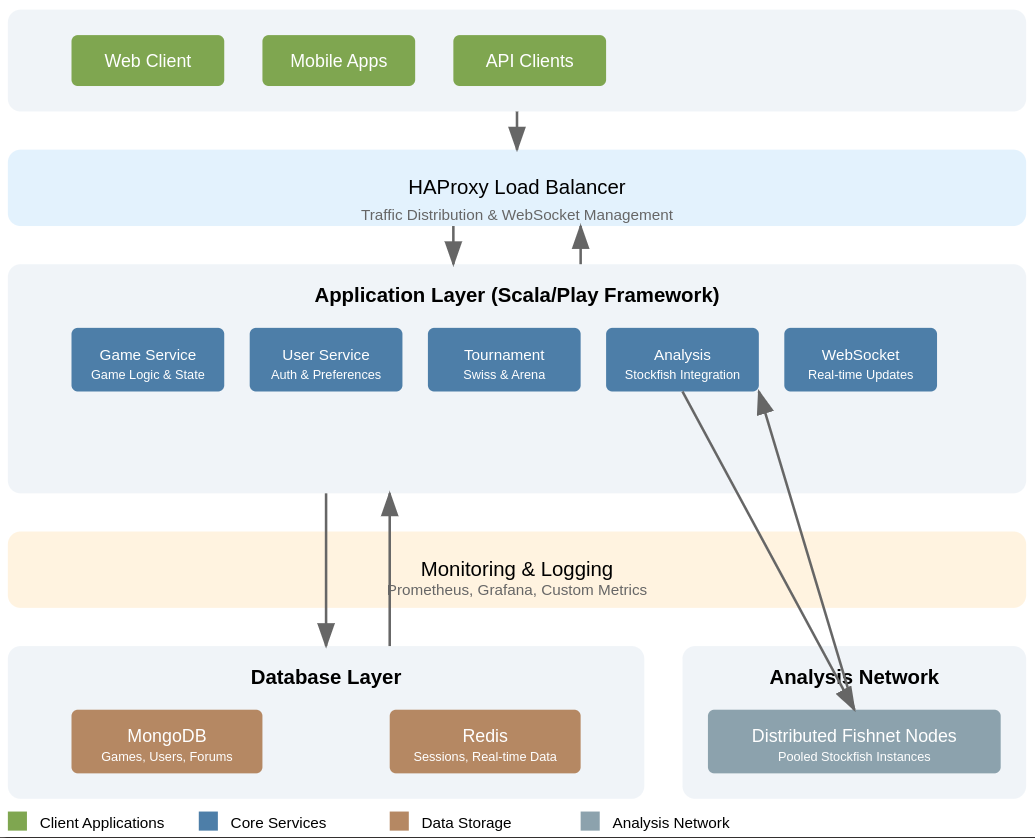
<h2 id="technical-architecture">Technical Architecture</h2>
<p><img loading="lazy" src="/images/content/chess-lichess-foss-revolution-b7a3b2f8-b6b1-4f24-bbff-9ec47edc0a4c.png" alt="tech-architecture" />
</p>
<p>The platform is built on a modern, scalable stack:</p>
<ul>
<li>Backend: Scala with Play Framework</li>
<li>Frontend: TypeScript and Mithril.js</li>
<li>Database: MongoDB and Redis</li>
<li>Real-time: WebSocket</li>
<li>Analysis: Distributed Stockfish instances</li>
</ul>
<h2 id="feature-comparison-with-other-platforms">Feature Comparison with Other Platforms</h2>
<h3 id="lichess">Lichess</h3>
<ul>
<li>Analysis: Unlimited free analysis</li>
<li>Cost: Completely free</li>
<li>Open Source: Yes</li>
<li>Privacy: Full privacy protection</li>
<li>Tournaments: Free unlimited access</li>
<li>Learning Tools: Free comprehensive tools</li>
<li>Mobile App: Full-featured free app</li>
</ul>
<h3 id="commercial-platforms">Commercial Platforms</h3>
<ul>
<li>Analysis: Limited or paid</li>
<li>Cost: Freemium or subscription-based</li>
<li>Open Source: No</li>
<li>Privacy: Limited protections</li>
<li>Tournaments: Often paywalled</li>
<li>Learning Tools: Premium features</li>
<li>Mobile App: Varies by platform</li>
</ul>
<h2 id="how-to-contribute">How to Contribute</h2>
<h3 id="1-development-environment-setup">1. Development Environment Setup</h3>
<div class="highlight"><pre tabindex="0" style="color:#f8f8f2;background-color:#282a36;-moz-tab-size:4;-o-tab-size:4;tab-size:4;"><code class="language-bash" data-lang="bash"><span style="display:flex;"><span><span style="color:#6272a4"># Prerequisites</span>
</span></span><span style="display:flex;"><span>sudo apt-get install mongodb-org nodejs git python3 java-11-openjdk
</span></span><span style="display:flex;"><span>
</span></span><span style="display:flex;"><span><span style="color:#6272a4"># Clone and run</span>
</span></span><span style="display:flex;"><span>git clone https://github.com/lichess-org/lila.git
</span></span><span style="display:flex;"><span><span style="color:#8be9fd;font-style:italic">cd</span> lila
</span></span><span style="display:flex;"><span>./ui/build
</span></span><span style="display:flex;"><span>sbt run
</span></span></code></pre></div><h3 id="2-running-a-fishnet-node">2. Running a Fishnet Node</h3>
<div class="highlight"><pre tabindex="0" style="color:#f8f8f2;background-color:#282a36;-moz-tab-size:4;-o-tab-size:4;tab-size:4;"><code class="language-bash" data-lang="bash"><span style="display:flex;"><span><span style="color:#6272a4"># Contribute to the analysis network</span>
</span></span><span style="display:flex;"><span>git clone https://github.com/niklasf/fishnet.git
</span></span><span style="display:flex;"><span><span style="color:#8be9fd;font-style:italic">cd</span> fishnet
</span></span><span style="display:flex;"><span>cargo run --release
</span></span></code></pre></div><h3 id="3-non-code-contributions">3. Non-Code Contributions</h3>
<ul>
<li>Translations via Crowdin</li>
<li>Community moderation</li>
<li>Bug reporting and testing</li>
<li>Documentation improvements</li>
<li>Creating educational content</li>
</ul>
<h2 id="platform-impact--community-growth">Platform Impact &amp; Community Growth</h2>
<p>Lichess has transformed online chess by offering a free, open-source platform that serves millions globally. Here’s how it stands out:</p>
<h3 id="educational-access">Educational Access</h3>
<p>Lichess provides free tools for all players, including:</p>
<ul>
<li>Unlimited puzzles, game analysis, and an opening explorer</li>
<li>A study feature for creating and sharing lessons</li>
<li>Position training against AI</li>
</ul>
<p>These tools make high-quality chess education accessible to everyone. (<a href="https://lichess.org/training">source</a>)</p>
<h3 id="tournament-platform">Tournament Platform</h3>
<p>Lichess is a major hub for competitive online chess:</p>
<ul>
<li>Hosts Arena, Swiss, and simultaneous tournaments</li>
<li>Offers private tournaments for clubs and schools</li>
<li>Runs regular titled player events</li>
</ul>
<p>Built-in anti-cheating measures ensure fair play. (<a href="https://lichess.org/tournament">source</a>)</p>
<h3 id="open-source-community">Open Source Community</h3>
<p>Lichess’s open-source model encourages global collaboration:</p>
<ul>
<li>400+ contributors on GitHub (<a href="https://github.com/lichess-org">source</a>)</li>
<li>AGPL-licensed code and an active developer Discord</li>
</ul>
<p>Regular user contributions reflect a transparent and evolving platform.</p>
<h3 id="technical-impact">Technical Impact</h3>
<p>Lichess has advanced chess tech with:</p>
<ul>
<li>A public API for developers, a distributed analysis network, and real-time event broadcasting</li>
<li>An open game database supporting research and innovation</li>
</ul>
<p>These features demonstrate Lichess’s commitment to a free, community-driven chess experience, backed by a transparent, open-source approach.</p>
<h2 id="getting-started">Getting Started</h2>
<ol>
<li>
<p><strong>As a Player</strong></p>
<ul>
<li>Visit <a href="https://lichess.org">lichess.org</a></li>
<li>No registration required to play</li>
<li>Full access to all features</li>
</ul>
</li>
<li>
<p><strong>As a Developer</strong></p>
<ul>
<li>Check GitHub issues</li>
<li>Join Discord community</li>
<li>Review contribution guidelines</li>
</ul>
</li>
<li>
<p><strong>As a Contributor</strong></p>
<ul>
<li>Run a Fishnet node</li>
<li>Help with translations</li>
<li>Create educational content</li>
</ul>
</li>
</ol>
<h2 id="resources">Resources</h2>
<ul>
<li><a href="https://github.com/lichess-org/lila">GitHub Repository</a></li>
<li><a href="https://github.com/lichess-org/lila/wiki">Development Wiki</a></li>
<li><a href="https://lichess.org/api">API Documentation</a></li>
<li><a href="https://discord.gg/lichess">Community Discord</a></li>
</ul>
<h2 id="call-to-action">Call to Action</h2>
<p>Lichess proves that a community-driven, open-source project can revolutionize an entire field. Whether you&rsquo;re a developer, chess enthusiast, or someone who believes in open source, there&rsquo;s a place for you in this revolution.</p>
<p>Join us in keeping chess free, open, and accessible to everyone.</p>
<hr>
<p><em>This blog post was last updated: November 2024</em></p>
]]></content>
      </entry>

</feed>