<?xml version="1.0" encoding="utf-8" standalone="yes"?>
<feed xmlns="http://www.w3.org/2005/Atom">
  <title>Cybersecurity on Sooraj Sathyanarayanan</title>
  <link rel="alternate" href="https://profincognito.me/tags/cybersecurity/" />
  <link rel="self" href="https://profincognito.me/tags/cybersecurity/index.xml" />
  <subtitle>Recent content in Cybersecurity on Sooraj Sathyanarayanan</subtitle>
  <id>https://profincognito.me/tags/cybersecurity/</id>
  <generator uri="http://gohugo.io" version="0.147.8">Hugo</generator>
  <language>en-us</language>
  <updated>2026-05-25T14:44:10-07:00</updated>
  <author>
    <name>Sooraj Sathyanarayanan</name>
    
  </author>
  <rights>[CC BY-SA 4.0](https://creativecommons.org/licenses/by-sa/4.0/)</rights>
      <entry>
        <title>Cyber Security Is a Game of Chess: Strategy, Anticipation, and the Battle of Wits</title>
        <link rel="alternate" href="https://profincognito.me/blog/security/cyber-security-chess-strategy/" />
        <id>https://profincognito.me/blog/security/cyber-security-chess-strategy/</id>
        <published>2026-03-04T00:00:00Z</published>
        <updated>2026-05-25T14:44:10-07:00</updated>
        <summary type="html">Explore how the strategic principles of chess apply to cyber security. Learn how anticipation, adaptability, and strategic thinking can help organizations stay ahead in the digital security landscape.</summary>
          <content type="html"><![CDATA[<p>When the <strong>NotPetya</strong> cyberattack struck in 2017, it spread across networks with the precision of a grandmaster executing a flawless chess strategy. Organizations worldwide were caught off-guard, leading to billions in damages. This watershed moment in cybersecurity history demonstrates how cyber security is much like a high-stakes game of chess—professionals must anticipate their opponent&rsquo;s moves, develop robust strategies, and sometimes make sacrifices to protect their most valuable assets. The parallels between cyber security and chess are profound, offering valuable insights into how organizations can better defend themselves in an ever-evolving digital landscape.</p>
<p><img loading="lazy" src="/images/content/blog-security-cyber-security-chess-strategy-6b244ce1-1c30-410a-ad4c-640405eb7dec.png" alt="Chess and Cybersecurity Strategic Matrix" />
</p>
<h2 id="the-opening-moves-establishing-a-strong-defense">The Opening Moves: Establishing a Strong Defense</h2>
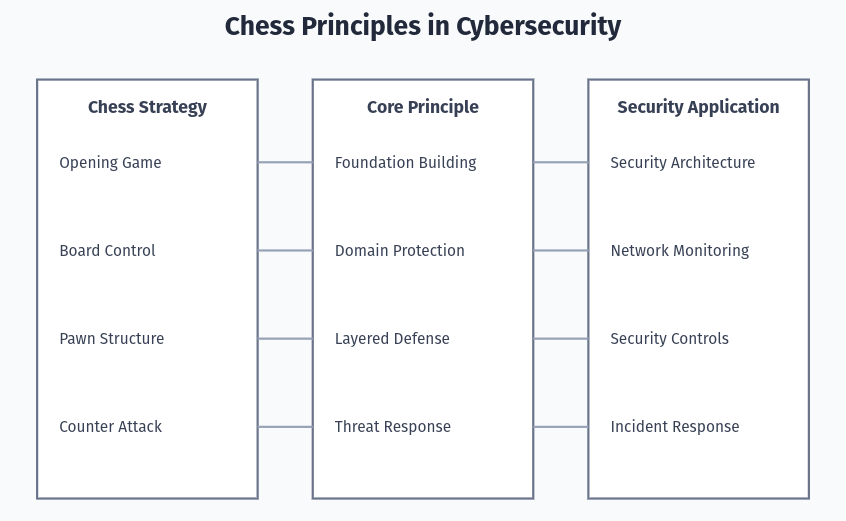
<p>In chess, the opening moves set the tone for the entire game. Players position their pieces strategically, aiming to control the board and protect key assets. Similarly, in cyber security, establishing a strong defense from the outset is crucial.</p>
<ul>
<li><strong>Implement Robust Firewalls</strong>: Utilizing advanced configurations like <strong>Next-Generation Firewalls (NGFWs)</strong> provides deep packet inspection, intrusion prevention, and application awareness—akin to deploying knights and bishops to guard critical squares early in the game.</li>
<li><strong>Deploy Antivirus and Anti-Malware Solutions</strong>: Tools such as <strong>Endpoint Detection and Response (EDR)</strong> systems act like pawns guarding the king, detecting and neutralizing threats before they infiltrate deeper into the network.</li>
<li><strong>Enforce Secure Configurations</strong>: Adopting security frameworks like <strong>CIS Benchmarks</strong> ensures systems are configured to minimize vulnerabilities, much like a chess player meticulously arranging their pieces for optimal defense.</li>
</ul>
<p><em>Real-World Example</em>: The <strong>2023 MOVEit Transfer breach</strong> affected thousands of organizations worldwide, demonstrating how a single vulnerability in a widely-used file transfer tool can lead to widespread data compromise. This incident reinforces the importance of maintaining robust security configurations and rapid patch management.</p>
<p>By establishing a strong defensive position early on, organizations can deter opportunistic attacks and reduce the attack surface.</p>
<h2 id="understanding-your-opponent-the-art-of-threat-intelligence">Understanding Your Opponent: The Art of Threat Intelligence</h2>
<p>A skilled chess player studies their opponent&rsquo;s past games to anticipate strategies and tactics. In cyber security, understanding potential threats and adversaries is essential.</p>
<ul>
<li><strong>Threat Intelligence Gathering</strong>: Utilizing platforms like <strong>MITRE ATT&amp;CK</strong> helps collect data on emerging threats, aiding in the anticipation of attack methods.</li>
<li><strong>Analyzing Attack Vectors</strong>: Employing tools such as <strong>Security Information and Event Management (SIEM)</strong> systems allows for understanding how attackers exploit vulnerabilities, enabling stronger defenses.</li>
<li><strong>Profiling Adversaries</strong>: Identifying potential attackers—be it cybercriminals, insider threats, or nation-states—helps tailor the level of security required.</li>
</ul>
<p><em>Real-World Example</em>: The rising prominence of ransomware-as-a-service (RaaS) operations in 2023 has transformed the threat landscape, requiring organizations to adapt their defense strategies against increasingly sophisticated and organized criminal enterprises.</p>
<p>Knowledge of the opponent enhances the ability to predict and prevent potential attacks, much like foreseeing an opponent&rsquo;s move in chess.</p>
<h2 id="anticipation-and-strategy-staying-one-step-ahead">Anticipation and Strategy: Staying One Step Ahead</h2>
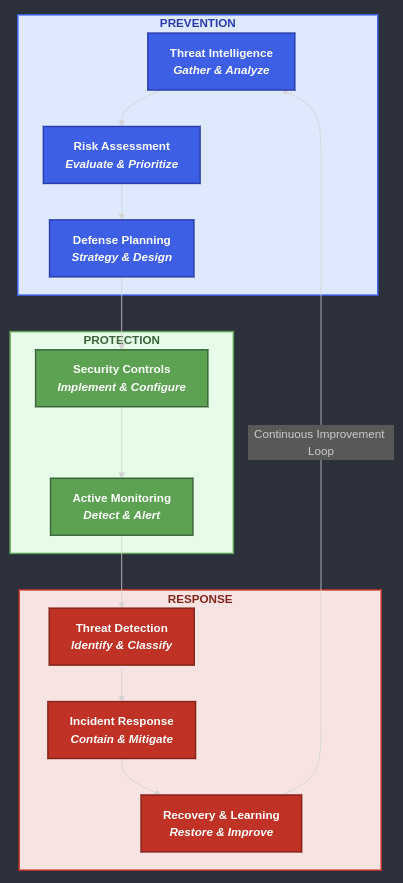
<p>Chess is a game of foresight, where players think several moves ahead. Cyber security demands a similar proactive approach.</p>
<ul>
<li><strong>Regular Vulnerability Assessments</strong>: Conducting assessments with tools like <strong>Nessus</strong> or <strong>OpenVAS</strong> helps identify weaknesses before attackers do, allowing for prompt patching.</li>
<li><strong>Penetration Testing</strong>: Simulating attacks using methodologies like <strong>OWASP Top Ten</strong> evaluations helps in assessing the effectiveness of existing security measures.</li>
<li><strong>Proactive Monitoring</strong>: Implementing <strong>Intrusion Detection Systems (IDS)</strong> and <strong>Intrusion Prevention Systems (IPS)</strong> ensures continuous network monitoring to detect unusual activities indicative of a breach.</li>
</ul>
<p><em>Real-World Example</em>: <strong>Microsoft&rsquo;s</strong> recent implementation of AI-powered threat detection in Microsoft 365 Defender demonstrates how organizations are leveraging advanced technologies to anticipate and prevent emerging threats.</p>
<p>By anticipating potential threats, cyber security professionals can implement strategies that mitigate risks before they materialize.</p>
<p><img loading="lazy" src="/images/content/blog-security-cyber-security-chess-strategy-bc4de073-634a-41a4-8f68-3bd1c5182a57.png" alt="Strategic Defense Cycle" />
</p>
<h2 id="adaptability-responding-to-an-ever-changing-landscape">Adaptability: Responding to an Ever-Changing Landscape</h2>
<p>No chess game unfolds exactly the same way, requiring players to adapt their strategies on the fly. The cyber threat landscape is equally dynamic.</p>
<ul>
<li><strong>Emerging Threats</strong>: Staying updated on new malware, phishing techniques, and zero-day exploits is crucial. Utilizing <strong>Advanced Threat Protection (ATP)</strong> solutions helps in adapting defenses.</li>
<li><strong>Technological Advancements</strong>: The evolution of AI, quantum computing, and IoT devices introduces new vulnerabilities. Implementing <strong>Zero Trust Architecture</strong> ensures security regardless of technology stack or location.</li>
<li><strong>Regulatory Changes</strong>: Compliance with regulations like <strong>GDPR</strong>, <strong>CCPA</strong>, and emerging AI governance frameworks necessitates continuous adjustments in security policies and practices.</li>
</ul>
<p><em>Real-World Example</em>: The widespread adoption of AI tools in 2023 has introduced new security challenges, from prompt injection attacks to data poisoning, requiring organizations to develop novel defense strategies for these emerging threats.</p>
<p>Adaptability ensures that defenses remain robust against the latest threats, just as a chess player adjusts their tactics in response to the opponent&rsquo;s moves.</p>
<h2 id="sacrifices-for-greater-gain-risk-management-and-prioritization">Sacrifices for Greater Gain: Risk Management and Prioritization</h2>
<p>In chess, sacrificing a lesser piece can be a strategic move to protect more valuable ones or gain a positional advantage. In cyber security:</p>
<ul>
<li><strong>Accepting Certain Risks</strong>: Recognizing that it&rsquo;s impractical to secure everything equally, organizations may accept minor risks to focus on protecting critical assets.</li>
<li><strong>Resource Allocation</strong>: Prioritizing resources to secure customer data over less sensitive information ensures effective use of limited resources.</li>
<li><strong>Implementing Least Privilege Access</strong>: Limiting user access rights minimizes potential damage from compromised accounts, similar to controlling key squares on the chessboard.</li>
</ul>
<p><em>Real-World Example</em>: Many organizations now implement passwordless authentication despite the initial complexity and user adjustment period, recognizing that this &ldquo;sacrifice&rdquo; of convenience strengthens overall security posture.</p>
<p>These calculated decisions help maintain overall security posture without overextending resources.</p>
<h2 id="the-endgame-incident-response-and-recovery">The Endgame: Incident Response and Recovery</h2>
<p>As a chess game approaches its conclusion, precision becomes critical. In cyber security:</p>
<ul>
<li><strong>Incident Response Planning</strong>: Developing a plan aligned with frameworks like <strong>NIST SP 800-61</strong> ensures quick and effective action when a breach occurs.</li>
<li><strong>Disaster Recovery</strong>: Regular backups and recovery procedures using solutions like <strong>Disaster Recovery as a Service (DRaaS)</strong> minimize downtime and data loss.</li>
<li><strong>Post-Incident Analysis</strong>: Conducting thorough <strong>root cause analysis</strong> helps in strengthening defenses against future attacks.</li>
</ul>
<p><em>Real-World Example</em>: The swift response to the 2023 ChatGPT data breach, where OpenAI temporarily shut down the service to address a critical vulnerability, demonstrates the importance of having well-prepared incident response procedures.</p>
<p>The endgame in cyber security focuses on mitigating damage and restoring normal operations, akin to securing a checkmate.</p>
<h2 id="conclusion-embracing-the-strategic-mindset-in-cyber-security">Conclusion: Embracing the Strategic Mindset in Cyber Security</h2>
<p>The strategic principles of chess provide invaluable insights for modern cybersecurity practices. By approaching digital security with the same level of strategic thinking, organizations can better prepare for, prevent, and respond to cyber threats.</p>
<p>In today&rsquo;s rapidly evolving threat landscape, this strategic approach enables security professionals to think several moves ahead, anticipating attacks while maintaining the flexibility to adapt to new challenges. Success in cybersecurity, like chess, ultimately comes down to strategic thinking, careful preparation, and the ability to execute under pressure.</p>
<hr>
]]></content>
      </entry>
      <entry>
        <title>Privacy-First Security: Building Trust Through Data Protection</title>
        <link rel="alternate" href="https://profincognito.me/blog/security/privacyfirst-security/" />
        <id>https://profincognito.me/blog/security/privacyfirst-security/</id>
        <published>2026-03-04T00:00:00Z</published>
        <updated>2026-05-25T14:44:10-07:00</updated>
        <summary type="html">Explore how adopting a privacy-first security approach not only safeguards data but also builds lasting trust with customers. This comprehensive guide delves into practical strategies, emerging trends, and real-world examples to help organizations implement effective privacy-enhanced security.</summary>
          <content type="html"><![CDATA[<p>In an era where data breaches and privacy concerns dominate headlines, adopting a privacy-first security approach is more critical than ever. This guide examines how organizations can build trust through robust privacy practices, offering insights into foundational principles, advanced implementation strategies, and real-world case studies. Discover how leading organizations are achieving enhanced security and customer trust by prioritizing privacy at every level.</p>
<h2 id="introduction">Introduction</h2>
<p>The digital age has transformed data into one of the most valuable assets—and one of the most significant liabilities. Privacy has shifted from being a mere compliance requirement to a cornerstone of customer trust and brand reputation. According to a 2023 McKinsey report, <strong>76% of consumers</strong> indicate they won&rsquo;t engage with companies they don&rsquo;t trust to handle their data responsibly. This shift underscores that privacy isn&rsquo;t just about avoiding fines; it&rsquo;s about fostering sustainable relationships built on trust and transparency.</p>
<p>As Dr. Ann Cavoukian, creator of Privacy by Design, aptly states:</p>
<blockquote>
<p>&ldquo;Privacy is not about secrecy; it&rsquo;s about control, transparency, and trust in data relationships.&rdquo;</p></blockquote>
<h2 id="the-current-privacy-landscape">The Current Privacy Landscape</h2>
<p>Recent statistics highlight the urgency for a privacy-first approach:</p>
<ul>
<li><strong>$4.45 million</strong>: The average cost of a data breach in 2023, as reported by IBM Security.</li>
<li><strong>42% increase</strong>: Growth in global privacy regulations since 2020, according to the IAPP&rsquo;s 2023 Privacy Governance Report.</li>
<li><strong>40% faster</strong>: Organizations with mature privacy programs resolve security incidents more quickly, per Cisco&rsquo;s 2023 Data Privacy Benchmark Study.</li>
</ul>
<p>These figures emphasize that privacy is a strategic imperative, integral to operational success and customer trust.</p>
<h2 id="key-components-of-privacy-first-security">Key Components of Privacy-First Security</h2>
<h3 id="1-embedding-privacy-as-a-core-value">1. Embedding Privacy as a Core Value</h3>
<p>Prioritizing privacy transforms how organizations handle data:</p>
<ul>
<li><strong>Intentional Data Collection</strong>: Gathering only what is necessary, reducing risk.</li>
<li><strong>Aligned Security Controls</strong>: Implementing measures that respect user rights and data protection.</li>
<li><strong>Comprehensive Risk Assessments</strong>: Including privacy impact analyses to identify potential vulnerabilities.</li>
<li><strong>Inherent Compliance</strong>: Meeting regulatory requirements naturally through robust privacy practices.</li>
</ul>
<p>Organizations embracing these principles often experience:</p>
<ul>
<li><strong>Reduced Incident Response Times</strong></li>
<li><strong>Improved Customer Retention Rates</strong></li>
<li><strong>Enhanced Regulatory Compliance</strong></li>
<li><strong>Lower Operational Costs through Data Minimization</strong></li>
</ul>
<h3 id="2-leveraging-privacy-enhancing-technologies-pets">2. Leveraging Privacy-Enhancing Technologies (PETs)</h3>
<p>Advanced technologies play a pivotal role in safeguarding privacy:</p>
<h4 id="homomorphic-encryption"><strong>Homomorphic Encryption</strong></h4>
<ul>
<li><strong>Functionality</strong>: Allows computation on encrypted data without decryption.</li>
<li><strong>Benefits</strong>: Maintains confidentiality during processing; ideal for outsourcing computations securely.</li>
<li><strong>Real-world Applications</strong>: Financial service computations, healthcare data analysis, secure multi-party computations.</li>
</ul>
<h4 id="differential-privacy"><strong>Differential Privacy</strong></h4>
<ul>
<li><strong>Functionality</strong>: Introduces statistical noise to datasets, protecting individual data points.</li>
<li><strong>Benefits</strong>: Enables useful analytics while preserving individual privacy; supports transparent data sharing.</li>
<li><strong>Implementation Examples</strong>: Census data analysis, machine learning model training, public health research.</li>
</ul>
<h4 id="synthetic-data"><strong>Synthetic Data</strong></h4>
<ul>
<li><strong>Functionality</strong>: Creates artificial datasets that mirror real data patterns without exposing personal information.</li>
<li><strong>Benefits</strong>: Facilitates development and testing without privacy risks; enhances machine learning training.</li>
<li><strong>Use Cases</strong>: Software testing, AI model development, regulatory compliance training.</li>
</ul>
<h3 id="3-implementing-zero-trust-privacy-architecture">3. Implementing Zero-Trust Privacy Architecture</h3>
<p>Adopting a zero-trust model ensures continuous validation and minimal risk:</p>
<h4 id="continuous-validation"><strong>Continuous Validation</strong></h4>
<ul>
<li><strong>Authentication at Every Step</strong>: No user or device is inherently trusted.</li>
<li><strong>Privacy Permission Verification</strong>: Ensuring data access aligns with user consent.</li>
<li><strong>Regular Privacy Impact Assessments</strong>: Ongoing evaluation of privacy risks.</li>
<li><strong>Context-Aware Access Decisions</strong>: Access granted based on current context, not just credentials.</li>
</ul>
<h4 id="privacy-aware-access-control"><strong>Privacy-Aware Access Control</strong></h4>
<ul>
<li><strong>Purpose-Based Access Management</strong>: Users access data only for specified purposes.</li>
<li><strong>Time-Bound Permissions</strong>: Access rights expire after a set period.</li>
<li><strong>Context-Based Authorization</strong>: Dynamic adjustment of permissions based on user behavior and environment.</li>
<li><strong>Privacy Impact Consideration</strong>: Evaluating how access affects individual privacy.</li>
</ul>
<h2 id="real-world-implementation">Real-World Implementation</h2>
<h3 id="case-study-global-financial-services-provider-2022-2023"><strong>Case Study: Global Financial Services Provider (2022-2023)</strong></h3>
<p><strong>Challenge:</strong>
A major financial institution faced multiple privacy challenges while processing over 10 million daily transactions across 50 countries:</p>
<ul>
<li><strong>Legacy Systems</strong>: Multiple outdated mainframe systems processing sensitive data</li>
<li><strong>Regulatory Complexity</strong>: Compliance with GDPR, CCPA, and sector-specific regulations</li>
<li><strong>Scale</strong>: Managing privacy for 50+ million customer records</li>
</ul>
<p><strong>Solution Implementation:</strong></p>
<ol>
<li>
<p><strong>Privacy-Aware Architecture Transformation</strong>:</p>
<ul>
<li>Deployed IBM Confidential Computing for secure data processing</li>
<li>Implemented Privacera for data governance and access control</li>
<li>Utilized HashiCorp Vault for secrets management</li>
</ul>
</li>
<li>
<p><strong>Enhanced Access Controls</strong>:</p>
<ul>
<li>Implemented purpose-based access using SailPoint IdentityIQ</li>
<li>Deployed Okta for identity management with continuous authentication</li>
<li>Integrated OneTrust for consent management</li>
</ul>
</li>
<li>
<p><strong>Privacy-Preserving Analytics</strong>:</p>
<ul>
<li>Implemented Google&rsquo;s differential privacy library</li>
<li>Deployed Privitar for data anonymization</li>
<li>Utilized synthetic data for testing environments</li>
</ul>
</li>
</ol>
<p><strong>Measurable Results</strong> (Q4 2022 - Q3 2023):</p>
<ul>
<li><strong>60% Reduction in Privacy Incidents</strong>: From 25 monthly incidents to 10</li>
<li><strong>40% Faster Compliance Verification</strong>: Audit time reduced from 45 days to 27</li>
<li><strong>35% Reduction in Data Storage Costs</strong>: Through efficient classification and deletion</li>
<li><strong>90% Automated Privacy Controls</strong>: Reduced manual privacy oversight needs</li>
</ul>
<h2 id="emerging-challenges-and-solutions">Emerging Challenges and Solutions</h2>
<h3 id="1-artificial-intelligence-and-privacy">1. <strong>Artificial Intelligence and Privacy</strong></h3>
<ul>
<li><strong>Privacy-Preserving Machine Learning</strong>: Implementation of federated learning frameworks</li>
<li><strong>Model Privacy Assessment</strong>: Regular evaluation using established privacy metrics</li>
<li><strong>Training Data Protection</strong>: Implementation of privacy-preserving training techniques</li>
</ul>
<h3 id="2-edge-computing-privacy">2. <strong>Edge Computing Privacy</strong></h3>
<ul>
<li><strong>Local Privacy Enforcement</strong>: Using secure enclaves for protected processing</li>
<li><strong>Distributed Consent Management</strong>: Implementation of decentralized identity solutions</li>
<li><strong>Edge-to-Cloud Privacy Controls</strong>: Integration with cloud services for consistent policy enforcement</li>
<li><strong>Privacy-Aware Data Synchronization</strong>: Using distributed database systems for secure storage</li>
</ul>
<h3 id="3-quantum-computing-implications">3. <strong>Quantum Computing Implications</strong></h3>
<p>Current Status (2023):</p>
<ul>
<li>NIST has selected initial quantum-resistant cryptographic algorithms</li>
<li>Major cloud providers are implementing post-quantum cryptography</li>
<li>Organizations are conducting quantum readiness assessments</li>
</ul>
<p>Preparation Steps:</p>
<ul>
<li><strong>Crypto-Agility</strong>: Implementing flexible cryptographic frameworks</li>
<li><strong>Risk Assessment</strong>: Regular evaluation using established frameworks</li>
<li><strong>Timeline Planning</strong>: Preparing for full quantum-safe encryption by 2025-2030</li>
</ul>
<h2 id="best-practices">Best Practices</h2>
<h3 id="do"><strong>Do&rsquo;s</strong></h3>
<ul>
<li><strong>Start with Comprehensive Data Mapping</strong>: Know where all personal data resides.</li>
<li><strong>Implement Privacy by Default</strong>: Make privacy the standard setting in all products and services.</li>
<li><strong>Automate Where Possible</strong>: Use tools to reduce human error in privacy management.</li>
<li><strong>Invest in Continuous Training</strong>: Keep teams updated on the latest privacy trends and regulations.</li>
<li><strong>Monitor and Measure Effectiveness</strong>: Regularly assess how well privacy measures are working.</li>
</ul>
<h3 id="don"><strong>Don&rsquo;ts</strong></h3>
<ul>
<li><strong>Ignore Privacy Debt</strong>: Don&rsquo;t postpone addressing known privacy issues.</li>
<li><strong>Implement Without Metrics</strong>: Avoid deploying solutions without a way to measure their impact.</li>
<li><strong>Neglect User Experience</strong>: Don&rsquo;t let privacy measures hinder usability.</li>
<li><strong>Overlook Edge Cases</strong>: Consider all scenarios, including less common ones that may pose risks.</li>
<li><strong>Assume One-Size-Fits-All</strong>: Customize privacy strategies to fit your organization&rsquo;s unique needs.</li>
</ul>
<h2 id="measuring-success">Measuring Success</h2>
<h3 id="operational-metrics"><strong>Operational Metrics</strong></h3>
<ul>
<li><strong>Frequency of Privacy Incidents</strong>: Aim for a downward trend.</li>
<li><strong>Response Time to Incidents</strong>: Track improvements in addressing privacy issues.</li>
<li><strong>Privacy Debt Reduction</strong>: Measure how much outstanding privacy work has been completed.</li>
<li><strong>Implementation Coverage</strong>: Assess the extent to which privacy measures have been adopted.</li>
</ul>
<h3 id="business-impact"><strong>Business Impact</strong></h3>
<ul>
<li><strong>Customer Trust Metrics</strong>: Use surveys and engagement rates to gauge trust levels.</li>
<li><strong>Operational Efficiency Gains</strong>: Identify cost savings from streamlined processes.</li>
<li><strong>Compliance Cost Reduction</strong>: Measure savings from avoiding fines and reducing audit expenses.</li>
<li><strong>Risk Profile Improvements</strong>: Evaluate the organization&rsquo;s overall risk exposure.</li>
</ul>
<h2 id="additional-resources">Additional Resources</h2>
<h3 id="standards-and-frameworks"><strong>Standards and Frameworks</strong></h3>
<ul>
<li><strong><a href="https://www.nist.gov/privacy-framework">NIST Privacy Framework</a></strong>: A comprehensive guide for privacy risk management</li>
<li><strong><a href="https://owasp.org/www-project-top-10-privacy-risks">OWASP Privacy Risks Project</a></strong>: Privacy risk assessment methodology</li>
</ul>
<h3 id="professional-organizations"><strong>Professional Organizations</strong></h3>
<ul>
<li><strong><a href="https://iapp.org">International Association of Privacy Professionals (IAPP)</a></strong></li>
<li><strong><a href="https://www.eff.org">Electronic Frontier Foundation (EFF)</a></strong></li>
<li><strong><a href="https://www.staysafeonline.org">National Cyber Security Alliance (NCSA)</a></strong></li>
</ul>
<p>These organizations provide training, certification programs, and current privacy research and guidelines.</p>
<hr>
]]></content>
      </entry>
      <entry>
        <title>Understanding Google Safe Browsing and Brave&#39;s Implementation: How It Works and Why It&#39;s Important</title>
        <link rel="alternate" href="https://profincognito.me/blog/security/brave-safe-browsing/" />
        <id>https://profincognito.me/blog/security/brave-safe-browsing/</id>
        <published>2026-03-04T00:00:00Z</published>
        <updated>2026-05-25T14:44:10-07:00</updated>
        <summary type="html">A technical deep dive into Google Safe Browsing, its importance, and how browsers like Brave enhance privacy while utilizing this technology.</summary>
          <content type="html"><![CDATA[<p>Imagine clicking a link and unwittingly downloading malware that encrypts all your files, or entering your banking credentials on what appears to be your bank&rsquo;s website—only to discover it&rsquo;s an elaborate fake. These aren&rsquo;t hypothetical scenarios; they&rsquo;re daily realities. Enter Google Safe Browsing, our guardian that silently protects billions of users from these exact threats.</p>
<p>In this deep dive, we&rsquo;ll peel back the layers of Google Safe Browsing&rsquo;s technical architecture, explore its critical role in modern web security, and examine how browsers like Brave have innovated upon its foundation to enhance user privacy. Whether you&rsquo;re a developer integrating these protections, a website owner ensuring your site stays secure, or simply someone who wants to understand what keeps you safe online, this guide will equip you with essential knowledge about one of the web&rsquo;s most crucial security systems.</p>
<h2 id="what-is-google-safe-browsing">What is Google Safe Browsing?</h2>
<p><a href="https://safebrowsing.google.com/">Google Safe Browsing</a> is a security service that identifies unsafe websites across the web and warns users when they attempt to navigate to dangerous sites or download harmful files. Integrated into major web browsers such as Google Chrome, Mozilla Firefox, Apple Safari, and Brave, it serves as a crucial defense against online threats.</p>
<h2 id="how-does-google-safe-browsing-work">How Does Google Safe Browsing Work?</h2>
<h3 id="1-continuous-web-crawling-and-analysis">1. Continuous Web Crawling and Analysis</h3>
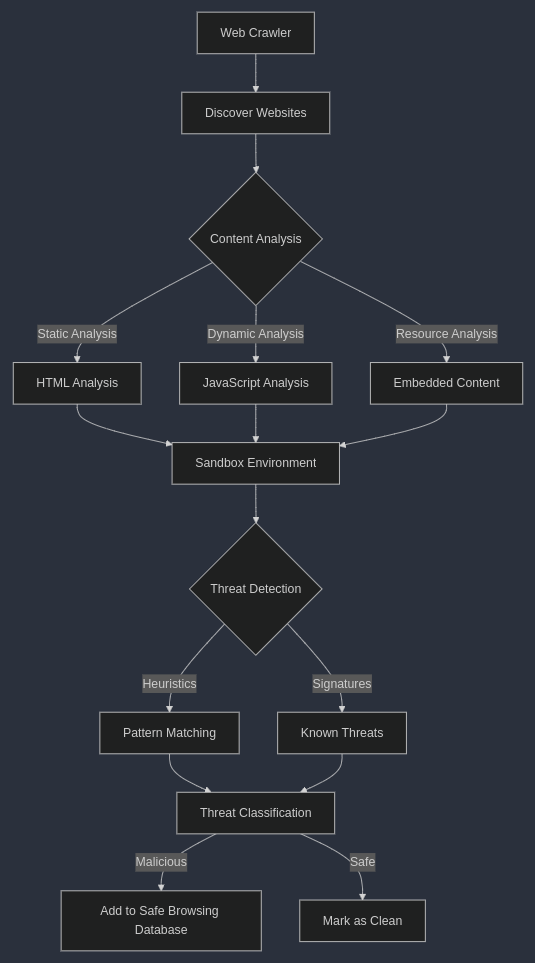
<p>Google employs automated systems called web crawlers to systematically browse the internet.</p>
<ul>
<li><strong>Content Examination</strong>: Crawlers analyze website content, including HTML, JavaScript, and embedded resources.</li>
<li><strong>Behavioral Analysis</strong>: Scripts and code are executed in a sandbox environment to detect malicious behaviors not apparent through static analysis.</li>
<li><strong>Detection Techniques</strong>: Heuristics, machine learning models, and signature-based detection identify malware and phishing sites.</li>
</ul>
<div align="center">
  <img src="/images/content/blog-security-brave-safe-browsing-4f6df1a6-9168-4d2d-8e11-ebc03b29ccf4.png" alt="Web Crawling and Analysis Process">
<p><em>Flowchart illustrating the web crawling and analysis process.</em></p>
</div>
<h3 id="2-threat-classification">2. Threat Classification</h3>
<p>Identified threats are classified into:</p>
<ul>
<li><strong>Malware Sites</strong>: Distribute harmful software.</li>
<li><strong>Phishing Sites</strong>: Imitate legitimate sites to steal sensitive information.</li>
<li><strong>Unwanted Software</strong>: Promote software that alters system settings without consent.</li>
</ul>
<h3 id="3-database-updates-and-management">3. Database Updates and Management</h3>
<p>Unsafe URLs are added to Google&rsquo;s Safe Browsing databases.</p>
<ul>
<li><strong>URL Hashing</strong>: URLs are hashed using cryptographic functions to create unique identifiers while preserving privacy.</li>
<li><strong>Incremental Updates</strong>: Browsers periodically download updates containing hashed prefixes of unsafe URLs for efficient local checks.</li>
</ul>
<h3 id="4-real-time-protection-in-browsers">4. Real-Time Protection in Browsers</h3>
<p>When a user navigates to a website:</p>
<ul>
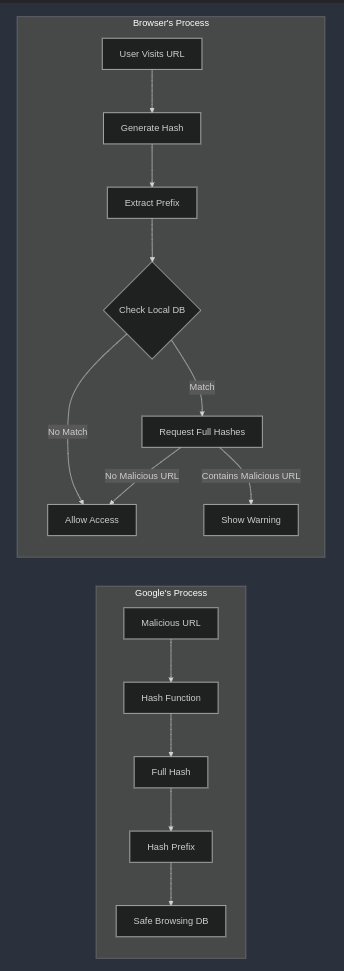
<li><strong>Local Check</strong>: The browser hashes the URL and compares the prefix against the local Safe Browsing list.</li>
<li><strong>Verification Request</strong>: If there&rsquo;s a match, the browser requests full hashes from Google&rsquo;s servers to verify if the URL is malicious.</li>
<li><strong>User Warning</strong>: The browser displays a warning if the site is confirmed harmful.</li>
</ul>
<h3 id="5-privacy-considerations">5. Privacy Considerations</h3>
<p>Google Safe Browsing is designed with privacy in mind:</p>
<ul>
<li><strong>Anonymized Requests</strong>: Verification requests do not include personal information or the actual URL.</li>
<li><strong>Limited Data Sharing</strong>: Only hashed prefixes are shared, and requests may include multiple hashes to obfuscate which one triggered the request.</li>
</ul>
<h2 id="why-is-google-safe-browsing-important">Why is Google Safe Browsing Important?</h2>
<h3 id="protecting-users">Protecting Users</h3>
<ul>
<li><strong>Prevents Malware Infections</strong>: Blocks access to sites distributing harmful software.</li>
<li><strong>Guards Against Phishing</strong>: Warns users before they enter information on fraudulent sites.</li>
<li><strong>Enhances Confidence</strong>: Users can browse safely knowing they&rsquo;re protected.</li>
</ul>
<h3 id="supporting-website-owners">Supporting Website Owners</h3>
<ul>
<li><strong>Maintains Reputation</strong>: Helps prevent legitimate sites from being flagged due to compromise.</li>
<li><strong>Encourages Best Practices</strong>: Incentivizes robust security measures to avoid being listed.</li>
<li><strong>Provides Recovery Tools</strong>: Offers resources to identify and fix security issues.</li>
</ul>
<h2 id="browser-implementations-the-case-of-brave">Browser Implementations: The Case of Brave</h2>
<p><a href="https://brave.com/">Brave</a> is a privacy-focused browser that utilizes Google Safe Browsing while enhancing user privacy through specific implementations.</p>
<h3 id="how-brave-uses-google-safe-browsing">How Brave Uses Google Safe Browsing</h3>
<p>Brave enhances privacy in its implementation of Google Safe Browsing by taking additional steps to protect user data.</p>
<h4 id="proxying-safe-browsing-requests">Proxying Safe Browsing Requests</h4>
<p>When Brave needs to request full hashes from Google&rsquo;s Safe Browsing servers (after a local match of a hashed prefix), it routes these requests through Brave&rsquo;s servers.</p>
<ul>
<li><strong>Anonymity</strong>: Prevents Google from seeing the user&rsquo;s IP address.</li>
<li><strong>Privacy Enhancement</strong>: Stops Google from associating Safe Browsing requests with specific users.</li>
</ul>
<h4 id="limiting-data-sent-to-google">Limiting Data Sent to Google</h4>
<p>Brave minimizes the data sent to Google by:</p>
<ul>
<li><strong>Not Including Identifiers</strong>: Excludes any identifying information from Safe Browsing requests.</li>
<li><strong>Batching Requests</strong>: Groups multiple requests to further obscure individual user activity.</li>
</ul>
<h4 id="local-checks-with-frequent-updates">Local Checks with Frequent Updates</h4>
<ul>
<li><strong>Regular Updates</strong>: Brave frequently updates the local Safe Browsing lists to ensure up-to-date protection.</li>
<li><strong>Efficiency</strong>: Local checks are fast and protect user privacy by avoiding unnecessary network requests.</li>
</ul>
<div align="center">
  <img src="/images/content/blog-security-brave-safe-browsing-1369f617-7f4d-45e0-a822-1fab54594034.png" alt="Standard Safe Browsing Implementation">
  <img src="/images/content/blog-security-brave-safe-browsing-620335d2-d227-4cae-a639-3f56af97f6a5.png" alt="Brave Safe Browsing Implementation">
  <br>
  <em>Flowchart comparing standard Safe Browsing implementation with Brave's enhanced privacy approach.</em>
</div>
<h2 id="responding-to-google-safe-browsing-warnings">Responding to Google Safe Browsing Warnings</h2>
<h3 id="for-users">For Users</h3>
<ul>
<li><strong>Heed Warnings</strong>: Avoid visiting sites flagged as unsafe.</li>
<li><strong>Report Issues</strong>: If you believe a site is mistakenly flagged, report it through the <a href="https://transparencyreport.google.com/safe-browsing/search?hl=en">Google Transparency Report</a>.</li>
</ul>
<h3 id="for-website-owners">For Website Owners</h3>
<ol>
<li><strong>Identify the Issue</strong>: Use <a href="https://search.google.com/search-console/about">Google Search Console</a> to find out why your site was flagged.</li>
<li><strong>Clean Your Site</strong>: Remove malicious code, infected files, or unauthorized content.</li>
<li><strong>Secure Your Site</strong>: Fix vulnerabilities, update passwords, and check user permissions.</li>
<li><strong>Request a Review</strong>: After ensuring your site is clean, request a review via Search Console.</li>
<li><strong>Monitor Regularly</strong>: Keep an eye on your site&rsquo;s security status to prevent future issues.</li>
</ol>
<h2 id="the-technical-details-behind-safe-browsing">The Technical Details Behind Safe Browsing</h2>
<h3 id="url-hashing-and-privacy">URL Hashing and Privacy</h3>
<ul>
<li><strong>Hash Functions</strong>: Convert URLs into fixed-size strings (hashes) using functions like SHA256.</li>
<li><strong>Hash Prefixes</strong>: Only a portion of the hash is used for local checks, enhancing privacy.</li>
<li><strong>Privacy Preservation</strong>: Reduces the chance of exposing browsing history to Google.</li>
</ul>
<p><a href="https://security.googleblog.com/2022/08/how-hash-based-safe-browsing-works-in.html">Learn more about hash-based Safe Browsing in this Google Security Blog post.</a></p>
<div align="center">
  <img src="/images/content/blog-security-brave-safe-browsing-7d1da7c2-32e6-4233-8c0e-677b3a4c35b2.png" alt="URL Hashing and Prefix Matching Process">
<p><em>Diagram showing the process of URL hashing and how hash prefixes are used to check against the Safe Browsing database without compromising privacy.</em></p>
</div>
<h3 id="machine-learning-and-threat-detection">Machine Learning and Threat Detection</h3>
<ul>
<li><strong>Pattern Recognition</strong>: Analyzes vast amounts of data to identify patterns indicative of malicious sites.</li>
<li><strong>Adaptive Algorithms</strong>: Continuously improves to detect new and sophisticated threats.</li>
</ul>
<h3 id="collaboration-and-data-sharing">Collaboration and Data Sharing</h3>
<ul>
<li><strong>Industry Partnerships</strong>: Shares threat intelligence with other organizations to enhance overall internet security.</li>
<li><strong>User Reports</strong>: Feedback from users and website owners helps improve detection accuracy.</li>
</ul>
<h2 id="the-impact-of-google-safe-browsing">The Impact of Google Safe Browsing</h2>
<ul>
<li><strong>Reduces Malware Spread</strong>: Blocks access to harmful sites, limiting malware distribution.</li>
<li><strong>Lowers Phishing Success</strong>: Protects users from deceptive sites, reducing phishing incidents.</li>
<li><strong>Promotes Security Standards</strong>: Encourages best practices globally, improving overall web security.</li>
</ul>
<h2 id="conclusion">Conclusion</h2>
<p>Google Safe Browsing is an elegant balance of robust security and technical sophistication that helps create a safer internet for everyone—from casual browsers to business owners. While the technology itself is remarkable, it&rsquo;s the innovations by privacy-focused browsers like <strong>Brave</strong> that truly showcase its potential, proving that we don&rsquo;t have to choose between staying safe and staying private. The future of web security isn&rsquo;t just about building walls; it&rsquo;s about building them intelligently.</p>
<hr>
<p><em>Do you have any experiences or tips related to staying safe online? Share your thoughts!</em></p>
]]></content>
      </entry>

</feed>