<?xml version="1.0" encoding="utf-8" standalone="yes"?>
<feed xmlns="http://www.w3.org/2005/Atom">
  <title>Security on Sooraj Sathyanarayanan</title>
  <link rel="alternate" href="https://profincognito.me/blog/security/" />
  <link rel="self" href="https://profincognito.me/blog/security/index.xml" />
  <subtitle>Recent content in Security on Sooraj Sathyanarayanan</subtitle>
  <id>https://profincognito.me/blog/security/</id>
  <generator uri="http://gohugo.io" version="0.147.8">Hugo</generator>
  <language>en-us</language>
  <updated>2026-06-10T15:20:29-07:00</updated>
  <author>
    <name>Sooraj Sathyanarayanan</name>
    
  </author>
  <rights>[CC BY-SA 4.0](https://creativecommons.org/licenses/by-sa/4.0/)</rights>
      <entry>
        <title>Beyond Memory Safety: Rust&#39;s Comprehensive Approach to Modern Programming</title>
        <link rel="alternate" href="https://profincognito.me/blog/security/rust/" />
        <id>https://profincognito.me/blog/security/rust/</id>
        <published>2026-03-04T00:00:00Z</published>
        <updated>2026-06-10T15:20:29-07:00</updated>
        <summary type="html">Explore why Rust is the all-encompassing language of choice for secure, high-performance, concurrent programming, and modern development in systems programming. Success stories from Android, Linux, and leading tech companies highlight Rust&amp;#39;s versatile strengths.</summary>
          <content type="html"><![CDATA[<p>I was deep into my personal projects—mostly written in Python—automating security audits and penetration testing workflows. Python was my trusted go-to for scripting and orchestration, offering rapid development cycles and a huge ecosystem of libraries. Yet, as my toolset grew in complexity and scale, I started bumping into its limits: performance bottlenecks when scanning large codebases, concurrency overheads, and a creeping sensation that I’d need something more robust if I ever ventured closer to the system’s metal.</p>
<p>That’s when I discovered Rust, and it opened my eyes to an entirely new paradigm for systems programming. Rust showed me that I could retain the confidence and productivity I enjoyed in Python, but also gain the low-level control, safety, and sheer speed required for the most demanding tasks. Memory safety without runtime costs. Performance without compromising security. A new approach for a new era of software.</p>
<h2 id="the-crisis-of-insecure-and-inefficient-code">The Crisis of Insecure and Inefficient Code</h2>
<p>As of the early 2020s, the software industry faces a multifaceted crisis. Memory-related bugs are responsible for the majority of severe security vulnerabilities in widely used systems. For instance, memory safety issues account for <strong><a href="https://www.zdnet.com/article/microsoft-70-percent-of-all-security-bugs-are-memory-safety-issues">70% of Microsoft&rsquo;s security vulnerabilities</a></strong><sup id="fnref:1"><a href="#fn:1" class="footnote-ref" role="doc-noteref">1</a></sup> and the majority of severe bugs in Chrome<sup id="fnref:2"><a href="#fn:2" class="footnote-ref" role="doc-noteref">2</a></sup>. The costs are staggering: stolen data, lost productivity, eroded trust.</p>
<p>But it’s not just about memory safety. Performance bottlenecks, complex concurrency models, and limited tooling all compound the challenges. We’ve tried patching these problems with garbage collectors, static analyzers, and exhaustive code reviews. Yet the core issues remain: languages often struggle to balance safety, speed, and developer productivity. We’ve been building skyscrapers on quicksand.</p>
<h2 id="rust-a-language-built-for-the-future">Rust: A Language Built for the Future</h2>
<p>Rust takes a radically different approach. Instead of layering on band-aids, it integrates safety, performance, and modern programming paradigms into the language itself.</p>
<h3 id="memory-safety-through-ownership">Memory Safety Through Ownership</h3>
<p>Rust&rsquo;s ownership system ensures memory safety without a garbage collector:</p>
<div class="highlight"><pre tabindex="0" style="color:#f8f8f2;background-color:#282a36;-moz-tab-size:4;-o-tab-size:4;tab-size:4;"><code class="language-rust" data-lang="rust"><span style="display:flex;"><span><span style="color:#ff79c6">fn</span> <span style="color:#50fa7b">process_data</span>(data: <span style="color:#8be9fd;font-style:italic">String</span>) {
</span></span><span style="display:flex;"><span>    <span style="color:#6272a4">// `data` is owned here.
</span></span></span><span style="display:flex;"><span><span style="color:#6272a4"></span>    <span style="color:#6272a4">// At the end of this scope, `data` is automatically freed.
</span></span></span><span style="display:flex;"><span><span style="color:#6272a4"></span>}
</span></span><span style="display:flex;"><span>
</span></span><span style="display:flex;"><span><span style="color:#ff79c6">fn</span> <span style="color:#50fa7b">main</span>() {
</span></span><span style="display:flex;"><span>    <span style="color:#8be9fd;font-style:italic">let</span> message <span style="color:#ff79c6">=</span> <span style="color:#8be9fd;font-style:italic">String</span>::from(<span style="color:#f1fa8c">&#34;Hello, world!&#34;</span>);
</span></span><span style="display:flex;"><span>    process_data(message);
</span></span><span style="display:flex;"><span>    <span style="color:#6272a4">// `message` has been moved, no double-free possible.
</span></span></span><span style="display:flex;"><span><span style="color:#6272a4"></span>}
</span></span></code></pre></div><p>The compiler enforces rules that prevent null pointers, dangling references, and buffer overflows at compile time. The result: robust, secure code without runtime overhead.</p>
<h3 id="performance-without-compromise">Performance Without Compromise</h3>
<p>Rust’s zero-cost abstractions and control over memory let you write highly efficient code:</p>
<div class="highlight"><pre tabindex="0" style="color:#f8f8f2;background-color:#282a36;-moz-tab-size:4;-o-tab-size:4;tab-size:4;"><code class="language-rust" data-lang="rust"><span style="display:flex;"><span><span style="color:#8be9fd;font-style:italic">let</span> sum: <span style="color:#8be9fd">u32</span> <span style="color:#ff79c6">=</span> (<span style="color:#bd93f9">0</span><span style="color:#ff79c6">..</span><span style="color:#bd93f9">1000</span>)
</span></span><span style="display:flex;"><span>    .filter(<span style="color:#ff79c6">|</span>x<span style="color:#ff79c6">|</span> x <span style="color:#ff79c6">%</span> <span style="color:#bd93f9">2</span> <span style="color:#ff79c6">==</span> <span style="color:#bd93f9">0</span>)
</span></span><span style="display:flex;"><span>    .map(<span style="color:#ff79c6">|</span>x<span style="color:#ff79c6">|</span> x <span style="color:#ff79c6">*</span> x)
</span></span><span style="display:flex;"><span>    .sum();
</span></span><span style="display:flex;"><span><span style="color:#6272a4">// Compiles down to optimized assembly with no hidden costs.
</span></span></span></code></pre></div><p>You no longer have to sacrifice safety for speed. Rust achieves high performance while preserving code quality and correctness.</p>
<h3 id="fearless-concurrency">Fearless Concurrency</h3>
<p>Concurrency is notoriously difficult, but Rust’s type system and ownership model simplify it:</p>
<div class="highlight"><pre tabindex="0" style="color:#f8f8f2;background-color:#282a36;-moz-tab-size:4;-o-tab-size:4;tab-size:4;"><code class="language-rust" data-lang="rust"><span style="display:flex;"><span><span style="color:#ff79c6">use</span> std::thread;
</span></span><span style="display:flex;"><span>
</span></span><span style="display:flex;"><span><span style="color:#ff79c6">fn</span> <span style="color:#50fa7b">main</span>() {
</span></span><span style="display:flex;"><span>    <span style="color:#8be9fd;font-style:italic">let</span> data <span style="color:#ff79c6">=</span> <span style="color:#50fa7b">vec!</span>[<span style="color:#bd93f9">1</span>, <span style="color:#bd93f9">2</span>, <span style="color:#bd93f9">3</span>];
</span></span><span style="display:flex;"><span>
</span></span><span style="display:flex;"><span>    <span style="color:#8be9fd;font-style:italic">let</span> handle <span style="color:#ff79c6">=</span> thread::spawn(<span style="color:#ff79c6">move</span> <span style="color:#ff79c6">||</span> {
</span></span><span style="display:flex;"><span>        <span style="color:#50fa7b">println!</span>(<span style="color:#f1fa8c">&#34;Data: </span><span style="color:#f1fa8c">{:?}</span><span style="color:#f1fa8c">&#34;</span>, data);
</span></span><span style="display:flex;"><span>    });
</span></span><span style="display:flex;"><span>
</span></span><span style="display:flex;"><span>    handle.join().unwrap();
</span></span><span style="display:flex;"><span>}
</span></span></code></pre></div><p>Rust statically prevents data races, allowing developers to write concurrent code with confidence and clarity.</p>
<h3 id="modern-tooling-and-ecosystem">Modern Tooling and Ecosystem</h3>
<p>Rust&rsquo;s tooling is top-notch. <strong>Cargo</strong>, the package manager and build system, streamlines dependency management and project setup:</p>
<div class="highlight"><pre tabindex="0" style="color:#f8f8f2;background-color:#282a36;-moz-tab-size:4;-o-tab-size:4;tab-size:4;"><code class="language-bash" data-lang="bash"><span style="display:flex;"><span><span style="color:#6272a4"># Create a new Rust project</span>
</span></span><span style="display:flex;"><span>cargo new my_project
</span></span><span style="display:flex;"><span><span style="color:#8be9fd;font-style:italic">cd</span> my_project
</span></span><span style="display:flex;"><span>
</span></span><span style="display:flex;"><span><span style="color:#6272a4"># Build and run</span>
</span></span><span style="display:flex;"><span>cargo run
</span></span><span style="display:flex;"><span>
</span></span><span style="display:flex;"><span><span style="color:#6272a4"># Add a dependency</span>
</span></span><span style="display:flex;"><span>cargo add serde
</span></span></code></pre></div><p><strong>Crates.io</strong>, Rust’s package registry, boasts over 100,000 high-quality libraries, making development faster and more collaborative.</p>
<h3 id="asynchronous-programming">Asynchronous Programming</h3>
<p>Rust’s async/await syntax makes writing asynchronous code intuitive and efficient:</p>
<div class="highlight"><pre tabindex="0" style="color:#f8f8f2;background-color:#282a36;-moz-tab-size:4;-o-tab-size:4;tab-size:4;"><code class="language-rust" data-lang="rust"><span style="display:flex;"><span><span style="color:#ff79c6">use</span> tokio::time::{sleep, Duration};
</span></span><span style="display:flex;"><span>
</span></span><span style="display:flex;"><span><span style="color:#ff79c6">#[tokio::main]</span>
</span></span><span style="display:flex;"><span><span style="color:#ff79c6">async</span> <span style="color:#ff79c6">fn</span> <span style="color:#50fa7b">main</span>() {
</span></span><span style="display:flex;"><span>    <span style="color:#50fa7b">println!</span>(<span style="color:#f1fa8c">&#34;Start&#34;</span>);
</span></span><span style="display:flex;"><span>    sleep(Duration::from_secs(<span style="color:#bd93f9">2</span>)).<span style="color:#ff79c6">await</span>;
</span></span><span style="display:flex;"><span>    <span style="color:#50fa7b">println!</span>(<span style="color:#f1fa8c">&#34;End&#34;</span>);
</span></span><span style="display:flex;"><span>}
</span></span></code></pre></div><p>This enables building high-performance, non-blocking services without the complexity of traditional concurrency models.</p>
<h3 id="error-handling">Error Handling</h3>
<p>Rust encourages explicit error handling through the <code>Result</code> type:</p>
<div class="highlight"><pre tabindex="0" style="color:#f8f8f2;background-color:#282a36;-moz-tab-size:4;-o-tab-size:4;tab-size:4;"><code class="language-rust" data-lang="rust"><span style="display:flex;"><span><span style="color:#ff79c6">use</span> std::fs::File;
</span></span><span style="display:flex;"><span><span style="color:#ff79c6">use</span> std::io::{<span style="font-style:italic">self</span>, Read};
</span></span><span style="display:flex;"><span>
</span></span><span style="display:flex;"><span><span style="color:#ff79c6">fn</span> <span style="color:#50fa7b">read_username_from_file</span>() -&gt; <span style="color:#8be9fd;font-style:italic">Result</span><span style="color:#ff79c6">&lt;</span><span style="color:#8be9fd;font-style:italic">String</span>, io::Error<span style="color:#ff79c6">&gt;</span> {
</span></span><span style="display:flex;"><span>    <span style="color:#8be9fd;font-style:italic">let</span> <span style="color:#ff79c6">mut</span> file <span style="color:#ff79c6">=</span> File::open(<span style="color:#f1fa8c">&#34;username.txt&#34;</span>)<span style="color:#ff79c6">?</span>;
</span></span><span style="display:flex;"><span>    <span style="color:#8be9fd;font-style:italic">let</span> <span style="color:#ff79c6">mut</span> username <span style="color:#ff79c6">=</span> <span style="color:#8be9fd;font-style:italic">String</span>::new();
</span></span><span style="display:flex;"><span>    file.read_to_string(<span style="color:#ff79c6">&amp;</span><span style="color:#ff79c6">mut</span> username)<span style="color:#ff79c6">?</span>;
</span></span><span style="display:flex;"><span>    <span style="color:#8be9fd;font-style:italic">Ok</span>(username)
</span></span><span style="display:flex;"><span>}
</span></span></code></pre></div><p>This forces developers to handle errors gracefully, reducing unexpected crashes and improving resilience.</p>
<h3 id="cross-platform-development">Cross-Platform Development</h3>
<p>Rust&rsquo;s cross-platform support allows you to target a range of environments, including WebAssembly:</p>
<div class="highlight"><pre tabindex="0" style="color:#f8f8f2;background-color:#282a36;-moz-tab-size:4;-o-tab-size:4;tab-size:4;"><code class="language-bash" data-lang="bash"><span style="display:flex;"><span><span style="color:#6272a4"># Build for WebAssembly</span>
</span></span><span style="display:flex;"><span>cargo build --target<span style="color:#ff79c6">=</span>wasm32-unknown-unknown
</span></span></code></pre></div><p>From desktops and servers to browsers, Rust code runs smoothly everywhere.</p>
<h3 id="macro-system">Macro System</h3>
<p>Rust’s macro system supports metaprogramming, reducing boilerplate and enabling expressive patterns:</p>
<div class="highlight"><pre tabindex="0" style="color:#f8f8f2;background-color:#282a36;-moz-tab-size:4;-o-tab-size:4;tab-size:4;"><code class="language-rust" data-lang="rust"><span style="display:flex;"><span>macro_rules<span style="color:#ff79c6">!</span> say_hello {
</span></span><span style="display:flex;"><span>    () <span style="color:#ff79c6">=&gt;</span> {
</span></span><span style="display:flex;"><span>        <span style="color:#50fa7b">println!</span>(<span style="color:#f1fa8c">&#34;Hello!&#34;</span>);
</span></span><span style="display:flex;"><span>    };
</span></span><span style="display:flex;"><span>}
</span></span><span style="display:flex;"><span>
</span></span><span style="display:flex;"><span><span style="color:#ff79c6">fn</span> <span style="color:#50fa7b">main</span>() {
</span></span><span style="display:flex;"><span>    <span style="color:#50fa7b">say_hello!</span>();
</span></span><span style="display:flex;"><span>}
</span></span></code></pre></div><p>Macros enhance maintainability and productivity by allowing developers to abstract common patterns.</p>
<h2 id="real-world-adoption">Real-World Adoption</h2>
<p>Rust’s success is not theoretical. Industry leaders are adopting Rust for its security, performance, and developer experience:</p>
<h3 id="android">Android</h3>
<p>Google employs Rust in Android&rsquo;s system components to reduce memory-related security flaws and improve reliability<sup id="fnref:3"><a href="#fn:3" class="footnote-ref" role="doc-noteref">3</a></sup>.</p>
<h3 id="linux-kernel">Linux Kernel</h3>
<p>The Linux kernel is integrating Rust for new drivers and subsystems, aiming to eliminate classes of memory safety vulnerabilities<sup id="fnref:4"><a href="#fn:4" class="footnote-ref" role="doc-noteref">4</a></sup>.</p>
<h3 id="redox-os">Redox OS</h3>
<p>Redox, a microkernel OS written in Rust, proves you can have memory safety at the lowest levels without sacrificing speed<sup id="fnref:5"><a href="#fn:5" class="footnote-ref" role="doc-noteref">5</a></sup>.</p>
<h3 id="cloudflare">Cloudflare</h3>
<p>Cloudflare uses Rust in performance-critical network services, reporting improved efficiency and reliability<sup id="fnref:6"><a href="#fn:6" class="footnote-ref" role="doc-noteref">6</a></sup>.</p>
<h3 id="discord">Discord</h3>
<p>Discord rewrote parts of its infrastructure in Rust to achieve better efficiency and reliability, enhancing the experience for millions of users<sup id="fnref:7"><a href="#fn:7" class="footnote-ref" role="doc-noteref">7</a></sup>.</p>
<h3 id="aws">AWS</h3>
<p>AWS employs Rust in components of its cloud infrastructure for performance, reliability, and sustainability gains<sup id="fnref:8"><a href="#fn:8" class="footnote-ref" role="doc-noteref">8</a></sup>.</p>
<h3 id="webassembly">WebAssembly</h3>
<p>Rust’s seamless integration with WebAssembly enables fast, safe code in the browser:</p>
<div class="highlight"><pre tabindex="0" style="color:#f8f8f2;background-color:#282a36;-moz-tab-size:4;-o-tab-size:4;tab-size:4;"><code class="language-rust" data-lang="rust"><span style="display:flex;"><span><span style="color:#ff79c6">use</span> wasm_bindgen::prelude::<span style="color:#ff79c6">*</span>;
</span></span><span style="display:flex;"><span>
</span></span><span style="display:flex;"><span><span style="color:#ff79c6">#[wasm_bindgen]</span>
</span></span><span style="display:flex;"><span><span style="color:#ff79c6">pub</span> <span style="color:#ff79c6">struct</span> <span style="color:#50fa7b">Calculator</span> {
</span></span><span style="display:flex;"><span>    value: <span style="color:#8be9fd">i32</span>,
</span></span><span style="display:flex;"><span>}
</span></span><span style="display:flex;"><span>
</span></span><span style="display:flex;"><span><span style="color:#ff79c6">#[wasm_bindgen]</span>
</span></span><span style="display:flex;"><span><span style="color:#ff79c6">impl</span> Calculator {
</span></span><span style="display:flex;"><span>    <span style="color:#ff79c6">#[wasm_bindgen(constructor)]</span>
</span></span><span style="display:flex;"><span>    <span style="color:#ff79c6">pub</span> <span style="color:#ff79c6">fn</span> <span style="color:#50fa7b">new</span>() -&gt; <span style="color:#50fa7b">Calculator</span> {
</span></span><span style="display:flex;"><span>        Calculator { value: <span style="color:#bd93f9">0</span> }
</span></span><span style="display:flex;"><span>    }
</span></span><span style="display:flex;"><span>
</span></span><span style="display:flex;"><span>    <span style="color:#ff79c6">pub</span> <span style="color:#ff79c6">fn</span> <span style="color:#50fa7b">add</span>(<span style="color:#ff79c6">&amp;</span><span style="color:#ff79c6">mut</span> <span style="font-style:italic">self</span>, x: <span style="color:#8be9fd">i32</span>) {
</span></span><span style="display:flex;"><span>        <span style="font-style:italic">self</span>.value <span style="color:#ff79c6">+=</span> x;
</span></span><span style="display:flex;"><span>    }
</span></span><span style="display:flex;"><span>
</span></span><span style="display:flex;"><span>    <span style="color:#ff79c6">pub</span> <span style="color:#ff79c6">fn</span> <span style="color:#50fa7b">get_value</span>(<span style="color:#ff79c6">&amp;</span><span style="font-style:italic">self</span>) -&gt; <span style="color:#8be9fd">i32</span> {
</span></span><span style="display:flex;"><span>        <span style="font-style:italic">self</span>.value
</span></span><span style="display:flex;"><span>    }
</span></span><span style="display:flex;"><span>}
</span></span></code></pre></div><p>From JavaScript, you can call this module as if it were native code.</p>
<h3 id="aiml-systems">AI/ML Systems</h3>
<p>Rust is increasingly popular in AI and ML workloads, offering a blend of performance and safety. Libraries like <a href="https://github.com/LaurentMazare/tch-rs">tch-rs</a> bring Rust’s advantages to complex machine learning environments.</p>
<p>These examples show that Rust is not a fad—it’s a reliable tool solving critical problems that matter in production environments.</p>
<h2 id="practical-results">Practical Results</h2>
<p>In production deployments across various companies, Rust delivers tangible benefits:</p>
<ul>
<li><strong>Reduced CPU usage and memory footprint:</strong> Rust’s efficiency allows more services per machine.</li>
<li><strong>Improved latency:</strong> Low-level control delivers consistently faster response times.</li>
<li><strong>Stronger reliability:</strong> Many have seen a significant drop in memory-related bugs since adopting Rust.</li>
<li><strong>Enhanced developer productivity:</strong> Cargo and the Rust ecosystem streamline workflows and simplify complex tasks.</li>
</ul>
<p>With Rust, developers focus on application logic rather than debugging memory hazards. Operations are smoother, deployments are more confident, and codebases are more maintainable.</p>
<h2 id="climbing-the-learning-curve">Climbing the Learning Curve</h2>
<p>Rust’s learning curve can be steep if you’re used to Python, C++, or Java. Ownership, borrowing, and lifetimes feel alien at first. The compiler’s strictness can seem daunting.</p>
<p>But the payoff is worth it. Once your code compiles, you can trust it to be memory-safe. Debugging shifts from chasing memory errors to refining business logic. The community and resources help flatten this curve:</p>
<ul>
<li><a href="https://doc.rust-lang.org/book/">The Rust Programming Language Book</a></li>
<li><a href="https://doc.rust-lang.org/rust-by-example/">Rust by Example</a></li>
<li><a href="https://github.com/rust-lang/rustlings">Rustlings</a></li>
<li><a href="https://users.rust-lang.org/">Rust Users Forum</a></li>
<li><a href="https://rust-lang.github.io/async-book/">Asynchronous Programming in Rust</a></li>
<li><a href="https://play.rust-lang.org/">Rust Playground</a></li>
<li><a href="https://newrustacean.com/">New Rustacean (Podcast)</a></li>
<li><a href="https://rust-analyzer.github.io/">Rust Analyzer</a></li>
</ul>
<p>Investing in Rust pays long-term dividends in code quality and maintainability.</p>
<h2 id="rusts-community-the-secret-ingredient">Rust&rsquo;s Community: The Secret Ingredient</h2>
<p>Rust stands out not just for its technical merits but also for its inclusive, enthusiastic community. From the core team to newcomers, the community shares a commitment to producing correct, efficient, and elegant code.</p>
<ul>
<li><strong>Crates.io:</strong> Over 100,000 crates ready to accelerate development.</li>
<li><strong>Conferences &amp; Meetups:</strong> RustConf and local gatherings foster networking and knowledge sharing.</li>
<li><strong>Open RFC Process:</strong> Rust evolves through community proposals and consensus.</li>
<li><strong>Mentorship &amp; Inclusion:</strong> Initiatives like Rust Reach and Rust Bridge welcome newcomers.</li>
<li><strong>Welcoming Culture:</strong> Rustaceans value diversity, respect, and mutual support.</li>
</ul>
<p>In the Rust world, you’re part of a movement that’s redefining how we write software.</p>
<h2 id="oxidizing-the-future">Oxidizing the Future</h2>
<p>Rust is not a silver bullet. It won’t replace every language, and it’s not always the ideal choice.</p>
<p>But for systems programming, mission-critical code, and projects where security, performance, concurrency, and developer productivity are essential, Rust is transformative. It represents a new standard, proving that safety and speed can coexist.</p>
<p>The future looks Rusty. As Android, Linux, and other foundational systems embrace Rust, we see a new era of software: secure, reliable, maintainable, and blazingly fast.</p>
<p>Join the Rust revolution and help shape the future of safe, efficient, and reliable software.</p>
<div class="footnotes" role="doc-endnotes">
<hr>
<ol>
<li id="fn:1">
<p><a href="https://msrc.microsoft.com/blog/2019/07/a-proactive-approach-to-more-secure-code">A proactive approach to more secure code – Microsoft Security Blog (2019)</a>&#160;<a href="#fnref:1" class="footnote-backref" role="doc-backlink">&#x21a9;&#xfe0e;</a></p>
</li>
<li id="fn:2">
<p><a href="https://security.googleblog.com/2021/09/an-update-on-memory-safety-in-chrome.html">Memory Safety in Chromium – Google Project Zero (2021)</a>&#160;<a href="#fnref:2" class="footnote-backref" role="doc-backlink">&#x21a9;&#xfe0e;</a></p>
</li>
<li id="fn:3">
<p><a href="https://security.googleblog.com/2021/04/rust-in-android-platform.html">Rust in the Android Platform – Google Security Blog (2021)</a>&#160;<a href="#fnref:3" class="footnote-backref" role="doc-backlink">&#x21a9;&#xfe0e;</a></p>
</li>
<li id="fn:4">
<p><a href="https://www.zdnet.com/article/rust-in-linux-where-we-are-and-where-were-going-next">Rust in Linux: Where we are and where we&rsquo;re going next – ZDNet</a>&#160;<a href="#fnref:4" class="footnote-backref" role="doc-backlink">&#x21a9;&#xfe0e;</a></p>
</li>
<li id="fn:5">
<p><a href="https://www.redox-os.org">Redox OS</a>&#160;<a href="#fnref:5" class="footnote-backref" role="doc-backlink">&#x21a9;&#xfe0e;</a></p>
</li>
<li id="fn:6">
<p><a href="https://blog.cloudflare.com/network-performance-update-platform-week">How Cloudflare Uses Rust</a>&#160;<a href="#fnref:6" class="footnote-backref" role="doc-backlink">&#x21a9;&#xfe0e;</a></p>
</li>
<li id="fn:7">
<p><a href="https://discord.com/blog/why-discord-is-switching-from-go-to-rust">Why Discord Is Switching from Go to Rust – Discord Blog</a>&#160;<a href="#fnref:7" class="footnote-backref" role="doc-backlink">&#x21a9;&#xfe0e;</a></p>
</li>
<li id="fn:8">
<p><a href="https://aws.amazon.com/blogs/opensource/sustainability-with-rust">Sustainability with Rust on AWS</a>&#160;<a href="#fnref:8" class="footnote-backref" role="doc-backlink">&#x21a9;&#xfe0e;</a></p>
</li>
</ol>
</div>
]]></content>
      </entry>
      <entry>
        <title>Comparing Browser Engine Security: Chromium, Gecko, WebKit</title>
        <link rel="alternate" href="https://profincognito.me/blog/security/browser-engine-security-comparison/" />
        <id>https://profincognito.me/blog/security/browser-engine-security-comparison/</id>
        <published>2026-03-04T00:00:00Z</published>
        <updated>2026-06-10T15:20:29-07:00</updated>
        <summary type="html">A deep-dive into multi-process sandboxing, exploit mitigations, memory safety, extension security, and specialized hardened Chromium forks like Vanadium (for GrapheneOS) and Trivalent (for desktop Linux).</summary>
          <content type="html"><![CDATA[<p>Web browsers are our primary gateway to the internet—and a significant magnet for exploits. Attackers target browsers in search of remote code execution, credential theft, or advanced side-channel leaks. In response, modern browsers incorporate multi-process architectures, robust sandboxes, memory-safe rewrites, and rapid patch cycles.</p>
<p>This post reviews <strong>Chromium</strong>, <strong>Gecko (Firefox)</strong>, and <strong>WebKit (Safari)</strong>, detailing their security models and known gaps. We’ll also focus on specialized hardened forks like <strong>Vanadium</strong> (on GrapheneOS for mobile) and <strong>Trivalent</strong> (for desktop Linux), both of which significantly enhance Chromium’s baseline security features. By contrasting these engines, we get a clearer picture of what truly modern browser security can look like—and why it matters for both mobile and desktop users.</p>
<h2 id="overview-of-major-engines">Overview of Major Engines</h2>
<h3 id="chromium">Chromium</h3>
<ul>
<li><strong>Maintainers</strong>: Google + open-source community</li>
<li><strong>Used By</strong>: Google Chrome, Microsoft Edge, <strong>Brave</strong>, Opera, <strong>Vanadium</strong> (GrapheneOS), <strong>Trivalent</strong> (Desktop Linux), and more</li>
<li><strong>Security Model</strong>:
<ul>
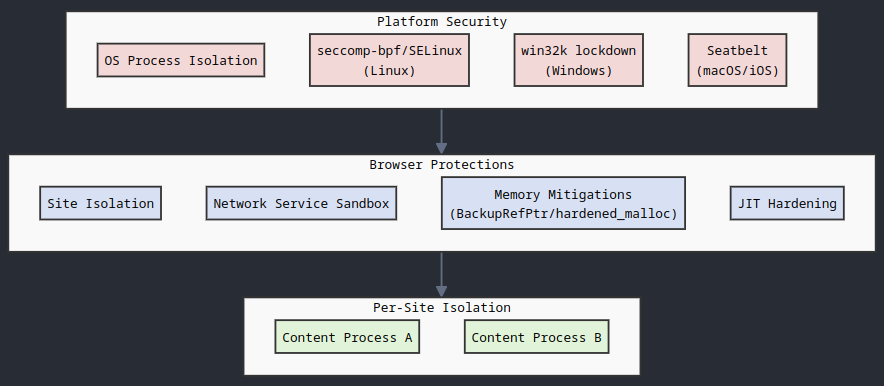
<li>Strong multi-process architecture (Site Isolation)</li>
<li>Robust sandboxing (seccomp-bpf on Linux, win32k lockdown on Windows, etc.)</li>
<li>Frequent updates (~4-week release cycle), tight zero-day patch turnaround</li>
<li>Memory safety moves: Rust integration in selected components, advanced mitigations like Control Flow Integrity (CFI), AddressSanitizer in dev builds</li>
</ul>
</li>
<li><strong>Recent Innovations</strong>:
<ul>
<li><strong>BackupRefPtr</strong> and “MiraclePtr” in PartitionAlloc to defeat use-after-free bugs</li>
<li>Dedicated Network Service Sandbox</li>
<li>Fine-grained site isolation (one process per domain/iframe group)</li>
</ul>
</li>
</ul>
<h3 id="gecko-firefox">Gecko (Firefox)</h3>
<ul>
<li><strong>Maintainer</strong>: Mozilla Foundation</li>
<li><strong>Used By</strong>: Mozilla Firefox, Tor Browser</li>
<li><strong>Security Highlights</strong>:
<ul>
<li>Ongoing multi-process expansion (“Electrolysis” → “Fission” for site isolation)</li>
<li>Heavy Rust usage (CSS, URL parsing, AV1 decoder), RLBox library sandboxing</li>
<li>ESR (Extended Support Release) for enterprise and Tor</li>
</ul>
</li>
<li><strong>Known Gaps</strong>:
<ul>
<li>Historically weaker sandbox than Chromium, especially on Linux/Android</li>
<li>Fission not yet as mature as Chromium’s site-per-process approach</li>
<li>Android Firefox does not use <code>isolatedProcess</code>, weakening content-process isolation</li>
</ul>
</li>
</ul>
<h3 id="webkit-safari">WebKit (Safari)</h3>
<ul>
<li><strong>Maintainer</strong>: Apple + open-source</li>
<li><strong>Used By</strong>: Safari on macOS/iOS, and all iOS-based browsers (App Store policy)</li>
<li><strong>Security Highlights</strong>:
<ul>
<li>Process separation (UI vs. WebContent)</li>
<li>Deep OS-level integration (Pointer Authentication on ARM64, strict code signing on iOS)</li>
<li>JIT hardening in JavaScriptCore</li>
</ul>
</li>
<li><strong>Release Model</strong>:
<ul>
<li>Often tied to Apple’s OS updates, though Apple can ship out-of-band fixes</li>
<li>Site isolation is more limited than Chromium’s, but offset by strong OS-level sandbox entitlements and pointer authentication</li>
</ul>
</li>
</ul>
<h2 id="vanadium-hardened-chromium-for-grapheneos">Vanadium: Hardened Chromium for GrapheneOS</h2>
<p><a href="https://grapheneos.org"><strong>GrapheneOS</strong></a> is a security-focused Android-based OS that tightens SELinux policies, app permissions, and compiler hardening. <strong>Vanadium</strong> is its default browser and system WebView—<strong>a hardened Chromium fork</strong> specialized for Android.</p>
<ol>
<li><strong>Strict Site Isolation</strong> on Android, matching desktop Chrome (Android Chrome often relaxes it to save RAM).</li>
<li><strong>Aggressive Exploit Mitigations</strong>:
<ul>
<li>Zero-initialization of local variables (disabled in stock Chrome for performance)</li>
<li>Type-based CFI, stronger stack canaries</li>
<li>Upstream features like BackupRefPtr in PartitionAlloc are fully enabled.</li>
</ul>
</li>
<li><strong>OS-Level Synergy</strong>:
<ul>
<li>Each Vanadium renderer runs as an <code>isolatedProcess</code> under GrapheneOS, restricting syscalls beyond Chrome’s defaults.</li>
<li>GrapheneOS adds toggles for system sensors, microphone, camera, etc., which complements Vanadium’s security posture.</li>
</ul>
</li>
</ol>
<p>By integrating with GrapheneOS’s broader OS-level approach, <strong>Vanadium</strong> significantly raises the bar for exploit success on mobile devices. However, Vanadium is exclusive to GrapheneOS—stock Android does not provide this level of per-process hardening.</p>
<h2 id="trivalent-hardened-chromium-for-desktop-linux">Trivalent: Hardened Chromium for Desktop Linux</h2>
<p>While Vanadium focuses on Android, <strong>Trivalent</strong> targets <strong>desktop Linux</strong> with a similarly hardened Chromium approach. Developed by <a href="https://github.com/secureblue/secureblue">secureblue</a> and inspired by Vanadium, Trivalent uses Fedora’s Chromium RPM as a base, then applies a suite of security-minded patches and configuration changes:</p>
<ul>
<li><strong>Desktop-Relevant Patches from Vanadium</strong>:<br>
Trivalent adopts or adapts Vanadium’s security enhancements where relevant to desktop environments (e.g., stricter sandbox flags, forced site isolation).</li>
<li><strong>Integration with <a href="https://github.com/GrapheneOS/hardened_malloc">hardened_malloc</a></strong>:<br>
Bundled with secureblue’s packages, giving better heap protections and runtime checks than typical system allocators.</li>
<li><strong>Opt-In Secondary Features</strong>:
<ul>
<li>Password manager, search suggestions, and usage metrics are disabled or made optional.</li>
<li>The idea is to remove potential privacy or data collection surfaces unless specifically enabled by the user.</li>
</ul>
</li>
<li><strong>Additional Hardening Flags</strong>:
<ul>
<li><code>chrome://flags/#show-punycode-domains</code> (prevents IDN homograph attacks)</li>
<li><code>chrome://flags/#clear-cross-origin-referrers</code> (reduces cross-site tracking/leakage)</li>
<li>Strict popup blocking, network service sandbox toggles, etc.</li>
</ul>
</li>
</ul>
<p>Trivalent is especially interesting for users on Fedora or other RPM-based Linux distros, though it may be ported or used on others. While it’s not an official GrapheneOS product, Trivalent’s approach aligns with Vanadium: <strong>retain Chrome’s robust security baseline and add further compiler, runtime, and build-time hardening</strong>.</p>
<h2 id="process-architecture--sandboxing">Process Architecture &amp; Sandboxing</h2>
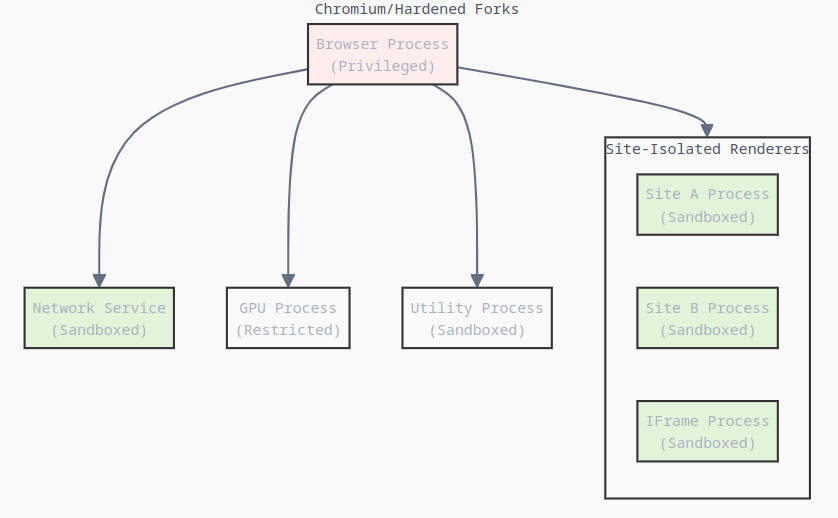
<h3 id="chromium--its-hardened-forks-vanadium-trivalent">Chromium &amp; Its Hardened Forks (Vanadium, Trivalent)</h3>
<ul>
<li><strong>Site-Per-Process (Site Isolation)</strong>:<br>
Each site runs in its own renderer, enforced by a strict inter-process communication model. Attackers escaping one site’s sandbox typically cannot pivot to another.</li>
<li><strong>Sandbox Depth</strong>:
<ul>
<li>On Linux, <strong>seccomp-bpf</strong> restricts syscall usage to a minimal subset.</li>
<li>On Windows, <strong>win32k lockdown</strong> cuts off a large chunk of kernel attack surface.</li>
<li>On macOS, Chromium integrates with seatbelt entitlements.</li>
</ul>
</li>
<li><strong>Network Service Sandbox</strong>:
<ul>
<li>A separate process for network tasks is heavily locked down, reducing the risk of turning protocol parser bugs into OS-level compromises.</li>
</ul>
</li>
<li><strong>Desktop vs. Mobile</strong>:
<ul>
<li><strong>Trivalent</strong> enforces these sandbox policies on Linux desktops, occasionally enabling extra flags like stricter GPU process isolation.</li>
<li><strong>Vanadium</strong> uses <code>isolatedProcess</code> for each renderer on Android, matching or exceeding desktop-level isolation.</li>
</ul>
</li>
</ul>
<p><img loading="lazy" src="/images/content/blog-security-browser-engine-security-comparison-2683e8c5-8491-4293-a080-d7a8ba7f84e0.png" alt="image" />
</p>
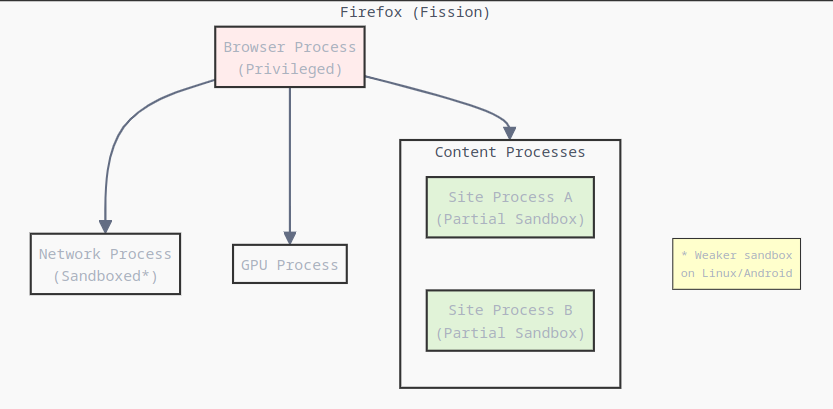
<h3 id="firefox-gecko">Firefox (Gecko)</h3>
<ul>
<li><strong>Fission</strong>:
<ul>
<li>Rolling out site isolation, still behind Chromium in coverage and maturity.</li>
</ul>
</li>
<li><strong>Sandbox Shortcomings</strong>:
<ul>
<li>On Linux, content processes can access X11, PulseAudio, etc., which are known sandbox-escape vectors.</li>
<li>On Android, there’s no usage of <code>isolatedProcess</code> for the renderer.</li>
</ul>
</li>
<li><strong>RLBox</strong>:
<ul>
<li>Sandboxes certain risky libraries in WebAssembly, preventing direct memory corruption from impacting the main process. It’s an interesting approach but doesn’t fully compensate for weaker multi-process architecture.</li>
</ul>
</li>
</ul>
<p><img loading="lazy" src="/images/content/blog-security-browser-engine-security-comparison-bf59f6e4-7483-486f-a62d-b2aac8eab1d5.png" alt="image" />
</p>
<h3 id="safari-webkit">Safari (WebKit)</h3>
<ul>
<li><strong>Multi-Process</strong> with UI vs. WebContent separation.</li>
<li><strong>Tight Integration</strong>:
<ul>
<li>On iOS, the entire app environment is heavily sandboxed, plus Pointer Authentication on Apple Silicon.</li>
<li>On macOS, Safari’s sandbox also leverages system entitlements, though not as granular as Chromium’s site-per-process.</li>
</ul>
</li>
<li><strong>JIT Hardening</strong>:
<ul>
<li>JavaScriptCore uses pointer authentication on ARM64, limiting trivial code reuse attacks.</li>
<li>Apple invests heavily in in-house fuzzing, though less is publicly documented.</li>
</ul>
</li>
</ul>
<hr>
<h3 id="security-boundaries-overview">Security Boundaries Overview</h3>
<p><img loading="lazy" src="/images/content/blog-security-browser-engine-security-comparison-76d3ac40-73bb-43f8-9c1e-50abfede38a9.png" alt="image" />
</p>
<hr>
<h2 id="memory-safety--exploit-mitigations">Memory Safety &amp; Exploit Mitigations</h2>
<h3 id="backuprefptr-miracleptr--hardened-allocators">BackupRefPtr, MiraclePtr &amp; Hardened Allocators</h3>
<ul>
<li><strong>Chromium &amp; Forks</strong>:
<ul>
<li><strong>PartitionAlloc</strong> + <strong>BackupRefPtr</strong>: Prevents silent pointer invalidation, mitigating a key class of use-after-free exploits.</li>
<li><strong>MiraclePtr</strong>: Potential future reference-counted approach.</li>
<li><strong>hardened_malloc</strong>: In Trivalent’s desktop context, bundling with <strong>hardened_malloc</strong> can drastically reduce exploit viability by forcing deterministic crash or detection on memory corruption.</li>
</ul>
</li>
<li><strong>Firefox</strong>:
<ul>
<li>Relies on Rust for new components, but older C++ code doesn’t benefit from something like BackupRefPtr.</li>
<li>mozjemalloc is not as hardened as PartitionAlloc with advanced pointer protection.</li>
</ul>
</li>
<li><strong>WebKit (Safari)</strong>:
<ul>
<li>Mostly uses system allocators on macOS/iOS. Apple is rumored to be exploring memory tagging or other hardware-based checks, but details are sparse.</li>
</ul>
</li>
</ul>
<h3 id="javascript-engines">JavaScript Engines</h3>
<p>All modern browsers rely on powerful JIT compilers, each with its own design:</p>
<ul>
<li><strong>V8 (Chromium, Vanadium, Trivalent)</strong>
<ul>
<li>Uses TurboFan and other optimization pipelines.</li>
<li>Enforces W^X (no memory region is writable and executable at the same time).</li>
<li>Integrates with OS-level mitigations on Windows, macOS, Linux, and Android.</li>
</ul>
</li>
<li><strong>SpiderMonkey (Firefox)</strong>
<ul>
<li>Uses IonMonkey/Warp for optimization.</li>
<li>RLBox in Firefox can sandbox some third-party libraries, but it’s not used for the entire JIT pipeline.</li>
</ul>
</li>
<li><strong>JavaScriptCore (Safari)</strong>
<ul>
<li>Uses the FTL JIT pipeline.</li>
<li>On Apple Silicon, leverages Pointer Authentication to cryptographically sign code pointers.</li>
</ul>
</li>
</ul>
<p>Key mitigations across engines often include pointer authentication (on supported hardware), guard pages, constant blinding, and fuzzing. <strong>Vanadium</strong> and <strong>Trivalent</strong> inherit V8’s advanced JIT mitigations from upstream Chromium, with additional sandbox or build-time hardening where possible.</p>
<h2 id="additional-privacy--usability-considerations">Additional Privacy &amp; Usability Considerations</h2>
<h3 id="avoiding-privacy-theater">Avoiding “Privacy Theater”</h3>
<ul>
<li>Overloading browsers with privacy-centric add-ons often backfires by making your configuration more unique and fingerprintable.</li>
<li>Vanadium, Trivalent, and many hardened browser efforts prefer <strong>secure defaults</strong> with minimal code or extension overhead. They typically disable or make optional telemetry, password managers, or search suggestions that phone home by default—striking a balance between privacy and maintainable security.</li>
</ul>
<h3 id="tor-browser-vs-hardened-chromium-forks">Tor Browser vs. Hardened Chromium Forks</h3>
<ul>
<li><strong>Tor Browser</strong> tries to unify fingerprints but is still based on Firefox, which has weaker sandboxing.</li>
<li><strong>Trivalent</strong> or <strong>Vanadium</strong> can be combined with a local or external Tor proxy/VPN, yet benefit from the robust multi-process architecture and advanced exploit mitigations in Chromium.</li>
<li>If anonymity is top priority, you might still prefer Tor Browser. But for raw exploit resistance, hardened Chromium forks typically outpace it.</li>
</ul>
<h2 id="browser-extension-security-models">Browser Extension Security Models</h2>
<p>Extension frameworks can broaden a browser’s functionality but also introduce new attack surfaces. The major engines approach extension security differently:</p>
<ul>
<li><strong>Chromium (Manifest V2 → V3)</strong>
<ul>
<li>Migrating from Manifest V2 to V3, restricting certain APIs (like background scripts, network request modifications) to reduce abuse.</li>
<li>Sandboxes extensions to limit direct OS access. Still, a malicious extension can pose risks if it gains sufficient permissions.</li>
</ul>
</li>
<li><strong>Firefox (WebExtensions)</strong>
<ul>
<li>Aims for Chrome compatibility with “WebExtensions,” but supports some legacy APIs.</li>
<li>Security model is somewhat stricter than older XUL-based extensions but can still be a vector for attacks or privacy leaks.</li>
</ul>
</li>
<li><strong>Safari (Safari Web Extensions)</strong>
<ul>
<li>Generally aligned with the WebExtensions model, but with Apple’s own provisioning approach.</li>
<li>Extensions must be signed and distributed via Apple’s channels on iOS, adding an extra layer of gatekeeping.</li>
</ul>
</li>
</ul>
<p>Hardened forks like <strong>Vanadium</strong> or <strong>Trivalent</strong> may disable or limit extension functionality by default—or allow them only under certain conditions—to reduce the overall attack surface. In all cases, extension curation and strong permission boundaries are essential for safe usage.</p>
<h2 id="supply-chain-security--reproducible-builds">Supply Chain Security &amp; Reproducible Builds</h2>
<ul>
<li><strong>Vanadium</strong>
<ul>
<li>Ships as part of GrapheneOS, which aims for reproducible builds and close upstream tracking of Chromium changes.</li>
<li>GrapheneOS is open source, so the entire build process is transparent, albeit specialized for Pixel devices.</li>
</ul>
</li>
<li><strong>Trivalent</strong>
<ul>
<li>Provided by <a href="https://github.com/secureblue/secureblue">secureblue</a> via Fedora COPR or direct RPMs.</li>
<li>Desktop-based approach to keep patches consistent, tested for each new Chromium release.</li>
<li>Encourages reproducible build techniques so that others can verify the binaries match the published source.</li>
</ul>
</li>
<li><strong>Firefox &amp; Safari</strong>
<ul>
<li>Mozilla publishes frequent security advisories and open-source code; some parts of the build can be verified reproducibly, but it’s not fully guaranteed for all releases.</li>
<li>Apple’s model is more closed; Safari updates are often tied to macOS/iOS releases, although out-of-band patches do appear. Reproducibility is limited to Apple’s internal processes.</li>
</ul>
</li>
</ul>
<h2 id="emerging-trends--future-directions">Emerging Trends &amp; Future Directions</h2>
<ol>
<li><strong>Expanded Memory Tagging</strong>
<ul>
<li>Apple’s rumored memory tagging might soon be mirrored on ARM-based Linux or Android devices, further containing heap corruption.</li>
</ul>
</li>
<li><strong>Advanced Sandbox Layers</strong>
<ul>
<li>Chrome’s Network Service Sandbox could be a precursor to even more service-specific sandboxes (e.g., PDF or font isolation).</li>
<li>Firefox continues exploring process priority management and RLBox expansions.</li>
</ul>
</li>
<li><strong>Ephemeral or Containerized Browsing</strong>
<ul>
<li>Desktop OSes like Qubes OS push ephemeral VMs for each browsing session. Mobile and standard Linux might adopt smaller “container” approaches.</li>
</ul>
</li>
<li><strong>Increasing Rust or Memory-Safe Rewrites</strong>
<ul>
<li>Chromium is expanding Rust usage, while Mozilla doubles down on it. WebKit’s public progress is less clear.</li>
</ul>
</li>
</ol>
<h2 id="conclusions">Conclusions</h2>
<p><strong>Chromium</strong> stands out for its rigorous sandbox, advanced site isolation, and continuous exploit mitigations.</p>
<p>Among <strong>hardened forks</strong>:</p>
<ul>
<li>
<p><strong>Vanadium</strong> (GrapheneOS) shows what’s possible on <strong>Android</strong>:</p>
<ul>
<li>Strict site isolation, aggressive compiler flags, synergy with GrapheneOS’s <code>isolatedProcess</code> usage.</li>
<li>Continual patches from upstream, with security-driven customizations for negligible performance cost.</li>
</ul>
</li>
<li>
<p><strong>Trivalent</strong> (Desktop Linux) offers a <strong>similar</strong> approach:</p>
<ul>
<li>Desktop-centric patches inspired by Vanadium, integrating <strong>hardened_malloc</strong> and extra security toggles.</li>
<li>Minimizes or opts out of features that might reduce security or add unneeded telemetry.</li>
<li>Especially appealing on Fedora or RPM-based distributions looking for a secure, hardened Chromium replacement.</li>
</ul>
</li>
</ul>
<p><strong>Brave</strong> also deserves mention as a popular Chromium-based browser. It focuses on <strong>privacy features</strong>—such as built-in ad and tracker blocking, plus Tor integration in private windows—yet it still benefits from Chromium’s sandbox. It’s generally <strong>not as hardened</strong> against exploits. Still, <strong>Brave</strong> remains a strong choice for users seeking an easier out-of-the-box privacy experience over standard Chrome.</p>
<p>Ultimately, if <strong>raw exploit resistance</strong> is your goal, a hardened Chromium variant—like <strong>Vanadium</strong> on GrapheneOS or <strong>Trivalent</strong> on desktop Linux—provides some of the best defenses available today. Coupled with responsible user practices, these projects represent a leading edge of browser security, bridging upstream progress with deeper, platform-specific hardening.</p>
<h2 id="references--further-reading">References &amp; Further Reading</h2>
<ul>
<li><a href="https://www.chromium.org/Home/chromium-security/">Chromium Security Documentation</a></li>
<li><a href="https://wiki.mozilla.org/Project_Fission">Mozilla Fission (Site Isolation)</a></li>
<li><a href="https://webkit.org/category/security/">WebKit Security Policy</a></li>
<li><a href="https://github.com/GrapheneOS/Vanadium">Vanadium on GrapheneOS</a></li>
<li><a href="https://github.com/secureblue/Trivalent">Trivalent on GitHub</a></li>
<li><a href="https://github.com/GrapheneOS/hardened_malloc">hardened_malloc by GrapheneOS</a></li>
<li><a href="https://chromium.googlesource.com/chromium/src/+/ddc017f9569973a731a574be4199d8400616f5a5/base/memory/raw_ptr.md">BackupRefPtr &amp; MiraclePtr in Chromium</a></li>
<li><a href="https://blog.mozilla.org/attack-and-defense/2021/12/06/webassembly-and-back-again-fine-grained-sandboxing-in-firefox-95">Firefox Sandboxing (Mozilla Blog)</a></li>
<li><a href="https://developer.arm.com/-/media/Arm%20Developer%20Community/PDF/Arm_Memory_Tagging_Extension_Whitepaper.pdf">ARM Memory Tagging</a></li>
<li><a href="https://www.qubes-os.org/doc/disposablevm/">Qubes OS Documentation on Disposable VMs</a></li>
<li><a href="https://developer.chrome.com/docs/extensions/mv3/intro/">Chrome Manifest V3 Overview</a></li>
</ul>
]]></content>
      </entry>
      <entry>
        <title>Cyber Security Is a Game of Chess: Strategy, Anticipation, and the Battle of Wits</title>
        <link rel="alternate" href="https://profincognito.me/blog/security/cyber-security-chess-strategy/" />
        <id>https://profincognito.me/blog/security/cyber-security-chess-strategy/</id>
        <published>2026-03-04T00:00:00Z</published>
        <updated>2026-06-10T15:20:29-07:00</updated>
        <summary type="html">Explore how the strategic principles of chess apply to cyber security. Learn how anticipation, adaptability, and strategic thinking can help organizations stay ahead in the digital security landscape.</summary>
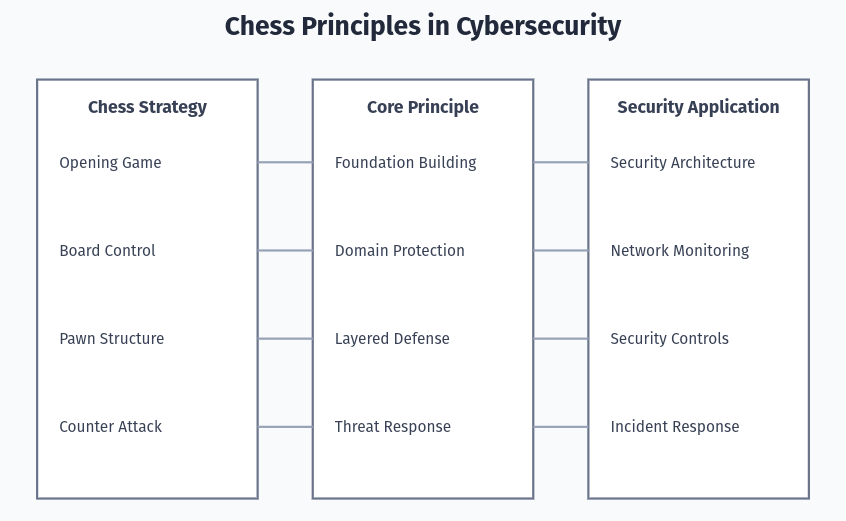
          <content type="html"><![CDATA[<p>When the <strong>NotPetya</strong> cyberattack struck in 2017, it spread across networks with the precision of a grandmaster executing a flawless chess strategy. Organizations worldwide were caught off-guard, leading to billions in damages. This watershed moment in cybersecurity history demonstrates how cyber security is much like a high-stakes game of chess—professionals must anticipate their opponent&rsquo;s moves, develop robust strategies, and sometimes make sacrifices to protect their most valuable assets. The parallels between cyber security and chess are profound, offering valuable insights into how organizations can better defend themselves in an ever-evolving digital landscape.</p>
<p><img loading="lazy" src="/images/content/blog-security-cyber-security-chess-strategy-6b244ce1-1c30-410a-ad4c-640405eb7dec.png" alt="Chess and Cybersecurity Strategic Matrix" />
</p>
<h2 id="the-opening-moves-establishing-a-strong-defense">The Opening Moves: Establishing a Strong Defense</h2>
<p>In chess, the opening moves set the tone for the entire game. Players position their pieces strategically, aiming to control the board and protect key assets. Similarly, in cyber security, establishing a strong defense from the outset is crucial.</p>
<ul>
<li><strong>Implement Robust Firewalls</strong>: Utilizing advanced configurations like <strong>Next-Generation Firewalls (NGFWs)</strong> provides deep packet inspection, intrusion prevention, and application awareness—akin to deploying knights and bishops to guard critical squares early in the game.</li>
<li><strong>Deploy Antivirus and Anti-Malware Solutions</strong>: Tools such as <strong>Endpoint Detection and Response (EDR)</strong> systems act like pawns guarding the king, detecting and neutralizing threats before they infiltrate deeper into the network.</li>
<li><strong>Enforce Secure Configurations</strong>: Adopting security frameworks like <strong>CIS Benchmarks</strong> ensures systems are configured to minimize vulnerabilities, much like a chess player meticulously arranging their pieces for optimal defense.</li>
</ul>
<p><em>Real-World Example</em>: The <strong>2023 MOVEit Transfer breach</strong> affected thousands of organizations worldwide, demonstrating how a single vulnerability in a widely-used file transfer tool can lead to widespread data compromise. This incident reinforces the importance of maintaining robust security configurations and rapid patch management.</p>
<p>By establishing a strong defensive position early on, organizations can deter opportunistic attacks and reduce the attack surface.</p>
<h2 id="understanding-your-opponent-the-art-of-threat-intelligence">Understanding Your Opponent: The Art of Threat Intelligence</h2>
<p>A skilled chess player studies their opponent&rsquo;s past games to anticipate strategies and tactics. In cyber security, understanding potential threats and adversaries is essential.</p>
<ul>
<li><strong>Threat Intelligence Gathering</strong>: Utilizing platforms like <strong>MITRE ATT&amp;CK</strong> helps collect data on emerging threats, aiding in the anticipation of attack methods.</li>
<li><strong>Analyzing Attack Vectors</strong>: Employing tools such as <strong>Security Information and Event Management (SIEM)</strong> systems allows for understanding how attackers exploit vulnerabilities, enabling stronger defenses.</li>
<li><strong>Profiling Adversaries</strong>: Identifying potential attackers—be it cybercriminals, insider threats, or nation-states—helps tailor the level of security required.</li>
</ul>
<p><em>Real-World Example</em>: The rising prominence of ransomware-as-a-service (RaaS) operations in 2023 has transformed the threat landscape, requiring organizations to adapt their defense strategies against increasingly sophisticated and organized criminal enterprises.</p>
<p>Knowledge of the opponent enhances the ability to predict and prevent potential attacks, much like foreseeing an opponent&rsquo;s move in chess.</p>
<h2 id="anticipation-and-strategy-staying-one-step-ahead">Anticipation and Strategy: Staying One Step Ahead</h2>
<p>Chess is a game of foresight, where players think several moves ahead. Cyber security demands a similar proactive approach.</p>
<ul>
<li><strong>Regular Vulnerability Assessments</strong>: Conducting assessments with tools like <strong>Nessus</strong> or <strong>OpenVAS</strong> helps identify weaknesses before attackers do, allowing for prompt patching.</li>
<li><strong>Penetration Testing</strong>: Simulating attacks using methodologies like <strong>OWASP Top Ten</strong> evaluations helps in assessing the effectiveness of existing security measures.</li>
<li><strong>Proactive Monitoring</strong>: Implementing <strong>Intrusion Detection Systems (IDS)</strong> and <strong>Intrusion Prevention Systems (IPS)</strong> ensures continuous network monitoring to detect unusual activities indicative of a breach.</li>
</ul>
<p><em>Real-World Example</em>: <strong>Microsoft&rsquo;s</strong> recent implementation of AI-powered threat detection in Microsoft 365 Defender demonstrates how organizations are leveraging advanced technologies to anticipate and prevent emerging threats.</p>
<p>By anticipating potential threats, cyber security professionals can implement strategies that mitigate risks before they materialize.</p>
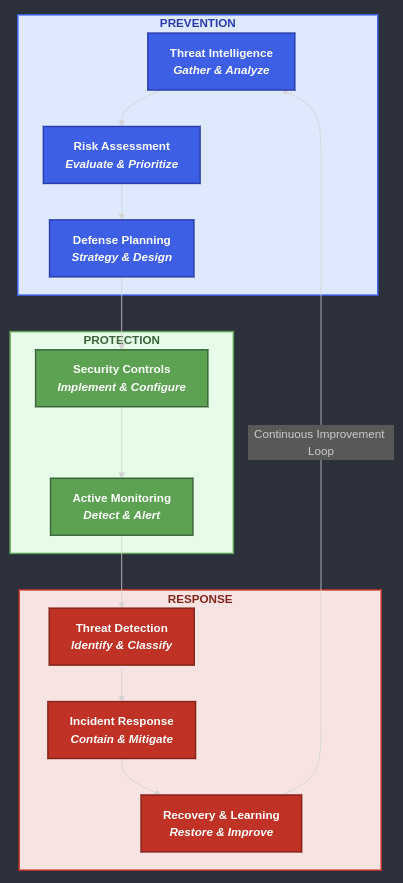
<p><img loading="lazy" src="/images/content/blog-security-cyber-security-chess-strategy-bc4de073-634a-41a4-8f68-3bd1c5182a57.png" alt="Strategic Defense Cycle" />
</p>
<h2 id="adaptability-responding-to-an-ever-changing-landscape">Adaptability: Responding to an Ever-Changing Landscape</h2>
<p>No chess game unfolds exactly the same way, requiring players to adapt their strategies on the fly. The cyber threat landscape is equally dynamic.</p>
<ul>
<li><strong>Emerging Threats</strong>: Staying updated on new malware, phishing techniques, and zero-day exploits is crucial. Utilizing <strong>Advanced Threat Protection (ATP)</strong> solutions helps in adapting defenses.</li>
<li><strong>Technological Advancements</strong>: The evolution of AI, quantum computing, and IoT devices introduces new vulnerabilities. Implementing <strong>Zero Trust Architecture</strong> ensures security regardless of technology stack or location.</li>
<li><strong>Regulatory Changes</strong>: Compliance with regulations like <strong>GDPR</strong>, <strong>CCPA</strong>, and emerging AI governance frameworks necessitates continuous adjustments in security policies and practices.</li>
</ul>
<p><em>Real-World Example</em>: The widespread adoption of AI tools in 2023 has introduced new security challenges, from prompt injection attacks to data poisoning, requiring organizations to develop novel defense strategies for these emerging threats.</p>
<p>Adaptability ensures that defenses remain robust against the latest threats, just as a chess player adjusts their tactics in response to the opponent&rsquo;s moves.</p>
<h2 id="sacrifices-for-greater-gain-risk-management-and-prioritization">Sacrifices for Greater Gain: Risk Management and Prioritization</h2>
<p>In chess, sacrificing a lesser piece can be a strategic move to protect more valuable ones or gain a positional advantage. In cyber security:</p>
<ul>
<li><strong>Accepting Certain Risks</strong>: Recognizing that it&rsquo;s impractical to secure everything equally, organizations may accept minor risks to focus on protecting critical assets.</li>
<li><strong>Resource Allocation</strong>: Prioritizing resources to secure customer data over less sensitive information ensures effective use of limited resources.</li>
<li><strong>Implementing Least Privilege Access</strong>: Limiting user access rights minimizes potential damage from compromised accounts, similar to controlling key squares on the chessboard.</li>
</ul>
<p><em>Real-World Example</em>: Many organizations now implement passwordless authentication despite the initial complexity and user adjustment period, recognizing that this &ldquo;sacrifice&rdquo; of convenience strengthens overall security posture.</p>
<p>These calculated decisions help maintain overall security posture without overextending resources.</p>
<h2 id="the-endgame-incident-response-and-recovery">The Endgame: Incident Response and Recovery</h2>
<p>As a chess game approaches its conclusion, precision becomes critical. In cyber security:</p>
<ul>
<li><strong>Incident Response Planning</strong>: Developing a plan aligned with frameworks like <strong>NIST SP 800-61</strong> ensures quick and effective action when a breach occurs.</li>
<li><strong>Disaster Recovery</strong>: Regular backups and recovery procedures using solutions like <strong>Disaster Recovery as a Service (DRaaS)</strong> minimize downtime and data loss.</li>
<li><strong>Post-Incident Analysis</strong>: Conducting thorough <strong>root cause analysis</strong> helps in strengthening defenses against future attacks.</li>
</ul>
<p><em>Real-World Example</em>: The swift response to the 2023 ChatGPT data breach, where OpenAI temporarily shut down the service to address a critical vulnerability, demonstrates the importance of having well-prepared incident response procedures.</p>
<p>The endgame in cyber security focuses on mitigating damage and restoring normal operations, akin to securing a checkmate.</p>
<h2 id="conclusion-embracing-the-strategic-mindset-in-cyber-security">Conclusion: Embracing the Strategic Mindset in Cyber Security</h2>
<p>The strategic principles of chess provide invaluable insights for modern cybersecurity practices. By approaching digital security with the same level of strategic thinking, organizations can better prepare for, prevent, and respond to cyber threats.</p>
<p>In today&rsquo;s rapidly evolving threat landscape, this strategic approach enables security professionals to think several moves ahead, anticipating attacks while maintaining the flexibility to adapt to new challenges. Success in cybersecurity, like chess, ultimately comes down to strategic thinking, careful preparation, and the ability to execute under pressure.</p>
<hr>
]]></content>
      </entry>
      <entry>
        <title>Inside the Signal Protocol’s Security Architecture: A Technical Deep Dive</title>
        <link rel="alternate" href="https://profincognito.me/blog/security/signal-security-architecture/" />
        <id>https://profincognito.me/blog/security/signal-security-architecture/</id>
        <published>2026-03-04T00:00:00Z</published>
        <updated>2026-06-10T15:20:29-07:00</updated>
        <summary type="html">A comprehensive, technical exploration of the Signal Protocol’s cryptographic underpinnings, including PQXDH for post-quantum resistance, formal verification references, performance benchmarks, secure memory management best practices, and additional considerations such as user verification, multi-device security, ephemeral messaging, reproducible builds, and future standards.</summary>
          <content type="html"><![CDATA[<p><strong>Audience</strong>: This post is intended for security researchers, cryptographers, and engineers with a deep interest in the technical underpinnings of secure messaging protocols. It assumes familiarity with modern cryptographic primitives, end-to-end encryption (E2EE), forward secrecy concepts, post-compromise security, post-quantum cryptography, formal verification tools (like ProVerif and Tamarin), secure software development practices, and related operational considerations (such as reproducible builds and user verification methods).</p>
<p><strong>Scope</strong>: This analysis reflects the state of the Signal Protocol as of late 2024. It covers foundational concepts such as the Double Ratchet and X3DH, the introduction of PQXDH (Post-Quantum X3DH), formal verification efforts, platform-specific memory-hardening techniques, hardware-backed key management, user verification methods (Safety Numbers), multi-device session handling, ephemeral messages, security boundaries, supply chain security considerations, known implementation pitfalls, and potential future evolutions (including references to MLS). While comprehensive, this post should be supplemented by the latest official specifications, recent academic research, code-level audits, benchmark results, formal verification artifacts, and community analyses.</p>
<p><strong>Disclaimer</strong>: The Signal ecosystem and the Signal Protocol are actively maintained and improved. Parameters, code details, and protocol enhancements may have changed since this writing. Verify specifics against the latest official Signal documentation, code commits, NIST PQC standards, research papers, and audit reports. Peer review by cryptography experts is recommended prior to relying on these details for critical security decisions.</p>
<hr>
<h2 id="1-introduction-and-threat-model">1. Introduction and Threat Model</h2>
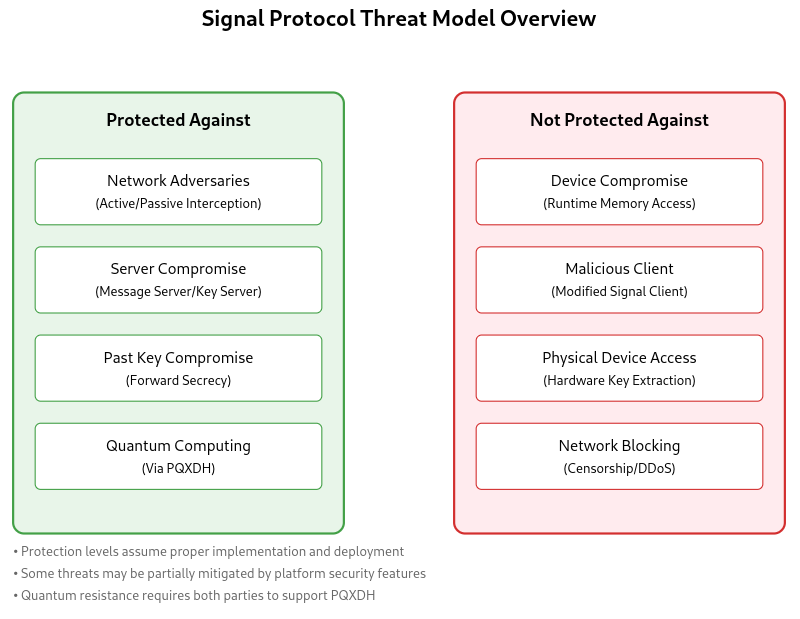
<p>The <strong>Signal Protocol</strong>, widely recognized for powering Signal Messenger and other secure messaging apps, is designed to ensure that messages and calls remain confidential and tamper-resistant against a wide range of adversaries.</p>
<ul>
<li>
<p><strong>Protected Against</strong>:</p>
<ul>
<li>Passive and active network adversaries</li>
<li>Server compromises</li>
<li>Retrospective decryption of past messages (with forward secrecy and PQXDH)</li>
<li>Attempts to impersonate users without their private keys</li>
</ul>
</li>
<li>
<p><strong>Not Protected Against</strong>:</p>
<ul>
<li>Full device compromise at runtime (e.g., reading decrypted messages from RAM)</li>
<li>Large-scale network blocking</li>
<li>Physical exfiltration of keys from secure hardware</li>
</ul>
</li>
</ul>
<p>Future-proofing against large-scale quantum adversaries is now part of the threat model, with <strong>PQXDH</strong> ensuring that even if a quantum computer becomes capable of breaking elliptic curve assumptions, the post-quantum KEM layer will preserve message confidentiality.</p>
<p><img loading="lazy" src="/images/content/blog-security-signal-security-architecture-187de5ee-0680-4e14-951b-730df5c2e35e.png" alt="Signal Protocol Threat Model Overview" />
</p>
<p><em>Overview of the Signal Protocol threat model, highlighting the distinction between threats it mitigates (e.g., network-level attacks, server compromise) and those out of scope (e.g., active device compromise).</em></p>
<h2 id="2-key-security-properties">2. Key Security Properties</h2>
<ol>
<li><strong>End-to-End Encryption (E2EE)</strong>: Only intended recipients can read messages.</li>
<li><strong>Forward Secrecy</strong>: Compromise of long-term keys does not reveal past messages.</li>
<li><strong>Post-Compromise Security</strong>: After a device compromise, once keys ratchet forward, future messages remain secure.</li>
<li><strong>Deniability</strong>: The protocol design prevents creating cryptographic evidence that unequivocally ties messages to a particular identity key.</li>
<li><strong>Post-Quantum Resistance</strong>: PQXDH ensures future quantum capabilities do not retroactively break current message confidentiality.</li>
</ol>
<h2 id="3-keys-and-identities">3. Keys and Identities</h2>
<ul>
<li><strong>Identity Keys</strong>: Long-term Curve25519 keys signed via Ed25519.</li>
<li><strong>Signed Prekeys</strong>: Medium-term Curve25519 keys uploaded to the server.</li>
<li><strong>One-Time Prekeys</strong>: Short-lived Curve25519 keys used once per handshake.</li>
</ul>
<p><strong>Hardware Security</strong>:</p>
<ul>
<li><strong>Android</strong>: StrongBox or KeyMaster for hardware-backed keys</li>
<li><strong>iOS</strong>: Secure Enclave for private key operations</li>
<li><strong>Desktop</strong>: OS-level secure storage and memory isolation</li>
</ul>
<p>Keys are never stored in plaintext if hardware support is present. Ephemeral private keys and intermediate values are zeroized after use, helping to prevent compromise by runtime memory inspection.</p>
<h2 id="4-initial-session-setup-x3dh">4. Initial Session Setup (X3DH)</h2>
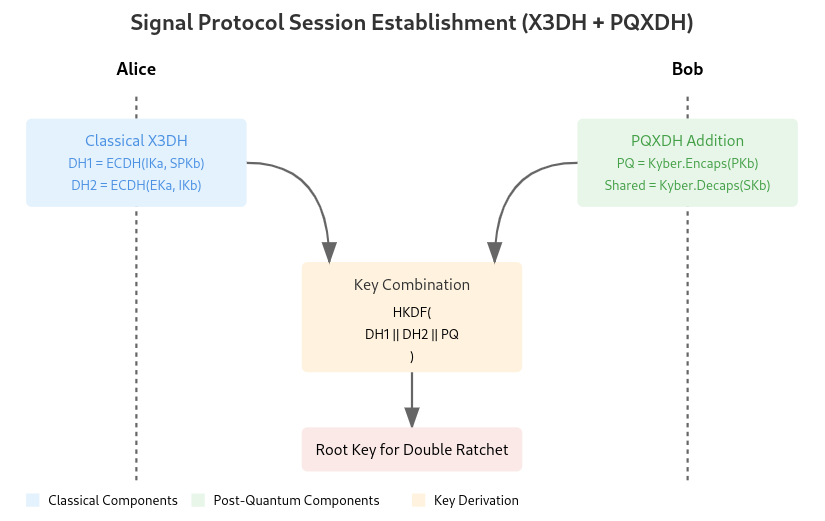
<p><strong>X3DH</strong> (Extended Triple Diffie-Hellman) establishes a shared secret without prior contact. It combines multiple Diffie-Hellman operations (DH1–DH4) that feed into an HKDF to derive a root key. Historically, X3DH relies solely on elliptic curve assumptions (X25519).</p>
<p><img loading="lazy" src="/images/content/blog-security-signal-security-architecture-a24c83ed-3342-4e39-89e6-8263bfe16f91.png" alt="Signal Protocol Session Establishment (X3DH &#43; PQXDH)" />
</p>
<p><em>X3DH and PQXDH combined handshake flow. The classical X3DH components (left) provide immediate security while the PQXDH addition (right) provides quantum resistance. Both feed secrets into HKDF to derive the Double Ratchet’s root key.</em></p>
<h2 id="5-pqxdh-introducing-post-quantum-resistance">5. PQXDH: Introducing Post-Quantum Resistance</h2>
<h3 id="rationale">Rationale</h3>
<p>X3DH’s classical security may be broken in a future where quantum computers can crack elliptic curve cryptography. <strong>PQXDH</strong> pairs X25519 with a post-quantum KEM (e.g., <a href="https://pq-crystals.org/kyber/">CRYSTALS-Kyber</a>) to achieve <strong>hybrid security</strong>, meaning an adversary must defeat both the classical ECC layer and the post-quantum layer simultaneously.</p>
<h3 id="mechanism">Mechanism</h3>
<ol>
<li><strong>Classical Part</strong>: X25519 ECDH</li>
<li><strong>Post-Quantum Part</strong>: Kyber KEM (though alternative PQ KEMs such as SABER or Classic McEliece may be considered in future)</li>
</ol>
<p>Both secrets are combined via HKDF, so breaking security requires simultaneously defeating both ECC and PQ layers—significantly raising the bar for attackers.</p>
<h3 id="performance">Performance</h3>
<p>Internal benchmarks show <strong>PQXDH</strong> adds only ~1–3ms to the handshake on mobile devices. On desktop platforms with hardware acceleration, overhead is negligible. Future improvements to PQC algorithms and optimized code may further reduce these costs.</p>
<h3 id="migration">Migration</h3>
<p>PQXDH is introduced in a phased approach:</p>
<ul>
<li><strong>Silent Adoption</strong>: Clients with PQ capabilities silently generate and exchange PQ prekeys.</li>
<li><strong>Gradual Enforcement</strong>: Once a critical mass of clients and server infrastructure support PQXDH, it becomes mandatory for all new sessions.</li>
</ul>
<h2 id="6-double-ratchet-detailed-state-machine-and-error-handling">6. Double Ratchet: Detailed State Machine and Error Handling</h2>
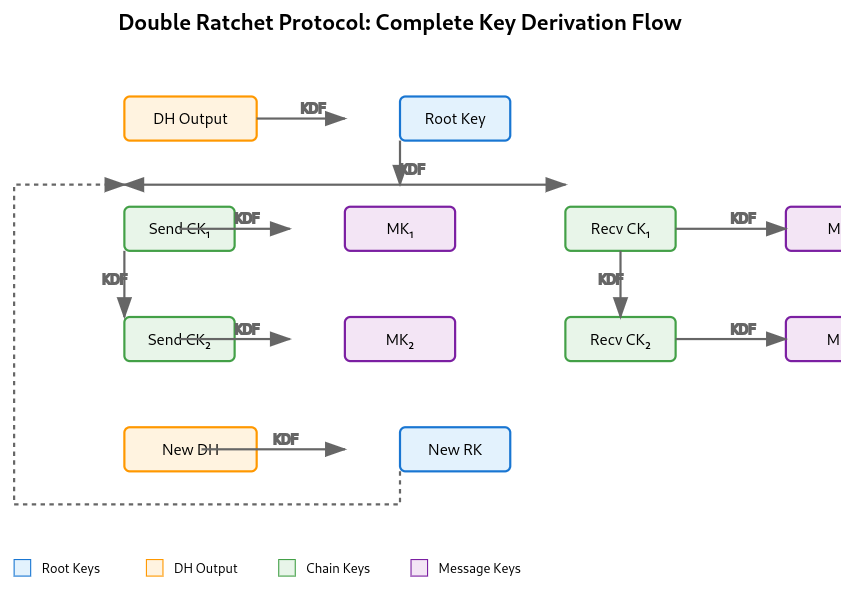
<p>After the initial handshake (X3DH or PQXDH), the <strong>Double Ratchet</strong> manages continuous re-keying and secure forward secrecy:</p>
<ol>
<li><strong>DH Ratchet</strong>: Each new ephemeral public key triggers a fresh shared secret (with the recipient’s ephemeral public key), which is combined via HKDF.</li>
<li><strong>Symmetric Ratchet</strong>: Evolves for each message sent or received, generating unique message keys.</li>
</ol>
<p>Robust error handling is critical:</p>
<ul>
<li><strong>Out-of-Order Messages</strong>: The protocol can handle missing or delayed messages by advancing the ratchet state.</li>
<li><strong>Session Resets</strong>: If states fall hopelessly out of sync, a new PQXDH handshake re-establishes session security.</li>
</ul>
<p><img loading="lazy" src="/images/content/blog-security-signal-security-architecture-6b6efe4c-de69-4099-a182-7a0b468f171c.png" alt="Double Ratchet Protocol: Complete Key Derivation Flow" />
</p>
<p><em>The Double Ratchet protocol uses DH and symmetric ratchets for forward secrecy and post-compromise security. Each message key is used once and never reused, ensuring old traffic cannot be decrypted if new keys are compromised.</em></p>
<h2 id="7-message-encryption-internals">7. Message Encryption Internals</h2>
<ul>
<li><strong>Ciphers</strong>: AES-256-CTR or ChaCha20 for encryption; HMAC-SHA256 for authenticity.</li>
<li><strong>Message Format</strong>: Includes version information, ephemeral keys, counters, ciphertext, and HMAC tags. Minimal padding is used; future releases may expand length-hiding strategies to counter traffic analysis.</li>
<li><strong>Ephemeral Key Usage</strong>: Ephemeral message keys generated by the Double Ratchet are never reused across sessions or devices.</li>
</ul>
<h2 id="8-secure-memory-management">8. Secure Memory Management</h2>
<p><strong>Memory Hardening</strong>:</p>
<ul>
<li>Immediate zeroization of keys after use to reduce exposure in memory dumps.</li>
<li>Hardware-backed keystores on supported platforms to store long-term or medium-term keys securely.</li>
<li>Minimizing plaintext key presence in RAM wherever possible.</li>
<li><strong>Rust <code>libsignal-client</code></strong> for memory safety at the language level and fewer low-level buffer overflows.</li>
</ul>
<h2 id="9-group-messaging-sender-keys-and-group-v2">9. Group Messaging (Sender Keys and Group V2)</h2>
<ul>
<li><strong>Sender Keys</strong>: A single symmetric key per group, with each sender using a <strong>Sender Signing Key</strong> for authenticity. This reduces overhead compared to individually encrypting messages for each recipient.</li>
<li><strong>Group V2</strong>: Maintains membership consistency, ensuring no stealthy additions or removals. Future research includes <strong>post-quantum hardening</strong> of group operations and further metadata reduction techniques.</li>
</ul>
<h2 id="10-calls-and-real-time-media-encryption">10. Calls and Real-Time Media Encryption</h2>
<p>Calls use <strong>DTLS + SRTP</strong>:</p>
<ul>
<li><strong>DTLS</strong>: Ephemeral ECDHE-based key agreement (upgradable to PQ in the future) establishes the session keys.</li>
<li><strong>SRTP</strong>: Secures the real-time media streams with AES-GCM or ChaCha20-Poly1305.</li>
<li><strong>Key Discard</strong>: Once the call ends, keys are discarded, ensuring no long-term correlation of voice/video data.</li>
</ul>
<h2 id="11-metadata-minimization-sealed-sender-and-wire-formats">11. Metadata Minimization, Sealed Sender, and Wire Formats</h2>
<ul>
<li><strong>Sealed Sender</strong>: Conceals the sender’s identity from the server by encrypting metadata with the recipient’s identity key.</li>
<li><strong>Transport Security</strong>:
<ul>
<li>TLS 1.3 with pinned certificates</li>
<li>Ongoing research into private contact discovery, domain fronting, and censorship circumvention</li>
</ul>
</li>
<li><strong>Wire Formats</strong>: Minimal metadata is included in transport packets, reducing potential for traffic analysis.</li>
</ul>
<h2 id="12-formal-verification-and-security-audits">12. Formal Verification and Security Audits</h2>
<p><strong>Tools</strong>: <a href="https://bblanche.gitlabpages.inria.fr/proverif/">ProVerif</a> and <a href="https://tamarin-prover.github.io/">Tamarin</a> for cryptographic protocol modeling.</p>
<ul>
<li><strong>Double Ratchet Models</strong>: Confirm forward secrecy, post-compromise security, and authentication properties under standard cryptographic assumptions.</li>
<li><strong>PQXDH Models</strong>: Indicate strong resistance to active attackers, reinforcing the hybrid approach’s resilience.</li>
<li><strong>Group Protocols</strong>: Remain an active research area for proofs of membership consistency and post-quantum security at scale.</li>
</ul>
<p>Independent audits (both internal and external) plus academic research have consistently validated the protocol’s security goals. <em>Recent proofs even confirm no attacker can break forward secrecy under widely accepted assumptions.</em></p>
<h2 id="13-implementation-verification">13. Implementation Verification</h2>
<p>A combination of testing methodologies ensures correctness and robustness:</p>
<ul>
<li><strong>Fuzzing</strong>: Detects parsing, memory safety, and state machine vulnerabilities by bombarding the protocol with malformed or random inputs.</li>
<li><strong>Property-Based Testing</strong>: Checks invariant properties (e.g., no key reuse, correct ratchet progression, correct ephemeral key rotation).</li>
<li><strong>Integration Testing</strong>: Validates interoperability across various devices (mobile, desktop, server) and PQXDH backward compatibility.</li>
</ul>
<h2 id="14-security-boundaries-and-attack-trees">14. Security Boundaries and Attack Trees</h2>
<p><strong>Threat Modeling</strong>: Attack trees illuminate potential vectors such as:</p>
<ul>
<li><strong>Server Compromise</strong>: Mitigated by end-to-end encryption, sealed sender, and ephemeral keys.</li>
<li><strong>Network MITM Attacks</strong>: Thwarted by authenticated key exchanges (X3DH, PQXDH) and pinned TLS.</li>
<li><strong>Device Extractions</strong>: Hardware security modules protect long-term keys; ephemeral keys are zeroized quickly.</li>
</ul>
<h2 id="15-performance-considerations-and-benchmarks">15. Performance Considerations and Benchmarks</h2>
<p>Despite the added <strong>PQ layer</strong>, the performance impact is manageable:</p>
<ul>
<li><strong>Mobile</strong>: ~1–3ms extra for PQXDH handshakes.</li>
<li><strong>Desktop</strong>: Negligible overhead with hardware acceleration.</li>
</ul>
<p>Group messaging and message-level operations remain efficient. As PQC algorithms mature, these overheads may drop further.</p>
<h2 id="16-known-implementation-issues-pitfalls-and-mitigations">16. Known Implementation Issues, Pitfalls, and Mitigations</h2>
<ol>
<li><strong>Incomplete Key Zeroization</strong>: Failing to overwrite memory can leak secrets.</li>
<li><strong>Out-of-Order Message Handling</strong>: The Double Ratchet must gracefully handle skipped or delayed messages; improper handling can break sessions.</li>
<li><strong>Platform-Specific Nuances</strong>: iOS, Android, and desktop OSes have different APIs for secure storage.</li>
</ol>
<p>Mitigations include rigorous code reviews, test harnesses for edge cases, and platform-specific checklists.</p>
<h2 id="17-user-verification-and-safety-numbers">17. User Verification and Safety Numbers</h2>
<p><strong>Safety Numbers</strong> and QR codes give users a simple, out-of-band way to confirm identity keys. If keys change unexpectedly (e.g., new device or potential MITM attempt), the app warns users. This system extends to multi-device contexts, although users should re-verify each device to maintain trust consistency.</p>
<h2 id="18-multi-device-security">18. Multi-Device Security</h2>
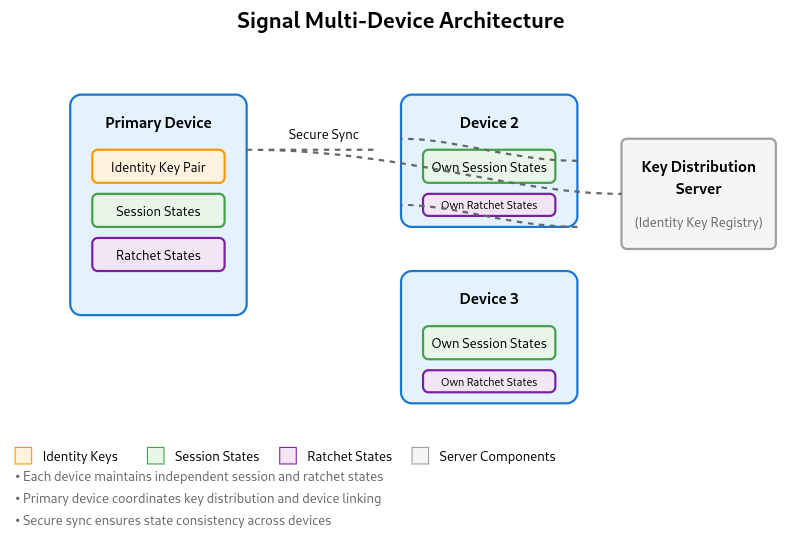
<p>Signal supports multiple linked devices:</p>
<ul>
<li><strong>Per-Device Identity Keys</strong>: Each device maintains its own ratchet state, so compromising one device does not endanger all past messages or other devices.</li>
<li><strong>Session Synchronization</strong>: Double Ratchet states and PQXDH handshakes automatically extend to new devices.</li>
<li><strong>User Verification Across Devices</strong>: Safety Numbers and user prompts ensure that newly added devices do not silently replace an existing identity.</li>
</ul>
<p><img loading="lazy" src="/images/content/blog-security-signal-security-architecture-bfa52f85-4189-4f30-8971-03f39caaccb9.png" alt="Signal Multi-Device Architecture" />
</p>
<p><em>The multi-device architecture for Signal. Each linked device maintains its own state, preserving forward secrecy. The key distribution server helps register device identity keys but does not have message access.</em></p>
<h2 id="19-ephemeral-messages-and-cryptographic-deletion">19. Ephemeral Messages and Cryptographic Deletion</h2>
<p>Ephemeral (disappearing) messages auto-delete after a set interval. While forward secrecy prevents decrypting old messages once ratchets advance, recipients can always screenshot or record content prior to deletion. Future enhancements may integrate ephemeral messaging with encrypted backup policies to reduce risk of indefinite retention.</p>
<h2 id="20-supply-chain-security-and-reproducible-builds">20. Supply Chain Security and Reproducible Builds</h2>
<p><strong>Implementation integrity</strong> is crucial:</p>
<ul>
<li><strong>Open Source</strong>: The Signal Protocol code is entirely public on <a href="https://github.com/signalapp">GitHub</a>.</li>
<li><strong>Dependency Management</strong>: Strict auditing of libraries, especially cryptographic ones.</li>
<li><strong>Reproducible Builds</strong>: Publicly released binaries can be verified to match the source, reducing the risk of supply chain tampering.</li>
</ul>
<p><img loading="lazy" src="/images/content/blog-security-signal-security-architecture-72d87f5a-61e4-4b5d-b3dd-737e1985938a.png" alt="Signal Supply Chain Security" />
</p>
<p><em>Comprehensive build and verification pipeline for Signal. Multiple steps—from source code review to final distribution—ensure that no hidden changes can be introduced without being detected.</em></p>
<h2 id="21-backup-and-key-export-procedures">21. Backup and Key Export Procedures</h2>
<p><strong>Backup Mechanisms</strong>:</p>
<ul>
<li><strong>Encrypted Backups</strong>: On mobile, backups are encrypted with a user-chosen passphrase.</li>
<li><strong>No Plaintext Cloud Storage</strong>: All data remains encrypted client-side.</li>
<li><strong>Migration to New Devices</strong>: PQXDH ensures a secure handshake for session transitions, allowing old devices to transfer or synchronize state without exposing plaintext keys.</li>
</ul>
<h2 id="22-interaction-with-emerging-standards-mls">22. Interaction with Emerging Standards (MLS)</h2>
<p><strong>Messaging Layer Security (MLS)</strong> is a new standard for large-scale, secure group chats. Future work may explore:</p>
<ul>
<li><strong>MLS Integration</strong>: Leveraging MLS’s tree-based group key rotation.</li>
<li><strong>PQ Considerations</strong>: Ensuring MLS can incorporate PQ primitives to complement or replace PQXDH.</li>
<li><strong>Metadata Minimization</strong>: Adapting MLS’s evolving approaches for privacy within bigger groups.</li>
</ul>
<h2 id="23-side-channel-resistance-and-implementation-security">23. Side-Channel Resistance and Implementation Security</h2>
<p>Beyond correct cryptographic design, robust implementation must address side-channels:</p>
<ul>
<li><strong>Constant-Time Implementations</strong>: Preventing timing or cache-based leaks.</li>
<li><strong>Hardened Crypto Libraries</strong>: Using well-reviewed libraries (e.g., BoringSSL, libsodium).</li>
<li><strong>Regular Audits</strong>: Independent researchers test for side-channel vulnerabilities, especially on mobile platforms where integrated circuits may be more exposed.</li>
</ul>
<h2 id="24-future-directions">24. Future Directions</h2>
<ul>
<li>
<p><strong>Post-Quantum Migration</strong>:</p>
<ul>
<li><em>Short Term</em>: Hybrid approaches (PQXDH) become standard for new sessions.</li>
<li><em>Mid Term</em>: Evaluate newly standardized PQC algorithms from NIST, possibly adopting them for all protocol components (KEM, signatures, etc.).</li>
<li><em>Long Term</em>: Transition entirely to quantum-safe algorithms once they are validated and widely supported.</li>
</ul>
</li>
<li>
<p><strong>Metadata Reduction</strong>:<br>
Research into privacy-preserving contact discovery, anonymous credentials, and minimizing trust in servers.</p>
</li>
<li>
<p><strong>Formal Verification Expansion</strong>:<br>
Extending machine-checked proofs to full-group messaging, ephemeral messaging, and advanced PQ constructs.</p>
</li>
<li>
<p><strong>Continuous Improvement</strong>:<br>
The protocol evolves as cryptographic standards mature. We plan to reevaluate these details in mid-2025, once new PQC standards are finalized.</p>
</li>
</ul>
<h2 id="25-conclusion">25. Conclusion</h2>
<p>The <strong>Signal Protocol</strong> sets a high bar for secure messaging. Its well-known features—end-to-end encryption, forward secrecy, and deniability—are now fortified by <strong>post-quantum security</strong> (via PQXDH), <strong>extensive formal verification</strong>, <strong>robust memory management</strong>, and <strong>supply chain integrity</strong> measures. While challenges remain—particularly regarding post-quantum transitions, large-group protocols, and ongoing metadata minimization—the Signal ecosystem is well-positioned to adapt alongside emerging standards like MLS.</p>
<p>Continued community involvement is vital:</p>
<ul>
<li><strong>Review and Contribute</strong>: <a href="https://github.com/signalapp/libsignal">github.com/signalapp/libsignal</a></li>
<li><strong>Conduct Security Research</strong>: Perform formal verification, cryptanalysis, and implementation testing.</li>
<li><strong>Engage in Technical Discussions</strong>: <a href="https://community.signalusers.org/">community.signalusers.org</a></li>
</ul>
<hr>
<h2 id="26-references-and-code-pointers">26. References and Code Pointers</h2>
<ul>
<li>
<p><strong>Signal Protocol Specifications</strong>:<br>
<a href="https://signal.org/docs/">https://signal.org/docs/</a></p>
</li>
<li>
<p><strong>Double Ratchet Paper (Cohn-Gordon et al.)</strong>:<br>
<a href="https://signal.org/docs/specifications/doubleratchet/">https://signal.org/docs/specifications/doubleratchet/</a></p>
</li>
<li>
<p><strong>X3DH &amp; PQXDH Specs + PQXDH Whitepaper</strong>:<br>
<a href="https://signal.org/docs/specifications/x3dh/">https://signal.org/docs/specifications/x3dh/</a><br>
<a href="https://signal.org/blog/pqxdh/">https://signal.org/blog/pqxdh/</a></p>
</li>
<li>
<p><strong>CRYSTALS-Kyber</strong>:<br>
<a href="https://pq-crystals.org/kyber/">https://pq-crystals.org/kyber/</a></p>
</li>
<li>
<p><strong>libsignal-protocol-c and Rust Bindings</strong>:<br>
<a href="https://github.com/signalapp/libsignal-protocol-c">https://github.com/signalapp/libsignal-protocol-c</a><br>
<a href="https://github.com/signalapp/libsignal">https://github.com/signalapp/libsignal</a></p>
</li>
<li>
<p><strong>Formal Verification</strong>:</p>
<ul>
<li>ProVerif/Tamarin models in academic papers:
<ul>
<li>“A Formal Security Analysis of the Signal Messaging Protocol” (2020)</li>
<li>“An Academic Analysis of PQXDH Parameters” (forthcoming)</li>
</ul>
</li>
<li><a href="https://csrc.nist.gov/projects/post-quantum-cryptography">NIST PQC Standards</a></li>
</ul>
</li>
<li>
<p><strong>Messaging Layer Security (MLS)</strong>:<br>
<a href="https://messaginglayersecurity.rocks/">https://messaginglayersecurity.rocks/</a></p>
</li>
<li>
<p><strong>Audits &amp; Community Analyses</strong>:<br>
Independent security audits, community-driven code reviews, and academic research. Check the latest audit reports for updates and commentary.</p>
</li>
</ul>
]]></content>
      </entry>
      <entry>
        <title>Privacy-First Security: Building Trust Through Data Protection</title>
        <link rel="alternate" href="https://profincognito.me/blog/security/privacyfirst-security/" />
        <id>https://profincognito.me/blog/security/privacyfirst-security/</id>
        <published>2026-03-04T00:00:00Z</published>
        <updated>2026-06-10T15:20:29-07:00</updated>
        <summary type="html">Explore how adopting a privacy-first security approach not only safeguards data but also builds lasting trust with customers. This comprehensive guide delves into practical strategies, emerging trends, and real-world examples to help organizations implement effective privacy-enhanced security.</summary>
          <content type="html"><![CDATA[<p>In an era where data breaches and privacy concerns dominate headlines, adopting a privacy-first security approach is more critical than ever. This guide examines how organizations can build trust through robust privacy practices, offering insights into foundational principles, advanced implementation strategies, and real-world case studies. Discover how leading organizations are achieving enhanced security and customer trust by prioritizing privacy at every level.</p>
<h2 id="introduction">Introduction</h2>
<p>The digital age has transformed data into one of the most valuable assets—and one of the most significant liabilities. Privacy has shifted from being a mere compliance requirement to a cornerstone of customer trust and brand reputation. According to a 2023 McKinsey report, <strong>76% of consumers</strong> indicate they won&rsquo;t engage with companies they don&rsquo;t trust to handle their data responsibly. This shift underscores that privacy isn&rsquo;t just about avoiding fines; it&rsquo;s about fostering sustainable relationships built on trust and transparency.</p>
<p>As Dr. Ann Cavoukian, creator of Privacy by Design, aptly states:</p>
<blockquote>
<p>&ldquo;Privacy is not about secrecy; it&rsquo;s about control, transparency, and trust in data relationships.&rdquo;</p></blockquote>
<h2 id="the-current-privacy-landscape">The Current Privacy Landscape</h2>
<p>Recent statistics highlight the urgency for a privacy-first approach:</p>
<ul>
<li><strong>$4.45 million</strong>: The average cost of a data breach in 2023, as reported by IBM Security.</li>
<li><strong>42% increase</strong>: Growth in global privacy regulations since 2020, according to the IAPP&rsquo;s 2023 Privacy Governance Report.</li>
<li><strong>40% faster</strong>: Organizations with mature privacy programs resolve security incidents more quickly, per Cisco&rsquo;s 2023 Data Privacy Benchmark Study.</li>
</ul>
<p>These figures emphasize that privacy is a strategic imperative, integral to operational success and customer trust.</p>
<h2 id="key-components-of-privacy-first-security">Key Components of Privacy-First Security</h2>
<h3 id="1-embedding-privacy-as-a-core-value">1. Embedding Privacy as a Core Value</h3>
<p>Prioritizing privacy transforms how organizations handle data:</p>
<ul>
<li><strong>Intentional Data Collection</strong>: Gathering only what is necessary, reducing risk.</li>
<li><strong>Aligned Security Controls</strong>: Implementing measures that respect user rights and data protection.</li>
<li><strong>Comprehensive Risk Assessments</strong>: Including privacy impact analyses to identify potential vulnerabilities.</li>
<li><strong>Inherent Compliance</strong>: Meeting regulatory requirements naturally through robust privacy practices.</li>
</ul>
<p>Organizations embracing these principles often experience:</p>
<ul>
<li><strong>Reduced Incident Response Times</strong></li>
<li><strong>Improved Customer Retention Rates</strong></li>
<li><strong>Enhanced Regulatory Compliance</strong></li>
<li><strong>Lower Operational Costs through Data Minimization</strong></li>
</ul>
<h3 id="2-leveraging-privacy-enhancing-technologies-pets">2. Leveraging Privacy-Enhancing Technologies (PETs)</h3>
<p>Advanced technologies play a pivotal role in safeguarding privacy:</p>
<h4 id="homomorphic-encryption"><strong>Homomorphic Encryption</strong></h4>
<ul>
<li><strong>Functionality</strong>: Allows computation on encrypted data without decryption.</li>
<li><strong>Benefits</strong>: Maintains confidentiality during processing; ideal for outsourcing computations securely.</li>
<li><strong>Real-world Applications</strong>: Financial service computations, healthcare data analysis, secure multi-party computations.</li>
</ul>
<h4 id="differential-privacy"><strong>Differential Privacy</strong></h4>
<ul>
<li><strong>Functionality</strong>: Introduces statistical noise to datasets, protecting individual data points.</li>
<li><strong>Benefits</strong>: Enables useful analytics while preserving individual privacy; supports transparent data sharing.</li>
<li><strong>Implementation Examples</strong>: Census data analysis, machine learning model training, public health research.</li>
</ul>
<h4 id="synthetic-data"><strong>Synthetic Data</strong></h4>
<ul>
<li><strong>Functionality</strong>: Creates artificial datasets that mirror real data patterns without exposing personal information.</li>
<li><strong>Benefits</strong>: Facilitates development and testing without privacy risks; enhances machine learning training.</li>
<li><strong>Use Cases</strong>: Software testing, AI model development, regulatory compliance training.</li>
</ul>
<h3 id="3-implementing-zero-trust-privacy-architecture">3. Implementing Zero-Trust Privacy Architecture</h3>
<p>Adopting a zero-trust model ensures continuous validation and minimal risk:</p>
<h4 id="continuous-validation"><strong>Continuous Validation</strong></h4>
<ul>
<li><strong>Authentication at Every Step</strong>: No user or device is inherently trusted.</li>
<li><strong>Privacy Permission Verification</strong>: Ensuring data access aligns with user consent.</li>
<li><strong>Regular Privacy Impact Assessments</strong>: Ongoing evaluation of privacy risks.</li>
<li><strong>Context-Aware Access Decisions</strong>: Access granted based on current context, not just credentials.</li>
</ul>
<h4 id="privacy-aware-access-control"><strong>Privacy-Aware Access Control</strong></h4>
<ul>
<li><strong>Purpose-Based Access Management</strong>: Users access data only for specified purposes.</li>
<li><strong>Time-Bound Permissions</strong>: Access rights expire after a set period.</li>
<li><strong>Context-Based Authorization</strong>: Dynamic adjustment of permissions based on user behavior and environment.</li>
<li><strong>Privacy Impact Consideration</strong>: Evaluating how access affects individual privacy.</li>
</ul>
<h2 id="real-world-implementation">Real-World Implementation</h2>
<h3 id="case-study-global-financial-services-provider-2022-2023"><strong>Case Study: Global Financial Services Provider (2022-2023)</strong></h3>
<p><strong>Challenge:</strong>
A major financial institution faced multiple privacy challenges while processing over 10 million daily transactions across 50 countries:</p>
<ul>
<li><strong>Legacy Systems</strong>: Multiple outdated mainframe systems processing sensitive data</li>
<li><strong>Regulatory Complexity</strong>: Compliance with GDPR, CCPA, and sector-specific regulations</li>
<li><strong>Scale</strong>: Managing privacy for 50+ million customer records</li>
</ul>
<p><strong>Solution Implementation:</strong></p>
<ol>
<li>
<p><strong>Privacy-Aware Architecture Transformation</strong>:</p>
<ul>
<li>Deployed IBM Confidential Computing for secure data processing</li>
<li>Implemented Privacera for data governance and access control</li>
<li>Utilized HashiCorp Vault for secrets management</li>
</ul>
</li>
<li>
<p><strong>Enhanced Access Controls</strong>:</p>
<ul>
<li>Implemented purpose-based access using SailPoint IdentityIQ</li>
<li>Deployed Okta for identity management with continuous authentication</li>
<li>Integrated OneTrust for consent management</li>
</ul>
</li>
<li>
<p><strong>Privacy-Preserving Analytics</strong>:</p>
<ul>
<li>Implemented Google&rsquo;s differential privacy library</li>
<li>Deployed Privitar for data anonymization</li>
<li>Utilized synthetic data for testing environments</li>
</ul>
</li>
</ol>
<p><strong>Measurable Results</strong> (Q4 2022 - Q3 2023):</p>
<ul>
<li><strong>60% Reduction in Privacy Incidents</strong>: From 25 monthly incidents to 10</li>
<li><strong>40% Faster Compliance Verification</strong>: Audit time reduced from 45 days to 27</li>
<li><strong>35% Reduction in Data Storage Costs</strong>: Through efficient classification and deletion</li>
<li><strong>90% Automated Privacy Controls</strong>: Reduced manual privacy oversight needs</li>
</ul>
<h2 id="emerging-challenges-and-solutions">Emerging Challenges and Solutions</h2>
<h3 id="1-artificial-intelligence-and-privacy">1. <strong>Artificial Intelligence and Privacy</strong></h3>
<ul>
<li><strong>Privacy-Preserving Machine Learning</strong>: Implementation of federated learning frameworks</li>
<li><strong>Model Privacy Assessment</strong>: Regular evaluation using established privacy metrics</li>
<li><strong>Training Data Protection</strong>: Implementation of privacy-preserving training techniques</li>
</ul>
<h3 id="2-edge-computing-privacy">2. <strong>Edge Computing Privacy</strong></h3>
<ul>
<li><strong>Local Privacy Enforcement</strong>: Using secure enclaves for protected processing</li>
<li><strong>Distributed Consent Management</strong>: Implementation of decentralized identity solutions</li>
<li><strong>Edge-to-Cloud Privacy Controls</strong>: Integration with cloud services for consistent policy enforcement</li>
<li><strong>Privacy-Aware Data Synchronization</strong>: Using distributed database systems for secure storage</li>
</ul>
<h3 id="3-quantum-computing-implications">3. <strong>Quantum Computing Implications</strong></h3>
<p>Current Status (2023):</p>
<ul>
<li>NIST has selected initial quantum-resistant cryptographic algorithms</li>
<li>Major cloud providers are implementing post-quantum cryptography</li>
<li>Organizations are conducting quantum readiness assessments</li>
</ul>
<p>Preparation Steps:</p>
<ul>
<li><strong>Crypto-Agility</strong>: Implementing flexible cryptographic frameworks</li>
<li><strong>Risk Assessment</strong>: Regular evaluation using established frameworks</li>
<li><strong>Timeline Planning</strong>: Preparing for full quantum-safe encryption by 2025-2030</li>
</ul>
<h2 id="best-practices">Best Practices</h2>
<h3 id="do"><strong>Do&rsquo;s</strong></h3>
<ul>
<li><strong>Start with Comprehensive Data Mapping</strong>: Know where all personal data resides.</li>
<li><strong>Implement Privacy by Default</strong>: Make privacy the standard setting in all products and services.</li>
<li><strong>Automate Where Possible</strong>: Use tools to reduce human error in privacy management.</li>
<li><strong>Invest in Continuous Training</strong>: Keep teams updated on the latest privacy trends and regulations.</li>
<li><strong>Monitor and Measure Effectiveness</strong>: Regularly assess how well privacy measures are working.</li>
</ul>
<h3 id="don"><strong>Don&rsquo;ts</strong></h3>
<ul>
<li><strong>Ignore Privacy Debt</strong>: Don&rsquo;t postpone addressing known privacy issues.</li>
<li><strong>Implement Without Metrics</strong>: Avoid deploying solutions without a way to measure their impact.</li>
<li><strong>Neglect User Experience</strong>: Don&rsquo;t let privacy measures hinder usability.</li>
<li><strong>Overlook Edge Cases</strong>: Consider all scenarios, including less common ones that may pose risks.</li>
<li><strong>Assume One-Size-Fits-All</strong>: Customize privacy strategies to fit your organization&rsquo;s unique needs.</li>
</ul>
<h2 id="measuring-success">Measuring Success</h2>
<h3 id="operational-metrics"><strong>Operational Metrics</strong></h3>
<ul>
<li><strong>Frequency of Privacy Incidents</strong>: Aim for a downward trend.</li>
<li><strong>Response Time to Incidents</strong>: Track improvements in addressing privacy issues.</li>
<li><strong>Privacy Debt Reduction</strong>: Measure how much outstanding privacy work has been completed.</li>
<li><strong>Implementation Coverage</strong>: Assess the extent to which privacy measures have been adopted.</li>
</ul>
<h3 id="business-impact"><strong>Business Impact</strong></h3>
<ul>
<li><strong>Customer Trust Metrics</strong>: Use surveys and engagement rates to gauge trust levels.</li>
<li><strong>Operational Efficiency Gains</strong>: Identify cost savings from streamlined processes.</li>
<li><strong>Compliance Cost Reduction</strong>: Measure savings from avoiding fines and reducing audit expenses.</li>
<li><strong>Risk Profile Improvements</strong>: Evaluate the organization&rsquo;s overall risk exposure.</li>
</ul>
<h2 id="additional-resources">Additional Resources</h2>
<h3 id="standards-and-frameworks"><strong>Standards and Frameworks</strong></h3>
<ul>
<li><strong><a href="https://www.nist.gov/privacy-framework">NIST Privacy Framework</a></strong>: A comprehensive guide for privacy risk management</li>
<li><strong><a href="https://owasp.org/www-project-top-10-privacy-risks">OWASP Privacy Risks Project</a></strong>: Privacy risk assessment methodology</li>
</ul>
<h3 id="professional-organizations"><strong>Professional Organizations</strong></h3>
<ul>
<li><strong><a href="https://iapp.org">International Association of Privacy Professionals (IAPP)</a></strong></li>
<li><strong><a href="https://www.eff.org">Electronic Frontier Foundation (EFF)</a></strong></li>
<li><strong><a href="https://www.staysafeonline.org">National Cyber Security Alliance (NCSA)</a></strong></li>
</ul>
<p>These organizations provide training, certification programs, and current privacy research and guidelines.</p>
<hr>
]]></content>
      </entry>
      <entry>
        <title>secureblue: Redefining Security in Linux Desktop Operating Systems</title>
        <link rel="alternate" href="https://profincognito.me/blog/security/secureblue/" />
        <id>https://profincognito.me/blog/security/secureblue/</id>
        <published>2026-03-04T00:00:00Z</published>
        <updated>2026-06-10T15:20:29-07:00</updated>
        <summary type="html">An in-depth look at secureblue, a security-hardened Linux distribution built on Fedora Atomic that aims to be the most secure desktop Linux OS while maintaining usability.</summary>
          <content type="html"><![CDATA[<p>In today&rsquo;s online landscape, security is paramount. With cyber threats becoming increasingly sophisticated, users need an operating system that not only provides robust security features but also maintains usability. <strong>secureblue</strong> emerges as a promising solution, aiming to redefine the standards of security in Linux desktop environments.</p>
<h2 id="what-is-secureblue">What is secureblue?</h2>
<p><strong>secureblue</strong> is a project that builds upon Fedora Atomic&rsquo;s base images to create <strong>hardened operating system images</strong>. Utilizing <strong>BlueBuild</strong>, it generates OS images with enhanced security measures designed to protect against both known and unknown vulnerabilities. secureblue&rsquo;s goal is to increase defenses without sacrificing usability for most use cases.</p>
<p>It&rsquo;s important to note that secureblue&rsquo;s mission is focused: <strong>to be the most secure desktop Linux OS</strong>. It does not claim to be the most secure desktop OS overall, as other systems like macOS have significant security advantages such as full verified boot. secureblue is designed for users whose first priority is using desktop Linux, with security as a second priority.</p>
<p>The project was founded and is being developed by <a href="https://github.com/RoyalOughtness">RoyalOughtness</a>.</p>
<h2 id="why-is-secureblue-based-on-fedora">Why is secureblue Based on Fedora?</h2>
<p>secureblue chooses <strong>Fedora</strong> as its base for two primary reasons:</p>
<ol>
<li>
<p><strong>SELinux Integration</strong>: Fedora ships with <strong>SELinux (Security-Enhanced Linux)</strong> in enforcing mode for system processes out of the box. SELinux provides a robust Mandatory Access Control (MAC) system that significantly enhances system security.</p>
</li>
<li>
<p><strong>Atomic Image Building</strong>: Fedora provides a robust ecosystem for <strong>atomic image building</strong>, which is essential for creating immutable operating system images that are easier to maintain and secure.</p>
</li>
</ol>
<p>While other distributions like NixOS were considered, they were ultimately not chosen due to SELinux compatibility issues stemming from their filesystem layout management.</p>
<h2 id="selinux-vs-apparmor">SELinux vs. AppArmor</h2>
<p>Both SELinux and AppArmor are Linux kernel security modules that provide Mandatory Access Control (MAC), but they differ in significant ways:</p>
<table>
  <thead>
      <tr>
          <th><strong>Feature</strong></th>
          <th><strong>SELinux</strong></th>
          <th><strong>AppArmor</strong></th>
      </tr>
  </thead>
  <tbody>
      <tr>
          <td><strong>Control Granularity</strong></td>
          <td>Fine-grained control over nearly every system aspect</td>
          <td>Profile-based restrictions with less granular control</td>
      </tr>
      <tr>
          <td><strong>Configuration Complexity</strong></td>
          <td>More complex, steeper learning curve</td>
          <td>Simpler to configure and manage</td>
      </tr>
      <tr>
          <td><strong>Policy Model</strong></td>
          <td>Type enforcement, roles, users</td>
          <td>Path-based access control</td>
      </tr>
      <tr>
          <td><strong>Default Implementation</strong></td>
          <td>Fedora, RHEL, CentOS</td>
          <td>Ubuntu, SUSE</td>
      </tr>
      <tr>
          <td><strong>Resource Requirements</strong></td>
          <td>Higher overhead</td>
          <td>Lower overhead</td>
      </tr>
      <tr>
          <td><strong>Security Depth</strong></td>
          <td>More comprehensive security model</td>
          <td>More straightforward but less detailed</td>
      </tr>
  </tbody>
</table>
<p><strong>Why SELinux?</strong> secureblue opts for SELinux because of its comprehensive security capabilities. The granular control allows secureblue to enforce strict security policies, making it harder for malicious applications to cause harm.</p>
<h2 id="key-features-of-secureblue">Key Features of secureblue</h2>
<p>secureblue introduces several enhancements to bolster system security:</p>
<h3 id="1-global-implementation-of-hardened_malloc">1. Global Implementation of hardened_malloc</h3>
<p>Replaces the default memory allocator with <strong><a href="https://github.com/GrapheneOS/hardened_malloc">hardened_malloc</a></strong>, which includes security enhancements to protect against various memory corruption vulnerabilities—even within Flatpak applications.</p>
<h3 id="2-hardened-chromium-browser-hardened-chromium">2. Hardened Chromium Browser (<code>hardened-chromium</code>)</h3>
<p>A security-enhanced version of Chromium, focusing on fortifying defenses against web-based attacks. Developed by the secureblue team, <code>hardened-chromium</code> provides:</p>
<ul>
<li><strong>Improved Sandboxing</strong>: Strengthens the isolation between browser processes.</li>
<li><strong>Security Patches</strong>: Incorporates the latest security fixes promptly.</li>
<li><strong>Strict Defaults</strong>: Configured with settings that prioritize security.</li>
</ul>
<p>For more details, visit the <a href="https://github.com/secureblue/hardened-chromium"><code>hardened-chromium</code> repository</a>.</p>
<h3 id="3-strict-sysctl-settings">3. Strict Sysctl Settings</h3>
<p>Adjusts numerous kernel parameters to enhance system security, such as:</p>
<ul>
<li>Limiting core dumps.</li>
<li>Restricting access to kernel logs.</li>
<li>Enhancing network security settings.</li>
</ul>
<h3 id="4-removal-of-suid-binaries">4. Removal of SUID Binaries</h3>
<p>By removing the <strong>SUID bit</strong> from several binaries and replacing their functionality with capabilities, secureblue reduces the risk of <strong>privilege escalation attacks</strong>.</p>
<h3 id="5-blacklisting-unused-kernel-modules">5. Blacklisting Unused Kernel Modules</h3>
<p>Minimizes the attack surface by <strong>preventing potential exploits</strong> that target seldom-used components. This is achieved by blacklisting unnecessary kernel modules.</p>
<h3 id="6-additional-security-enhancements">6. Additional Security Enhancements</h3>
<ul>
<li><strong>Disabling Unnecessary Services</strong>: Services like <code>cups</code>, <code>geoclue</code>, and others are disabled by default.</li>
<li><strong>Secure DNS Configurations</strong>: Implements opportunistic DNSSEC and DNS-over-TLS with <code>systemd-resolved</code>.</li>
<li><strong>User Account Protection</strong>: Implements brute-force protection and enforces strong password policies.</li>
<li><strong>Container and Flatpak Security</strong>: Adjusts policies for safer application management.</li>
</ul>
<h2 id="why-is-chromium-chosen-over-firefox">Why is Chromium Chosen Over Firefox?</h2>
<p>The choice of Chromium over Firefox is based on significant technical security advantages:</p>
<ol>
<li>
<p><strong>Site Isolation</strong></p>
<ul>
<li><strong>Chromium</strong>: Has had complete <strong>site isolation</strong> implementation for years, meaning each site runs in its own process, reducing the risk of cross-site attacks.</li>
<li><strong>Firefox</strong>: Still lacks complete site isolation, making it more vulnerable to certain types of exploits.</li>
</ul>
</li>
<li>
<p><strong>Sandbox Strength</strong></p>
<ul>
<li><strong>Chromium</strong>: Offers a robust sandboxing mechanism that isolates processes effectively.</li>
<li><strong>Firefox</strong>: Sandbox implementation is comparatively weaker, potentially allowing malicious code to affect the system.</li>
</ul>
</li>
<li>
<p><strong>Base Security</strong></p>
<ul>
<li>Even without hardening, Chromium provides better security than Firefox due to its architecture and security model.</li>
</ul>
</li>
<li>
<p><strong>Hardening Potential</strong></p>
<ul>
<li>Chromium&rsquo;s architecture allows for additional security enhancements through hardening, which the secureblue team leverages in <code>hardened-chromium</code>.</li>
</ul>
</li>
</ol>
<p><strong>Note on Privacy vs. Security</strong>: When security and privacy considerations conflict, secureblue prioritizes <strong>security</strong>. Certain privacy-focused browsers like Brave or ungoogled-chromium may reduce security (e.g., enabling Manifest V2 extensions), and thus are not chosen as the base.</p>
<h2 id="comparison-with-other-secure-systems">Comparison with Other Secure Systems</h2>
<p>It&rsquo;s important to understand that secureblue serves different goals than other security-focused systems:</p>
<ul>
<li>
<p><strong>Qubes OS</strong>: Focuses on virtualization-based sandboxing using a hypervisor. While highly secure, it&rsquo;s a different approach compared to secureblue&rsquo;s focus on hardening the Linux desktop environment.</p>
</li>
<li>
<p><strong>macOS</strong>: Provides certain security advantages like <strong>full verified boot</strong> that aren&rsquo;t currently possible with desktop Linux. secureblue acknowledges these limitations but aims to be the most secure option within the Linux ecosystem.</p>
</li>
</ul>
<h2 id="getting-started-with-secureblue">Getting Started with secureblue</h2>
<p>For installation instructions and documentation, visit the <strong><a href="https://github.com/secureblue/secureblue/">secureblue GitHub repository</a></strong>. The installation process and requirements are maintained in the repository to ensure you always have access to the most current information.</p>
<h2 id="shoutout-to-bluebuild">Shoutout to BlueBuild</h2>
<p>secureblue utilizes <strong><a href="https://blue-build.org/">BlueBuild</a></strong>, an innovative tool for building immutable, versioned, and containerized operating system images. BlueBuild plays a crucial role in enabling secureblue to deliver robust and secure OS images efficiently.</p>
<h2 id="contributing-and-community">Contributing and Community</h2>
<p>secureblue welcomes contributions and community involvement:</p>
<ul>
<li>
<p><strong>Contributing</strong>: Start with the <a href="https://github.com/secureblue/secureblue/">secureblue repository</a> and its <a href="https://github.com/secureblue/secureblue/blob/live/docs/README.md">documentation</a> for current build and contribution context.</p>
</li>
<li>
<p><strong>Code of Conduct</strong>: Adhere to the project&rsquo;s <a href="https://github.com/secureblue/secureblue/blob/live/docs/CODE_OF_CONDUCT.md">Code of Conduct</a>.</p>
</li>
<li>
<p><strong>Community Support</strong>: Join discussions on the <strong><a href="https://discord.gg/DxqDExrhXW">secureblue Discord server</a></strong> to collaborate with other contributors and users.</p>
</li>
<li>
<p><strong>Donations</strong>: Consider supporting the project through <a href="https://github.com/sponsors/secureblue">GitHub Sponsors</a>.</p>
</li>
</ul>
<h2 id="conclusion">Conclusion</h2>
<p>secureblue represents a significant step forward in enhancing the security of Linux desktop operating systems. By building on Fedora&rsquo;s robust security features and adding its own layers of hardening, secureblue offers a compelling option for users who prioritize both Linux and security.</p>
<p>Whether you&rsquo;re an individual concerned about personal security or an organization seeking a more secure desktop environment, secureblue is worth exploring.</p>
<hr>
<p><strong>Have you tried secureblue? Share your thoughts and experiences!</strong></p>
]]></content>
      </entry>
      <entry>
        <title>Understanding Google Safe Browsing and Brave&#39;s Implementation: How It Works and Why It&#39;s Important</title>
        <link rel="alternate" href="https://profincognito.me/blog/security/brave-safe-browsing/" />
        <id>https://profincognito.me/blog/security/brave-safe-browsing/</id>
        <published>2026-03-04T00:00:00Z</published>
        <updated>2026-06-10T15:20:29-07:00</updated>
        <summary type="html">A technical deep dive into Google Safe Browsing, its importance, and how browsers like Brave enhance privacy while utilizing this technology.</summary>
          <content type="html"><![CDATA[<p>Imagine clicking a link and unwittingly downloading malware that encrypts all your files, or entering your banking credentials on what appears to be your bank&rsquo;s website—only to discover it&rsquo;s an elaborate fake. These aren&rsquo;t hypothetical scenarios; they&rsquo;re daily realities. Enter Google Safe Browsing, our guardian that silently protects billions of users from these exact threats.</p>
<p>In this deep dive, we&rsquo;ll peel back the layers of Google Safe Browsing&rsquo;s technical architecture, explore its critical role in modern web security, and examine how browsers like Brave have innovated upon its foundation to enhance user privacy. Whether you&rsquo;re a developer integrating these protections, a website owner ensuring your site stays secure, or simply someone who wants to understand what keeps you safe online, this guide will equip you with essential knowledge about one of the web&rsquo;s most crucial security systems.</p>
<h2 id="what-is-google-safe-browsing">What is Google Safe Browsing?</h2>
<p><a href="https://safebrowsing.google.com/">Google Safe Browsing</a> is a security service that identifies unsafe websites across the web and warns users when they attempt to navigate to dangerous sites or download harmful files. Integrated into major web browsers such as Google Chrome, Mozilla Firefox, Apple Safari, and Brave, it serves as a crucial defense against online threats.</p>
<h2 id="how-does-google-safe-browsing-work">How Does Google Safe Browsing Work?</h2>
<h3 id="1-continuous-web-crawling-and-analysis">1. Continuous Web Crawling and Analysis</h3>
<p>Google employs automated systems called web crawlers to systematically browse the internet.</p>
<ul>
<li><strong>Content Examination</strong>: Crawlers analyze website content, including HTML, JavaScript, and embedded resources.</li>
<li><strong>Behavioral Analysis</strong>: Scripts and code are executed in a sandbox environment to detect malicious behaviors not apparent through static analysis.</li>
<li><strong>Detection Techniques</strong>: Heuristics, machine learning models, and signature-based detection identify malware and phishing sites.</li>
</ul>
<div align="center">
  <img src="/images/content/blog-security-brave-safe-browsing-4f6df1a6-9168-4d2d-8e11-ebc03b29ccf4.png" alt="Web Crawling and Analysis Process">
<p><em>Flowchart illustrating the web crawling and analysis process.</em></p>
</div>
<h3 id="2-threat-classification">2. Threat Classification</h3>
<p>Identified threats are classified into:</p>
<ul>
<li><strong>Malware Sites</strong>: Distribute harmful software.</li>
<li><strong>Phishing Sites</strong>: Imitate legitimate sites to steal sensitive information.</li>
<li><strong>Unwanted Software</strong>: Promote software that alters system settings without consent.</li>
</ul>
<h3 id="3-database-updates-and-management">3. Database Updates and Management</h3>
<p>Unsafe URLs are added to Google&rsquo;s Safe Browsing databases.</p>
<ul>
<li><strong>URL Hashing</strong>: URLs are hashed using cryptographic functions to create unique identifiers while preserving privacy.</li>
<li><strong>Incremental Updates</strong>: Browsers periodically download updates containing hashed prefixes of unsafe URLs for efficient local checks.</li>
</ul>
<h3 id="4-real-time-protection-in-browsers">4. Real-Time Protection in Browsers</h3>
<p>When a user navigates to a website:</p>
<ul>
<li><strong>Local Check</strong>: The browser hashes the URL and compares the prefix against the local Safe Browsing list.</li>
<li><strong>Verification Request</strong>: If there&rsquo;s a match, the browser requests full hashes from Google&rsquo;s servers to verify if the URL is malicious.</li>
<li><strong>User Warning</strong>: The browser displays a warning if the site is confirmed harmful.</li>
</ul>
<h3 id="5-privacy-considerations">5. Privacy Considerations</h3>
<p>Google Safe Browsing is designed with privacy in mind:</p>
<ul>
<li><strong>Anonymized Requests</strong>: Verification requests do not include personal information or the actual URL.</li>
<li><strong>Limited Data Sharing</strong>: Only hashed prefixes are shared, and requests may include multiple hashes to obfuscate which one triggered the request.</li>
</ul>
<h2 id="why-is-google-safe-browsing-important">Why is Google Safe Browsing Important?</h2>
<h3 id="protecting-users">Protecting Users</h3>
<ul>
<li><strong>Prevents Malware Infections</strong>: Blocks access to sites distributing harmful software.</li>
<li><strong>Guards Against Phishing</strong>: Warns users before they enter information on fraudulent sites.</li>
<li><strong>Enhances Confidence</strong>: Users can browse safely knowing they&rsquo;re protected.</li>
</ul>
<h3 id="supporting-website-owners">Supporting Website Owners</h3>
<ul>
<li><strong>Maintains Reputation</strong>: Helps prevent legitimate sites from being flagged due to compromise.</li>
<li><strong>Encourages Best Practices</strong>: Incentivizes robust security measures to avoid being listed.</li>
<li><strong>Provides Recovery Tools</strong>: Offers resources to identify and fix security issues.</li>
</ul>
<h2 id="browser-implementations-the-case-of-brave">Browser Implementations: The Case of Brave</h2>
<p><a href="https://brave.com/">Brave</a> is a privacy-focused browser that utilizes Google Safe Browsing while enhancing user privacy through specific implementations.</p>
<h3 id="how-brave-uses-google-safe-browsing">How Brave Uses Google Safe Browsing</h3>
<p>Brave enhances privacy in its implementation of Google Safe Browsing by taking additional steps to protect user data.</p>
<h4 id="proxying-safe-browsing-requests">Proxying Safe Browsing Requests</h4>
<p>When Brave needs to request full hashes from Google&rsquo;s Safe Browsing servers (after a local match of a hashed prefix), it routes these requests through Brave&rsquo;s servers.</p>
<ul>
<li><strong>Anonymity</strong>: Prevents Google from seeing the user&rsquo;s IP address.</li>
<li><strong>Privacy Enhancement</strong>: Stops Google from associating Safe Browsing requests with specific users.</li>
</ul>
<h4 id="limiting-data-sent-to-google">Limiting Data Sent to Google</h4>
<p>Brave minimizes the data sent to Google by:</p>
<ul>
<li><strong>Not Including Identifiers</strong>: Excludes any identifying information from Safe Browsing requests.</li>
<li><strong>Batching Requests</strong>: Groups multiple requests to further obscure individual user activity.</li>
</ul>
<h4 id="local-checks-with-frequent-updates">Local Checks with Frequent Updates</h4>
<ul>
<li><strong>Regular Updates</strong>: Brave frequently updates the local Safe Browsing lists to ensure up-to-date protection.</li>
<li><strong>Efficiency</strong>: Local checks are fast and protect user privacy by avoiding unnecessary network requests.</li>
</ul>
<div align="center">
  <img src="/images/content/blog-security-brave-safe-browsing-1369f617-7f4d-45e0-a822-1fab54594034.png" alt="Standard Safe Browsing Implementation">
  <img src="/images/content/blog-security-brave-safe-browsing-620335d2-d227-4cae-a639-3f56af97f6a5.png" alt="Brave Safe Browsing Implementation">
  <br>
  <em>Flowchart comparing standard Safe Browsing implementation with Brave's enhanced privacy approach.</em>
</div>
<h2 id="responding-to-google-safe-browsing-warnings">Responding to Google Safe Browsing Warnings</h2>
<h3 id="for-users">For Users</h3>
<ul>
<li><strong>Heed Warnings</strong>: Avoid visiting sites flagged as unsafe.</li>
<li><strong>Report Issues</strong>: If you believe a site is mistakenly flagged, report it through the <a href="https://transparencyreport.google.com/safe-browsing/search?hl=en">Google Transparency Report</a>.</li>
</ul>
<h3 id="for-website-owners">For Website Owners</h3>
<ol>
<li><strong>Identify the Issue</strong>: Use <a href="https://search.google.com/search-console/about">Google Search Console</a> to find out why your site was flagged.</li>
<li><strong>Clean Your Site</strong>: Remove malicious code, infected files, or unauthorized content.</li>
<li><strong>Secure Your Site</strong>: Fix vulnerabilities, update passwords, and check user permissions.</li>
<li><strong>Request a Review</strong>: After ensuring your site is clean, request a review via Search Console.</li>
<li><strong>Monitor Regularly</strong>: Keep an eye on your site&rsquo;s security status to prevent future issues.</li>
</ol>
<h2 id="the-technical-details-behind-safe-browsing">The Technical Details Behind Safe Browsing</h2>
<h3 id="url-hashing-and-privacy">URL Hashing and Privacy</h3>
<ul>
<li><strong>Hash Functions</strong>: Convert URLs into fixed-size strings (hashes) using functions like SHA256.</li>
<li><strong>Hash Prefixes</strong>: Only a portion of the hash is used for local checks, enhancing privacy.</li>
<li><strong>Privacy Preservation</strong>: Reduces the chance of exposing browsing history to Google.</li>
</ul>
<p><a href="https://security.googleblog.com/2022/08/how-hash-based-safe-browsing-works-in.html">Learn more about hash-based Safe Browsing in this Google Security Blog post.</a></p>
<div align="center">
  <img src="/images/content/blog-security-brave-safe-browsing-7d1da7c2-32e6-4233-8c0e-677b3a4c35b2.png" alt="URL Hashing and Prefix Matching Process">
<p><em>Diagram showing the process of URL hashing and how hash prefixes are used to check against the Safe Browsing database without compromising privacy.</em></p>
</div>
<h3 id="machine-learning-and-threat-detection">Machine Learning and Threat Detection</h3>
<ul>
<li><strong>Pattern Recognition</strong>: Analyzes vast amounts of data to identify patterns indicative of malicious sites.</li>
<li><strong>Adaptive Algorithms</strong>: Continuously improves to detect new and sophisticated threats.</li>
</ul>
<h3 id="collaboration-and-data-sharing">Collaboration and Data Sharing</h3>
<ul>
<li><strong>Industry Partnerships</strong>: Shares threat intelligence with other organizations to enhance overall internet security.</li>
<li><strong>User Reports</strong>: Feedback from users and website owners helps improve detection accuracy.</li>
</ul>
<h2 id="the-impact-of-google-safe-browsing">The Impact of Google Safe Browsing</h2>
<ul>
<li><strong>Reduces Malware Spread</strong>: Blocks access to harmful sites, limiting malware distribution.</li>
<li><strong>Lowers Phishing Success</strong>: Protects users from deceptive sites, reducing phishing incidents.</li>
<li><strong>Promotes Security Standards</strong>: Encourages best practices globally, improving overall web security.</li>
</ul>
<h2 id="conclusion">Conclusion</h2>
<p>Google Safe Browsing is an elegant balance of robust security and technical sophistication that helps create a safer internet for everyone—from casual browsers to business owners. While the technology itself is remarkable, it&rsquo;s the innovations by privacy-focused browsers like <strong>Brave</strong> that truly showcase its potential, proving that we don&rsquo;t have to choose between staying safe and staying private. The future of web security isn&rsquo;t just about building walls; it&rsquo;s about building them intelligently.</p>
<hr>
<p><em>Do you have any experiences or tips related to staying safe online? Share your thoughts!</em></p>
]]></content>
      </entry>

</feed>