<?xml version="1.0" encoding="utf-8" standalone="yes"?>
<feed xmlns="http://www.w3.org/2005/Atom">
  <title>Fundamentals on Sooraj Sathyanarayanan</title>
  <link rel="alternate" href="https://profincognito.me/blog/fundamentals/" />
  <link rel="self" href="https://profincognito.me/blog/fundamentals/index.xml" />
  <subtitle>Recent content in Fundamentals on Sooraj Sathyanarayanan</subtitle>
  <id>https://profincognito.me/blog/fundamentals/</id>
  <generator uri="http://gohugo.io" version="0.147.8">Hugo</generator>
  <language>en-us</language>
  <updated>2026-06-10T15:20:29-07:00</updated>
  <author>
    <name>Sooraj Sathyanarayanan</name>
    
  </author>
  <rights>[CC BY-SA 4.0](https://creativecommons.org/licenses/by-sa/4.0/)</rights>
      <entry>
        <title>First Principles Thinking: From Foundational Truths to Revolutionary Solutions</title>
        <link rel="alternate" href="https://profincognito.me/blog/fundamentals/first-principles-thinking/" />
        <id>https://profincognito.me/blog/fundamentals/first-principles-thinking/</id>
        <published>2026-03-04T00:00:00Z</published>
        <updated>2026-06-10T15:20:29-07:00</updated>
        <summary type="html">Master the art of first principles thinking to break down complex problems, challenge assumptions, and build innovative solutions from the ground up. Learn how security experts and innovators use this powerful mental model.</summary>
          <content type="html"><![CDATA[<p>When Elon Musk approached the challenge of building rockets at SpaceX, he didn&rsquo;t accept the conventional wisdom that rockets must be expensive. Instead, he broke down the problem to its fundamentals: What are rockets made of? What makes them costly? This approach led SpaceX to revolutionize space travel economics, reducing launch costs by over 90%. This is the power of first principles thinking – the ability to strip away assumptions and rebuild solutions from foundational truths.</p>
<blockquote>
<p>&ldquo;It&rsquo;s not that I&rsquo;m so smart, it&rsquo;s just that I stay with problems longer.&rdquo; — Albert Einstein</p></blockquote>
<p>In a world increasingly driven by inherited wisdom and conventional practices, the ability to think from first principles has never been more crucial. As a security researcher and advocate for evidence-based reasoning, I&rsquo;ve discovered that our most transformative insights come not from building upon existing assumptions, but from questioning everything and rebuilding from fundamental truths.</p>
<h2 id="what-is-first-principles-thinking">What Is First Principles Thinking?</h2>
<p>First principles thinking is the art of breaking down complex problems into their most basic, proven elements and then reassembling them from the ground up. It&rsquo;s about distinguishing between what we think we know and what we can prove through evidence and logical reasoning.</p>
<h2 id="the-power-of-starting-from-zero">The Power of Starting from Zero</h2>
<h3 id="quick-practice">Quick Practice</h3>
<p>Take a moment to apply first principles thinking to a daily activity:</p>
<ol>
<li>Choose a common task you perform (e.g., your morning routine)</li>
<li>List all your assumptions about how it must be done</li>
<li>Question each assumption: &ldquo;Why do I believe this is necessary?&rdquo;</li>
<li>Identify the fundamental goal of the task</li>
<li>Design a new approach based only on what&rsquo;s truly essential</li>
</ol>
<p><strong>Consider This</strong>: What &ldquo;obvious&rdquo; solutions in your field might be based on outdated assumptions?</p>
<h3 id="the-power-of-fundamental-truth">The Power of Fundamental Truth</h3>
<p>When we strip away assumptions, we&rsquo;re left with basic truths that can be proven through:</p>
<ul>
<li><strong>Direct Observation</strong>: Empirical evidence gathered through careful measurement and documentation</li>
<li><strong>Mathematical Proof</strong>: Rigorous logical demonstrations that establish unshakeable foundations</li>
<li><strong>Empirical Evidence</strong>: Reproducible results from controlled experiments and systematic observation</li>
<li><strong>Logical Reasoning</strong>: Step-by-step deduction that reveals necessary truths</li>
</ul>
<h2 id="practical-example-overhauling-your-morning-routine">Practical Example: Overhauling Your Morning Routine</h2>
<p>Let&rsquo;s walk through how to apply first principles thinking to redesign a common task: your morning routine.</p>
<h3 id="traditional-morning-routine-assumptions">Traditional Morning Routine Assumptions</h3>
<ol>
<li><strong>Wake up to an alarm clock.</strong></li>
<li><strong>Check phone for messages and emails immediately.</strong></li>
<li><strong>Drink coffee to wake up.</strong></li>
<li><strong>Watch or read the news.</strong></li>
<li><strong>Prepare and eat breakfast.</strong></li>
<li><strong>Commute to work by car.</strong></li>
</ol>
<h3 id="applying-the-first-principles-method">Applying the First Principles Method</h3>
<h4 id="1-question-everything-systematically">1. Question Everything Systematically</h4>
<ul>
<li><strong>Why do I wake up to an alarm clock?</strong>
<ul>
<li><em>Assumption</em>: I need an alarm to wake up on time.</li>
<li><em>Evidence</em>: Waking up abruptly often leaves me feeling groggy.</li>
</ul>
</li>
<li><strong>Why do I check my phone first thing?</strong>
<ul>
<li><em>Assumption</em>: I need to stay updated.</li>
<li><em>Evidence</em>: Early exposure to emails increases stress levels.</li>
</ul>
</li>
<li><strong>Why do I drink coffee to wake up?</strong>
<ul>
<li><em>Assumption</em>: Caffeine boosts my energy.</li>
<li><em>Evidence</em>: Reliance on coffee can lead to energy crashes later.</li>
</ul>
</li>
<li><strong>Why do I commute by car?</strong>
<ul>
<li><em>Assumption</em>: It&rsquo;s the fastest way to get to work.</li>
<li><em>Evidence</em>: Traffic congestion often delays me.</li>
</ul>
</li>
</ul>
<h4 id="2-break-down-complex-systems">2. Break Down Complex Systems</h4>
<ul>
<li><strong>Fundamental Goals of Morning Routine</strong>:
<ol>
<li>Wake up feeling refreshed.</li>
<li>Prepare mentally and physically for the day.</li>
<li>Arrive at work on time and stress-free.</li>
</ol>
</li>
</ul>
<h4 id="3-build-up-from-fundamentals">3. Build Up from Fundamentals</h4>
<ul>
<li>
<p><strong>Proven Truths</strong>:</p>
<ul>
<li>Quality sleep improves morning alertness.</li>
<li>Natural light exposure regulates circadian rhythms.</li>
<li>Physical activity boosts energy levels.</li>
<li>Mindfulness reduces stress.</li>
<li>A healthy breakfast fuels the body.</li>
</ul>
</li>
<li>
<p><strong>Reconstructing the Routine</strong>:</p>
<ol>
<li><strong>Optimize Sleep</strong>:
<ul>
<li>Go to bed earlier to ensure 7–8 hours of sleep.</li>
<li>Use a sleep tracker to find the optimal wake-up time.</li>
</ul>
</li>
<li><strong>Natural Wake-Up</strong>:
<ul>
<li>Use a light-based alarm clock that simulates sunrise.</li>
</ul>
</li>
<li><strong>Morning Hydration and Stretching</strong>:
<ul>
<li>Drink a glass of water upon waking.</li>
<li>Spend 10 minutes doing yoga or stretching exercises.</li>
</ul>
</li>
<li><strong>Mindfulness Practice</strong>:
<ul>
<li>Meditate for 5–10 minutes to start the day with a clear mind.</li>
</ul>
</li>
<li><strong>Nutritious Breakfast</strong>:
<ul>
<li>Prepare a meal rich in proteins and whole grains.</li>
</ul>
</li>
<li><strong>Digital Detox</strong>:
<ul>
<li>Avoid checking phone and emails until after arriving at work.</li>
</ul>
</li>
<li><strong>Active Commute</strong>:
<ul>
<li>Bike or walk part of the way to work to incorporate physical activity.</li>
</ul>
</li>
</ol>
</li>
</ul>
<h3 id="improved-results">Improved Results</h3>
<ul>
<li><strong>Enhanced Energy Levels</strong>: Better sleep and morning exercise increase alertness.</li>
<li><strong>Reduced Stress</strong>: Mindfulness and avoiding early digital distractions promote calmness.</li>
<li><strong>Better Health</strong>: A nutritious breakfast and physical activity contribute to overall well-being.</li>
<li><strong>Increased Productivity</strong>: Arriving at work refreshed leads to better focus and efficiency.</li>
</ul>
<h2 id="why-this-matters-now">Why This Matters Now</h2>
<p>In our rapidly evolving technological landscape, inherited solutions and &ldquo;best practices&rdquo; often become outdated before we even question them. First principles thinking offers:</p>
<ol>
<li><strong>Liberation from Cognitive Biases</strong>: Break free from inherited assumptions and conventional wisdom</li>
<li><strong>Innovation Potential</strong>: Create truly novel solutions by rebuilding from fundamentals</li>
<li><strong>Deeper Understanding</strong>: Know why solutions work, not just how they operate</li>
<li><strong>Intellectual Independence</strong>: Develop your own reasoned perspectives based on verified truths</li>
</ol>
<h2 id="the-first-principles-method">The First Principles Method</h2>
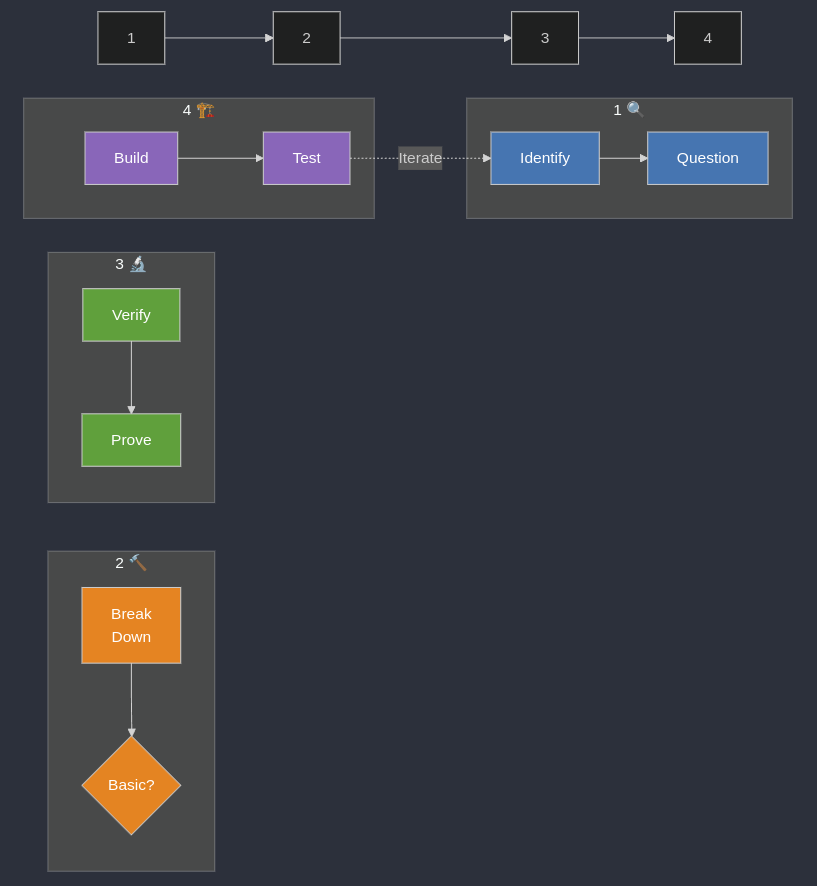
<p><img loading="lazy" src="/images/content/blog-fundamentals-first-principles-thinking-52406d03-a2a2-444d-bb31-3d2f94a88264.png" alt="Framework" />
</p>
<h3 id="1-question-everything-systematically-1">1. Question Everything Systematically</h3>
<p>Analysis Framework:</p>
<ol>
<li>What am I assuming about this situation?</li>
<li>What concrete evidence supports each assumption?</li>
<li>What observable facts might contradict these assumptions?</li>
<li>What&rsquo;s the simplest explanation that fits all the evidence?</li>
<li>How can I test these conclusions empirically?</li>
</ol>
<h3 id="2-break-down-complex-systems-1">2. Break Down Complex Systems</h3>
<p><em>Example: Analyzing System Security</em></p>
<table>
  <thead>
      <tr>
          <th>Traditional Approach</th>
          <th>First Principles Approach</th>
      </tr>
  </thead>
  <tbody>
      <tr>
          <td>Follow industry best practices</td>
          <td>What specific assets require protection?</td>
      </tr>
      <tr>
          <td>Implement standard security layers</td>
          <td>What are the actual threats to these assets?</td>
      </tr>
      <tr>
          <td>Apply common frameworks</td>
          <td>What security methods can we prove effective?</td>
      </tr>
      <tr>
          <td>Use established tools</td>
          <td>What minimal system achieves our security goals?</td>
      </tr>
  </tbody>
</table>
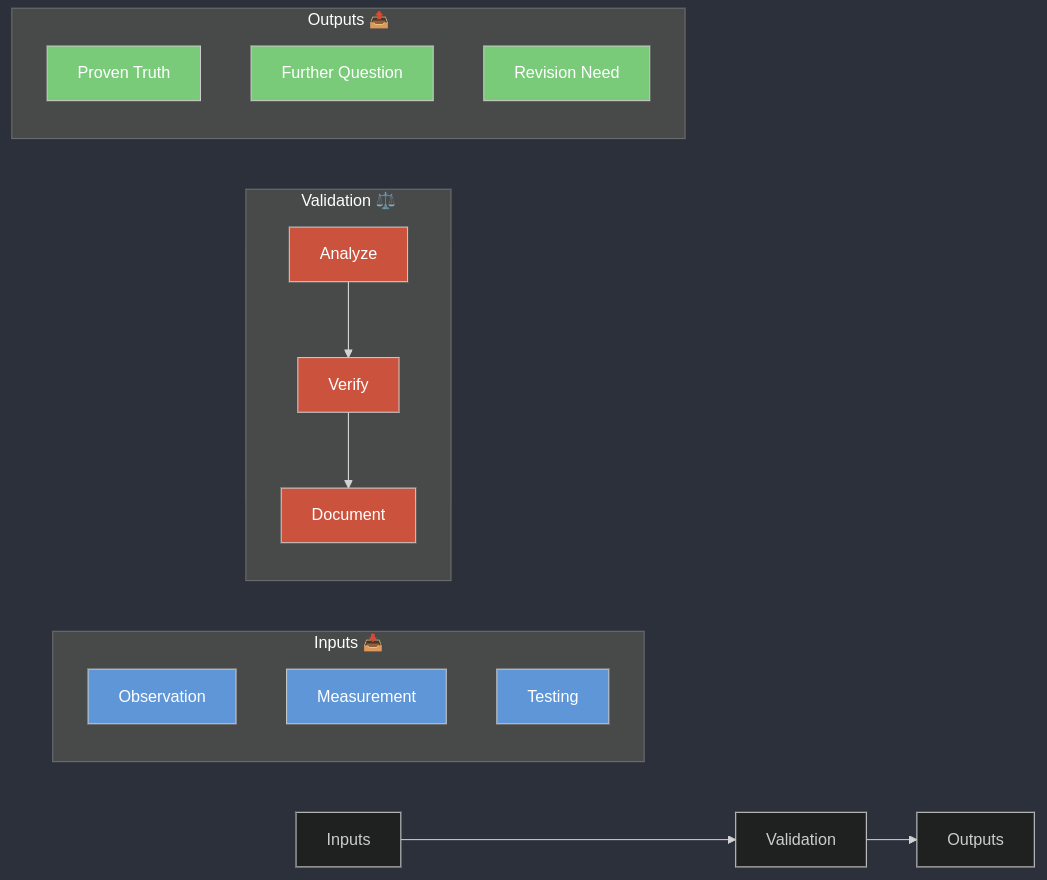
<h3 id="3-build-up-from-fundamentals-1">3. Build Up from Fundamentals</h3>
<p><img loading="lazy" src="/images/content/blog-fundamentals-first-principles-thinking-390bd7ee-a58e-4511-8052-9dd5d9ca5c37.png" alt="Validation Process" />
</p>
<ul>
<li><strong>Start with Proven Truths</strong>: Base your reasoning on established facts and mathematical certainties</li>
<li><strong>Add Only What You Can Verify</strong>: Incorporate new elements only when supported by evidence</li>
<li><strong>Test Each Addition</strong>: Validate new components through rigorous experimentation</li>
<li><strong>Document Your Reasoning</strong>: Maintain a clear record of your logical process</li>
</ul>
<h2 id="real-world-applications">Real-World Applications</h2>
<h3 id="1-cybersecurity-revolution">1. Cybersecurity Revolution</h3>
<p><strong>Traditional Thinking</strong>: &ldquo;Add more layers of security.&rdquo;</p>
<p><strong>First Principles Approach</strong>:</p>
<ul>
<li><strong>What is security fundamentally about?</strong> Protecting valuable assets from specific threats</li>
<li><strong>What makes a system trustworthy?</strong> Verifiable properties and proven resilience</li>
<li><strong>How can we prove security?</strong> Through formal verification and mathematical models</li>
</ul>
<p><strong>Result</strong>: Development of zero-trust architectures and provable security models that rely on continuous verification rather than perimeter defenses.</p>
<h3 id="2-privacy-engineering">2. Privacy Engineering</h3>
<p><strong>Starting from Scratch</strong>:</p>
<ul>
<li><strong>What is privacy essentially?</strong> Control over personal information flow and usage</li>
<li><strong>What data is truly necessary?</strong> The minimal set required for core functionality</li>
<li><strong>How can we verify privacy guarantees?</strong> Through cryptographic proofs and zero-knowledge protocols</li>
</ul>
<p><strong>Result</strong>: Creation of privacy-preserving systems that deliver functionality without compromising personal data.</p>
<h3 id="3-strategic-decision-making">3. Strategic Decision Making</h3>
<p><em>Chess Strategy Parallel</em>:</p>
<table>
  <thead>
      <tr>
          <th>Strategic Element</th>
          <th>First Principles Application</th>
      </tr>
  </thead>
  <tbody>
      <tr>
          <td>Position Evaluation</td>
          <td>What are the immutable facts of this position?</td>
      </tr>
      <tr>
          <td>Move Selection</td>
          <td>What can we logically deduce from the current state?</td>
      </tr>
      <tr>
          <td>Game Planning</td>
          <td>What strategies emerge from basic positional truths?</td>
      </tr>
  </tbody>
</table>
<h2 id="tools-for-first-principles-analysis">Tools for First Principles Analysis</h2>
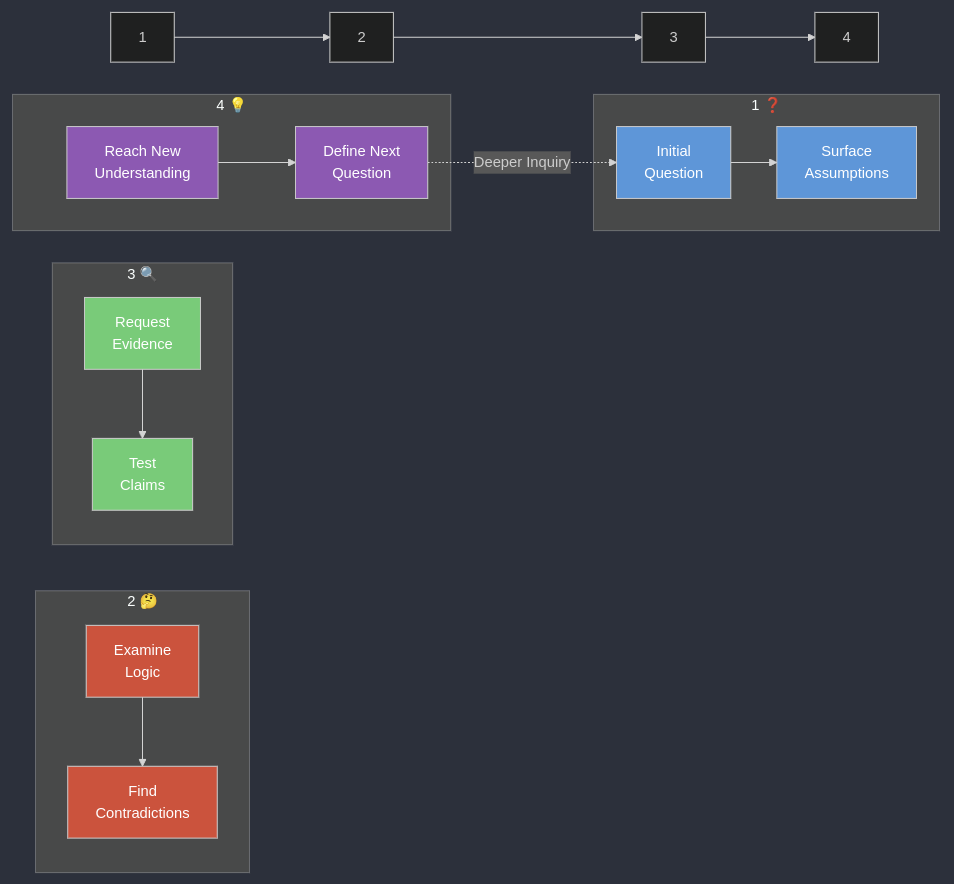
<h3 id="1-the-socratic-method">1. The Socratic Method</h3>
<p><img loading="lazy" src="/images/content/blog-fundamentals-first-principles-thinking-8dbbab7b-c911-448e-9cf7-c7bb22791a53.png" alt="Socratic Method Process" />
</p>
<ul>
<li><strong>Question Assumptions</strong>: Challenge every inherited belief</li>
<li><strong>Seek Evidence</strong>: Gather data that supports or refutes each position</li>
<li><strong>Follow Logical Consequences</strong>: Understand the full implications of your evidence</li>
<li><strong>Test Conclusions</strong>: Verify your reasoning through practical experiments</li>
</ul>
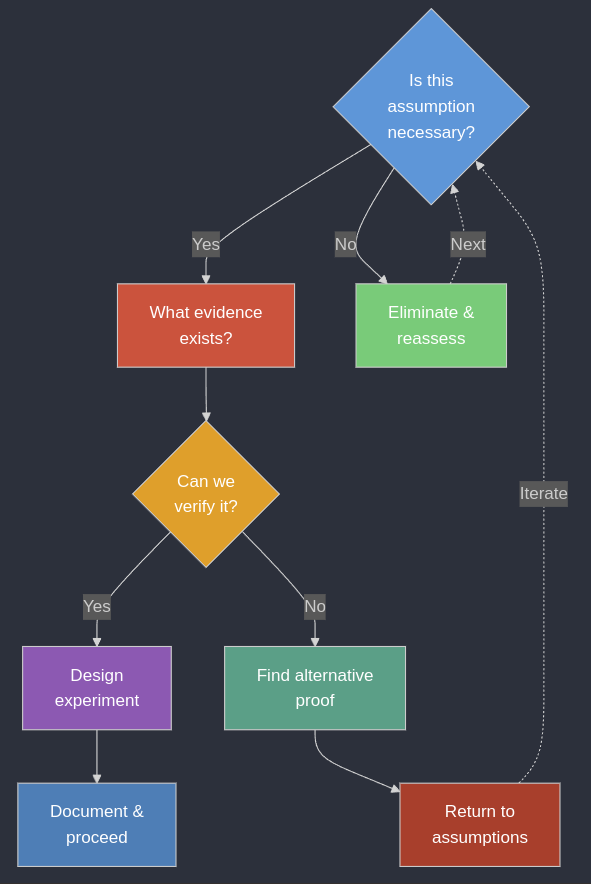
<h3 id="2-decision-trees">2. Decision Trees</h3>
<p><img loading="lazy" src="/images/content/blog-fundamentals-first-principles-thinking-fca96e43-dc4f-4da9-933b-87dcfb8a1e12.png" alt="Decision Tree" />
</p>
<h3 id="3-first-principles-matrix">3. First Principles Matrix</h3>
<table>
  <thead>
      <tr>
          <th>Assumption</th>
          <th>Evidence</th>
          <th>Counter-Evidence</th>
          <th>Conclusion</th>
      </tr>
  </thead>
  <tbody>
      <tr>
          <td>Users prioritize speed</td>
          <td>Performance metrics, user surveys</td>
          <td>Feature requests, usage patterns</td>
          <td>Balance speed with core functionality</td>
      </tr>
      <tr>
          <td>More features add value</td>
          <td>Initial user excitement</td>
          <td>Usage complexity, maintenance costs</td>
          <td>Focus on essential features</td>
      </tr>
      <tr>
          <td>Security requires complexity</td>
          <td>Attack prevention stats</td>
          <td>Usability studies</td>
          <td>Design simple, provable security</td>
      </tr>
  </tbody>
</table>
<h2 id="common-pitfalls-and-how-to-avoid-them">Common Pitfalls and How to Avoid Them</h2>
<h3 id="1-over-reduction">1. Over-reduction</h3>
<p><strong>Problem</strong>: Breaking things down too far and losing practical utility
<strong>Solution</strong>: Focus on the level of reduction that yields actionable insights</p>
<h3 id="2-analysis-paralysis">2. Analysis Paralysis</h3>
<p><strong>Problem</strong>: Getting stuck in the breakdown phase
<strong>Solution</strong>: Set clear timeframes for analysis and decision-making</p>
<h3 id="3-false-fundamentals">3. False Fundamentals</h3>
<p><strong>Problem</strong>: Mistaking assumptions for first principles
<strong>Solution</strong>: Rigorously test each &ldquo;fundamental&rdquo; through observation and experiment</p>
<h3 id="4-scope-creep">4. Scope Creep</h3>
<p><strong>Problem</strong>: Trying to apply the method to too many variables at once
<strong>Solution</strong>: Start with smaller, well-defined problems and gradually expand scope</p>
<h2 id="practical-exercises">Practical Exercises</h2>
<h3 id="daily-practice">Daily Practice</h3>
<ol>
<li><strong>Identify One Assumption</strong>: Choose something you take for granted</li>
<li><strong>Break It Down</strong>: Identify its fundamental components</li>
<li><strong>Rebuild with Evidence</strong>: Reconstruct your understanding based on facts</li>
<li><strong>Document Insights</strong>: Journal your discovery process</li>
</ol>
<h3 id="weekly-challenge">Weekly Challenge</h3>
<ol>
<li><strong>Choose a Complex System</strong>: Select a workflow or technology you use regularly</li>
<li><strong>Map Its Components</strong>: Document each element&rsquo;s purpose and relationships</li>
<li><strong>Question Necessity</strong>: Evaluate which components are truly essential</li>
<li><strong>Design Alternatives</strong>: Create improved solutions from first principles</li>
</ol>
<h3 id="measuring-progress">Measuring Progress</h3>
<p>Track your development through:</p>
<ol>
<li><strong>Decision Quality</strong>: Document outcomes of first-principles-based decisions</li>
<li><strong>Innovation Metrics</strong>: Count novel solutions generated</li>
<li><strong>Understanding Depth</strong>: Assess ability to explain complex topics simply</li>
<li><strong>Implementation Success</strong>: Measure effectiveness of solutions</li>
</ol>
<h2 id="a-personal-note-on-critical-thinking">A Personal Note on Critical Thinking</h2>
<p>Throughout my journey in security research and strategic thinking, I&rsquo;ve learned that our most powerful tool is our ability to question assumptions and seek evidence. This approach has transformed not just my professional work but my entire worldview—leading to clearer thinking, better decisions, and more reliable solutions.</p>
<p>By embracing first principles thinking, I&rsquo;ve tackled complex security challenges, designed more elegant systems, and contributed to our community&rsquo;s understanding of effective problem-solving.</p>
<h2 id="conclusion-the-path-forward">Conclusion: The Path Forward</h2>
<p>First principles thinking isn&rsquo;t just a methodology—it&rsquo;s a commitment to intellectual honesty and rigorous analysis. In a world where accepted wisdom often goes unquestioned, the ability to think from fundamentals becomes our most valuable tool.</p>
<p>Remember: The goal isn&rsquo;t merely to accumulate knowledge, but to develop the ability to derive truth from evidence and reason. Whether you&rsquo;re securing systems, solving complex problems, or examining your own beliefs, this approach will serve you well.</p>
<h3 id="next-steps">Next Steps</h3>
<ol>
<li><strong>Start Your First Principles Journal</strong>: Document your questioning process</li>
<li><strong>Join a Discussion Community</strong>: Engage with fellow critical thinkers</li>
<li><strong>Practice Daily Assumption Questioning</strong>: Make it a consistent habit</li>
<li><strong>Share Your Insights</strong>: Contribute to collective knowledge growth</li>
</ol>
<hr>
<p><em>Thank you for engaging with this exploration of first principles thinking. I look forward to your insights and contributions to this ongoing conversation.</em></p>
]]></content>
      </entry>
      <entry>
        <title>Ikigai: Finding Your Purpose and Living a Fulfilled Life</title>
        <link rel="alternate" href="https://profincognito.me/blog/fundamentals/ikigai/" />
        <id>https://profincognito.me/blog/fundamentals/ikigai/</id>
        <published>2026-03-04T00:00:00Z</published>
        <updated>2026-06-10T15:20:29-07:00</updated>
        <summary type="html">Discover how to apply the ancient Japanese concept of Ikigai to find meaning at the intersection of passion, profession, mission, and vocation. Learn practical steps to identify and live your purpose.</summary>
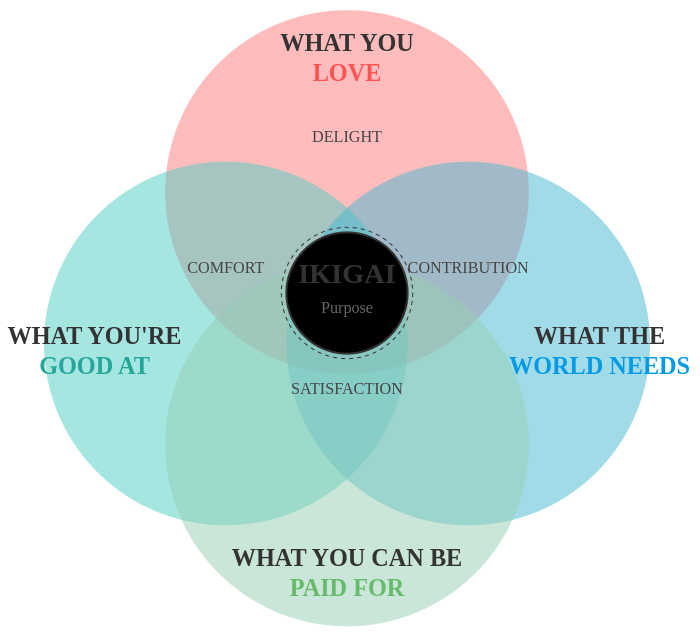
          <content type="html"><![CDATA[<p>In a world where many struggle to find meaning and purpose in their daily lives, the Japanese concept of <strong>Ikigai</strong> offers a profound framework for discovering what truly makes life worth living. Originating from the Japanese words <em>&ldquo;iki&rdquo;</em> (life) and <em>&ldquo;gai&rdquo;</em> (worth), Ikigai represents the intersection of what you love, what you&rsquo;re good at, what the world needs, and what you can be paid for.</p>
<p><img loading="lazy" src="/images/content/blog-fundamentals-ikigai-76d2e94c-19ff-4d0b-970a-c64ef79efb59.png" alt="Modern Ikigai Concept Diagram" />
</p>
<p><em>The four overlapping elements of Ikigai showing the sweet spot where purpose is found</em></p>
<h2 id="the-origins-of-ikigai">The Origins of Ikigai</h2>
<p>Ikigai has its roots in <strong>Okinawa</strong>, a small island in Japan renowned for its high concentration of centenarians. The locals attribute their longevity and happiness to living in alignment with their Ikigai. This concept is deeply ingrained in their daily lives, emphasizing community bonds, simplicity, and a strong sense of purpose.</p>
<h2 id="the-four-elements-of-ikigai">The Four Elements of Ikigai</h2>
<h3 id="what-you-love-passion">What You Love (Passion)</h3>
<p>These are the activities and causes that bring you joy and inspiration, regardless of their monetary value or practical application. It&rsquo;s about following your heart and pursuing what naturally excites and energizes you.</p>
<p><em>Reflect on moments when you feel truly alive. What are you doing? Who are you with?</em></p>
<p><strong>Action Item:</strong> Make a list of activities that make you lose track of time. Commit to engaging in at least one of these activities more frequently.</p>
<h3 id="what-youre-good-at-profession">What You&rsquo;re Good At (Profession)</h3>
<p>Your natural talents, acquired skills, and areas where you consistently excel. These are the capabilities you&rsquo;ve developed over time through practice, education, and experience.</p>
<p><em>Consider the tasks that others often ask for your help with. What skills do you bring to the table effortlessly?</em></p>
<p><strong>Action Item:</strong> Identify your top five skills. Seek feedback from friends or colleagues to uncover strengths you might overlook.</p>
<h3 id="what-the-world-needs-mission">What the World Needs (Mission)</h3>
<p>Problems you can solve and contributions you can make to improve society and help others. This connects your individual purpose to the greater good of humanity.</p>
<p><em>Ask yourself: What issues in the world resonate with you deeply? How can you contribute to making a positive change?</em></p>
<p><strong>Action Item:</strong> Choose a cause that resonates with you. Research ways you can get involved, whether through volunteering, advocacy, or education.</p>
<h3 id="what-you-can-be-paid-for-vocation">What You Can Be Paid For (Vocation)</h3>
<p>Skills and services that people value enough to compensate you for, creating financial sustainability. This ensures that your pursuit of purpose can be maintained in the practical world.</p>
<p><em>Think about professions or roles where your skills are in demand. How can you monetize what you&rsquo;re good at?</em></p>
<p><strong>Action Item:</strong> Explore job opportunities or entrepreneurial ventures that align with your skills and passions.</p>
<h2 id="a-real-world-example-finding-ikigai-in-action">A Real-World Example: Finding Ikigai in Action</h2>
<p>Consider the story of <strong>Marie Kondo</strong>, the Japanese organizing consultant and author. She had a passion for tidying and organizing (<strong>What You Love</strong>) and developed an exceptional skill in helping people declutter their homes (<strong>What You&rsquo;re Good At</strong>). Recognizing that many people struggle with organization and seek a more minimalist lifestyle (<strong>What the World Needs</strong>), she turned her expertise into a business and authored bestselling books (<strong>What You Can Be Paid For</strong>). By integrating these four elements, Marie Kondo discovered her Ikigai and has helped millions worldwide.</p>
<h2 id="finding-your-ikigai">Finding Your Ikigai</h2>
<p>Discovering your Ikigai is a journey of self-discovery and reflection. Here are key steps to help you find yours:</p>
<ol>
<li>
<p><strong>Self-Reflection</strong></p>
<p>Take time to understand your interests, values, and natural inclinations.</p>
<ul>
<li><strong>What activities make you lose track of time?</strong></li>
<li><strong>What topics do you love learning about?</strong></li>
<li><strong>What dreams have you held since childhood?</strong></li>
</ul>
<p><strong>Exercise:</strong> Keep a journal to note activities that bring you joy and fulfillment.</p>
</li>
<li>
<p><strong>Skill Assessment</strong></p>
<p>Identify your strengths and areas where you naturally excel.</p>
<ul>
<li><strong>What comes easily to you that others find difficult?</strong></li>
<li><strong>What do people often compliment you on?</strong></li>
<li><strong>What skills have you developed over time?</strong></li>
</ul>
<p><strong>Exercise:</strong> List your top skills and seek feedback from peers to uncover hidden strengths.</p>
</li>
<li>
<p><strong>Explore Market Needs</strong></p>
<p>Align your skills and interests with societal needs and market demands.</p>
<ul>
<li><strong>What problems do you see in the world that you could help solve?</strong></li>
<li><strong>What services or solutions are people willing to pay for?</strong></li>
<li><strong>Where do your skills intersect with market opportunities?</strong></li>
</ul>
<p><strong>Exercise:</strong> Research industries or sectors where your passions and skills are in demand.</p>
</li>
<li>
<p><strong>Experiment and Adapt</strong></p>
<p>Try different activities and roles to find what resonates most deeply.</p>
<ul>
<li><strong>Don&rsquo;t be afraid to step out of your comfort zone.</strong></li>
<li><strong>Learn from each experience.</strong></li>
<li><strong>Adjust your path based on what you discover.</strong></li>
</ul>
<p><strong>Exercise:</strong> Set a goal to try a new activity or take on a project that challenges you each month.</p>
</li>
</ol>
<h2 id="living-your-ikigai">Living Your Ikigai</h2>
<p>Once you discover your Ikigai, the real journey begins. Living your Ikigai means making conscious choices that align with your purpose. It involves continuous learning, adaptation, and sometimes making difficult decisions.</p>
<p>Remember, your Ikigai may evolve as you grow and change, and that&rsquo;s perfectly normal.</p>
<p>Consider these aspects when integrating Ikigai into your life:</p>
<ul>
<li>
<p><strong>Balance</strong></p>
<p>Find harmony between work, relationships, and personal growth.</p>
</li>
<li>
<p><strong>Growth</strong></p>
<p>Continue developing your skills to stay aligned with your Ikigai.</p>
</li>
<li>
<p><strong>Contribution</strong></p>
<p>Seek ways to make a positive impact on others and your community.</p>
</li>
<li>
<p><strong>Authenticity</strong></p>
<p>Stay true to your values and beliefs, even when faced with challenges.</p>
</li>
<li>
<p><strong>Flexibility</strong></p>
<p>Be open to change and willing to adjust your path as needed.</p>
</li>
</ul>
<h2 id="embracing-the-journey">Embracing the Journey</h2>
<p>Finding your Ikigai isn&rsquo;t about reaching a final destination; it&rsquo;s about embracing an ongoing journey of self-discovery and purpose. It&rsquo;s about creating a life that feels meaningful and fulfilled, where your daily activities align with your values and contribute to both your happiness and the greater good.</p>
<p><em>Remember, your Ikigai is uniquely yours—there&rsquo;s no one-size-fits-all solution. Take the time to explore, reflect, and discover what truly brings meaning to your life. The intersection of passion, mission, profession, and vocation is where you&rsquo;ll find your most fulfilled self.</em></p>
<hr>
<p>The beauty of Ikigai lies in its simplicity and profound impact. By aligning these four elements, you create a life of purpose that benefits both yourself and others. Start your journey today, and remember that each step brings you closer to living a life of meaning and fulfillment.</p>
<h2 id="resources-for-further-exploration">Resources for Further Exploration</h2>
<ul>
<li>
<p><strong>Books</strong></p>
<ul>
<li><em>Ikigai: The Japanese Secret to a Long and Happy Life</em> by Héctor García and Francesc Miralles</li>
<li><em>Awakening Your Ikigai: How the Japanese Wake Up to Joy and Purpose Every Day</em> by Ken Mogi</li>
<li><em>The Little Book of Ikigai: The Essential Japanese Way to Finding Your Purpose in Life</em> by Ken Mogi</li>
</ul>
</li>
<li>
<p><strong>Career Counseling and Guidance</strong></p>
<ul>
<li>Consult a career coach who specializes in aligning careers with personal purpose</li>
<li>Utilize platforms like <strong>LinkedIn Learning</strong> and <strong>Coursera</strong> for skill development</li>
</ul>
</li>
<li>
<p><strong>Community Service Opportunities</strong></p>
<ul>
<li>Volunteer with organizations that match your interests</li>
<li>Join local community groups or social initiatives</li>
</ul>
</li>
<li>
<p><strong>Professional Development Resources</strong></p>
<ul>
<li>Attend industry conferences, webinars, and networking events</li>
<li>Join professional associations related to your field of interest</li>
</ul>
</li>
</ul>
<p>Remember, finding your Ikigai is a personal journey that takes time and patience. Trust the process and stay committed to discovering what makes your life truly worth living.</p>
]]></content>
      </entry>
      <entry>
        <title>The Vital Importance of Free Speech in a Complex World</title>
        <link rel="alternate" href="https://profincognito.me/blog/fundamentals/free-speech/" />
        <id>https://profincognito.me/blog/fundamentals/free-speech/</id>
        <published>2026-03-04T00:00:00Z</published>
        <updated>2026-06-10T15:20:29-07:00</updated>
        <summary type="html">A wide-ranging exploration of free speech, its cultural and legal foundations, the nuances of censorship, the role of technology, and how platforms like Nostr can help preserve open dialogue.</summary>
          <content type="html"><![CDATA[<p>Free speech isn’t just an abstract principle tucked away in constitutions or law books—it’s a living, breathing cultural value that shapes how we think, communicate, and grow. Across generations and geographies, open expression has sparked innovation, challenged entrenched prejudices, and paved the way for progress in science, politics, and society at large. When we protect the right to speak freely and resist the urge to silence ideas we dislike, we nurture a healthier marketplace of thought, one where insights evolve through spirited debate rather than top-down decree.</p>
<h2 id="a-global-perspective-on-free-speech">A Global Perspective on Free Speech</h2>
<p>The way we treat free speech depends heavily on where we live. In the United States, the First Amendment sets a notably high bar for government intervention, serving as a legal guardian against official censorship. But other parts of the world strike different balances. Many European nations enforce stricter hate-speech laws out of a desire to protect individual dignity and maintain social cohesion. Some countries keep a tight grip on media, strictly policing what can be said, often in the name of national security or cultural integrity.</p>
<p>Recognizing these differences makes it clear that debates over free expression aren’t one-size-fits-all. They emerge from each society’s unique history, legal traditions, and collective priorities. By looking beyond our own borders, we gain a deeper understanding of why conversations about speech—and its boundaries—can be so complex and charged.</p>
<h2 id="understanding-the-first-amendment-for-international-readers">Understanding the First Amendment (For International Readers)</h2>
<p>For those outside the U.S., the First Amendment’s essence is simple yet profound: it prevents the government from punishing you just for speaking your mind. This protection encourages a climate where people can criticize leaders, challenge policies, and propose new ideas without fear of immediate state repression. Over time, this legal framework has helped reshape public discourse, allowing once-marginal viewpoints—like women’s suffrage or civil rights—to become widely accepted truths.</p>
<p>While this strict protection doesn’t extend to private businesses or social networks, the First Amendment’s spirit reverberates globally. It reminds us that progress often stems from open-ended questioning, debate, and the courage to say, “I disagree.”</p>
<h2 id="cancel-culture-and-the-chill-of-silence">Cancel Culture and the Chill of Silence</h2>
<p>Lately, we’ve seen the rise of “cancel culture”—a social phenomenon where individuals are shunned or ostracized for expressing certain opinions. Advocates may see it as a way to hold harmful voices accountable. But too often, it replaces dialogue with moral condemnation, pressuring people into silence rather than inviting them to defend or refine their ideas.</p>
<p>This dynamic can stifle honest conversation. Instead of approaching bad or uncomfortable ideas head-on—asking for evidence, exposing logical flaws, and offering better arguments—we rush to declare them off-limits. Open debate may be messy and sometimes tense, but it’s infinitely more constructive than hushed resentment and hidden echo chambers.</p>
<h2 id="misinformation-truth-and-who-decides">Misinformation, Truth, and Who Decides</h2>
<p>We can’t ignore the reality that misinformation can cause real harm. False cures can jeopardize health, conspiracy theories can rattle political stability, and distorted narratives can undermine trust in institutions. But a crucial question looms: Who should determine what counts as “misinformation”? If we vest too much power in any single authority—be it a government, a tech company, or a fact-checking board—we risk empowering biased gatekeepers. After all, history is full of examples where “established facts” were later debunked.</p>
<p>Instead of banning contested viewpoints, we can meet them with curiosity and rigor. Ask for sources. Highlight contradictory evidence. Foster a culture where people are encouraged to think critically rather than simply absorbing information. By doing this, we preserve the freedom to speak and learn, even as we work to separate fact from fiction.</p>
<h2 id="algorithms-platforms-and-invisible-constraints">Algorithms, Platforms, and Invisible Constraints</h2>
<p>While formal censorship grabs headlines, free expression also bumps into subtler barriers. Consider the algorithms that shape what you see online. Social media platforms decide—through code—what content appears in your feed first, what’s boosted, and what’s quietly buried. Automated moderation tools can swiftly remove borderline posts, and recommendation systems often amplify the loudest, most provocative voices.</p>
<p>These technological gatekeepers can unintentionally funnel us into echo chambers or marginalize certain viewpoints, not by explicit decree, but by how they prioritize and present content. Understanding this subtle influence is vital. Just as we demand fairness and clarity from human moderators, we should expect transparency and accountability from the algorithms that increasingly shape our public conversation.</p>
<h2 id="education-and-media-literacy-the-antidotes-to-bad-ideas">Education and Media Literacy: The Antidotes to Bad Ideas</h2>
<p>We don’t have to confront misinformation solely with takedowns and bans. Equipping people with media literacy and critical thinking skills can do wonders. When readers learn to spot biased sources, recognize logical fallacies, and place news in proper context, misinformation loses its foothold. Education becomes a powerful ally of free expression, ensuring that open dialogue doesn’t just “coexist” with misinformation but actively challenges and dismantles it.</p>
<p>Empowering individuals to navigate a crowded information landscape reduces the need for draconian controls. Instead of fearing “dangerous” ideas, we can trust people to evaluate them wisely, given the right tools and incentives.</p>
<h2 id="encryption-anonymity-and-the-complexity-of-privacy">Encryption, Anonymity, and the Complexity of Privacy</h2>
<p>Strong privacy protections—like end-to-end encryption—ensure that private conversations remain just that: private. This is a lifeline for journalists, activists, and dissidents living under oppressive regimes. They can share perspectives without worry that their messages will be intercepted, potentially putting them at risk.</p>
<p>Anonymity, too, can encourage honesty and boldness, allowing people to voice truths they might suppress if their identity were known. But it’s a double-edged sword: anonymity can also embolden bad actors, enabling harassment or hate speech without accountability. As with so many areas of free speech, nuance is key. We benefit from the freedom that privacy tools and anonymous speech provide, but must also grapple with the darker side of shielding identities online.</p>
<h2 id="nostr-charting-a-new-path-for-censorship-resistance">Nostr: Charting a New Path for Censorship Resistance</h2>
<p>Emerging technologies like Nostr, a decentralized protocol, offer intriguing possibilities. By eliminating a central authority, Nostr aims to make censorship more difficult. It’s not perfect—it still needs to find ways to handle harmful content—but its architecture challenges the status quo, pushing us to imagine a future where no single company or government holds the keys to public discourse.</p>
<p>Experimenting with platforms like Nostr can influence mainstream services as well. As users seek spaces that respect open dialogue, traditional platforms may feel pressure to become more transparent, more user-centric, and less prone to arbitrary rule changes.</p>
<h2 id="valuing-unpopular-ideas-and-minority-voices">Valuing Unpopular Ideas and Minority Voices</h2>
<p>A society truly committed to growth must welcome viewpoints outside the mainstream. History shows that today’s unpopular notions can spark tomorrow’s breakthroughs. Without room to challenge orthodoxy, we risk intellectual stagnation. Defending minority voices ensures that the conversation never ossifies, continually inviting fresh perspectives that can realign our moral compasses and reshape our futures.</p>
<h2 id="how-you-can-help-keep-speech-free-and-vibrant">How You Can Help Keep Speech Free and Vibrant</h2>
<p>Defending free speech isn’t just a matter of law—it’s a cultural effort that involves each of us. Consider these steps:</p>
<ol>
<li><strong>Engage, Don’t Silence:</strong> Instead of shutting down people you disagree with, question them kindly but firmly. Ask for evidence, point out contradictions, and offer counterexamples.</li>
<li><strong>Demand Transparency:</strong> Insist that platforms explain their moderation policies and how their algorithms work. Knowledge helps us hold them accountable.</li>
<li><strong>Explore Alternatives:</strong> If mainstream platforms feel too limiting, try emerging technologies like Nostr. Experimentation can guide us toward better, freer communication ecosystems.</li>
<li><strong>Invest in Media Literacy:</strong> Learn how to evaluate sources and claims, understand bias, and think critically. This is your best defense against misinformation.</li>
<li><strong>Consider Context and Privacy:</strong> Appreciate the benefits of encryption and anonymity for protecting vulnerable voices, while being aware of their potential downsides. Strive for balance.</li>
</ol>
<h2 id="conclusion-embracing-the-friction-of-ideas">Conclusion: Embracing the Friction of Ideas</h2>
<p>Free speech isn’t always neat or comfortable. Sometimes it’s loud, confrontational, and unsettling. But it’s precisely through this friction that new understandings emerge. By resisting the urge to silence inconvenient voices, challenging “facts” rather than accepting them at face value, and embracing tools that protect our privacy and autonomy, we can ensure that free speech continues to illuminate the path toward truth.</p>
<p>As our world grows more interconnected and complex, safeguarding free expression remains one of our most vital tasks. With curiosity, empathy, and a commitment to open dialogue, we can foster a global culture where debate thrives, truth prevails, and societies evolve for the better.</p>
]]></content>
      </entry>
      <entry>
        <title>Why America Is Worth Defending</title>
        <link rel="alternate" href="https://profincognito.me/blog/fundamentals/why-america-is-worth-defending/" />
        <id>https://profincognito.me/blog/fundamentals/why-america-is-worth-defending/</id>
        <published>2026-03-04T00:00:00Z</published>
        <updated>2026-06-10T15:20:29-07:00</updated>
        <summary type="html">A personal reflection on American exceptionalism - why the United States remains the world&amp;#39;s beacon of liberty, innovation, and opportunity. Exploring the values worth defending in a nation founded on ideas, not bloodlines.</summary>
          <content type="html"><![CDATA[<p><strong>America is the only nation in the history of the world founded on an idea.</strong></p>
<p>And what an audacious, radical idea it is.</p>
<p>While other nations were built on the bloodlines of kings, the geography of tribes, or the whims of tyrants, the United States was built on a single, lightning-bolt premise. <strong>That you are free.</strong> That your life belongs to you and not the state.</p>
<p>This is the heartbeat of <strong>American Exceptionalism</strong>. It is the reason why, nearly 250 years later, this &ldquo;fresh&rdquo; and young experiment is still the indispensable nation.</p>
<h2 id="where-merit-matters">Where Merit Matters</h2>
<p>I know this is not just theory. I look at this country not just as a resident but as someone who recognizes what a rare anomaly this is in human history.</p>
<p>In many parts of the world, your destiny is written before you are born. It is dictated by your last name, your class, or the connections your parents have. But here, the ceiling is defined only by your grit and your intellect. I work in an industry that did not even exist a generation ago, securing systems and data that power the world. That opportunity exists because America provides the canvas for it.</p>
<p>I chose to believe in the American horizon because it is the only one that promises that where you start does not dictate where you finish.</p>
<h2 id="the-magic-of-becoming">The Magic of Becoming</h2>
<p>This leads to something truly unique about the United States. In other nations, you can live there for decades but you might never be truly accepted as one of them. Identity there is tied to history and blood.</p>
<p>Here, identity is tied to belief. You can arrive with nothing but a suitcase and a dream, and if you embrace the values of liberty and hard work, you become American. This ability to assimilate the best and brightest minds from around the world is our secret weapon. It keeps the country young, hungry, and constantly reinventing itself.</p>
<h2 id="the-code-of-liberty-the-bill-of-rights">The Code of Liberty: The Bill of Rights</h2>
<p>The true genius of this country lies in the ink of its Constitution. Specifically, the Bill of Rights. These are not just dry laws. They are the source code of human dignity.</p>
<p>Look at the <strong>First Amendment</strong>. It is the crown jewel of liberty. In the US, you can stand in the town square, criticize your leaders, publish your dissent, and worship (or not) as you please.</p>
<p>Has America always lived up to these ideals? No. We have stumbled. We have had dark chapters. <strong>But here is what is exceptional.</strong> The system was designed to be fixed. The Constitution contains the seeds of its own redemption. The same First Amendment that protects the status quo also protects the movement that challenges it. It is a self-correcting system designed to be debugged, upgraded, and improved by its citizens.</p>
<h2 id="capitalism-the-engine-of-miracles">Capitalism: The Engine of Miracles</h2>
<p>And what powers this dream? Unapologetic, high-octane <strong>Capitalism</strong>.</p>
<p>Let us stop apologizing for the engine that built the modern world. American capitalism is the greatest force for poverty reduction and innovation mankind has ever known. It says that if you can build it, and people want it, you can prosper.</p>
<p>Furthermore, we have a culture that forgives failure. In other places, a failed business is a permanent shame. Here, it is just experience. This freedom to fail is exactly why we succeed.</p>
<p>Think about it: A bicycle shop in Ohio gave us powered flight. A garage in Silicon Valley gave us the personal computer. Graduate students with an algorithm reorganized human knowledge. Immigrants and their children built the technologies that connected the world. The mRNA vaccines that saved millions? American innovation. The microchips running every device on Earth? Born here. This isn&rsquo;t luck. This is what happens when you unleash human potential and let people chase the impossible without asking permission.</p>
<h2 id="the-beacon">The Beacon</h2>
<p>The world watches America because America is the proving ground for human potential.</p>
<p>Americans do not wait for the government to solve every problem. We form communities, associations, and volunteer networks at rates that astonish the rest of the world. This is a nation of neighbors helping neighbors.</p>
<p>So when people ask why the &ldquo;Idea of America&rdquo; matters, I tell them it is because I know what the alternative looks like. I know what happens when the state is the master and the citizen is the servant.</p>
<p>America is not perfect. But it is the only place on Earth where someone like me can work on securing the digital infrastructure of the free world, teach the next generation of defenders, and say exactly what I think about it - all without asking permission from a king or a commissar.</p>
<p>That is not just exceptionalism. That is freedom.</p>
<p>And that? That is absolutely worth defending. 🇺🇸</p>
]]></content>
      </entry>

</feed>